 Whatcom County
 Decking in Sunnyland Has to Handle More Than Sunny Days
Sunnyland is a quiet, established neighborhood, and a lot of the homes here have decks that were built decades ago under very different expectations for what "outdoor living space" should hold up to. Whatcom County sits close enough to the water that salt-laden air moves through even inland neighborhoods, and that air is corrosive to the wrong metal fasteners and hard on finishes that aren't rated for it. Add in driving rain that comes sideways off winter storms, and a moss season that can stretch from late fall well into spring, and you have a climate that punishes decking built to a generic national spec instead of a Pacific Northwest one.
Composite decking is a good match for this climate when it's installed correctly, but "composite" is not a single product with one installation method. Board composition, hidden fastener systems, substructure choices, and drainage detailing all vary, and in Sunnyland those choices show up as either a deck that stays tight and dry for 20+ years or one that starts showing moss, staining, and fastener corrosion within a few seasons.
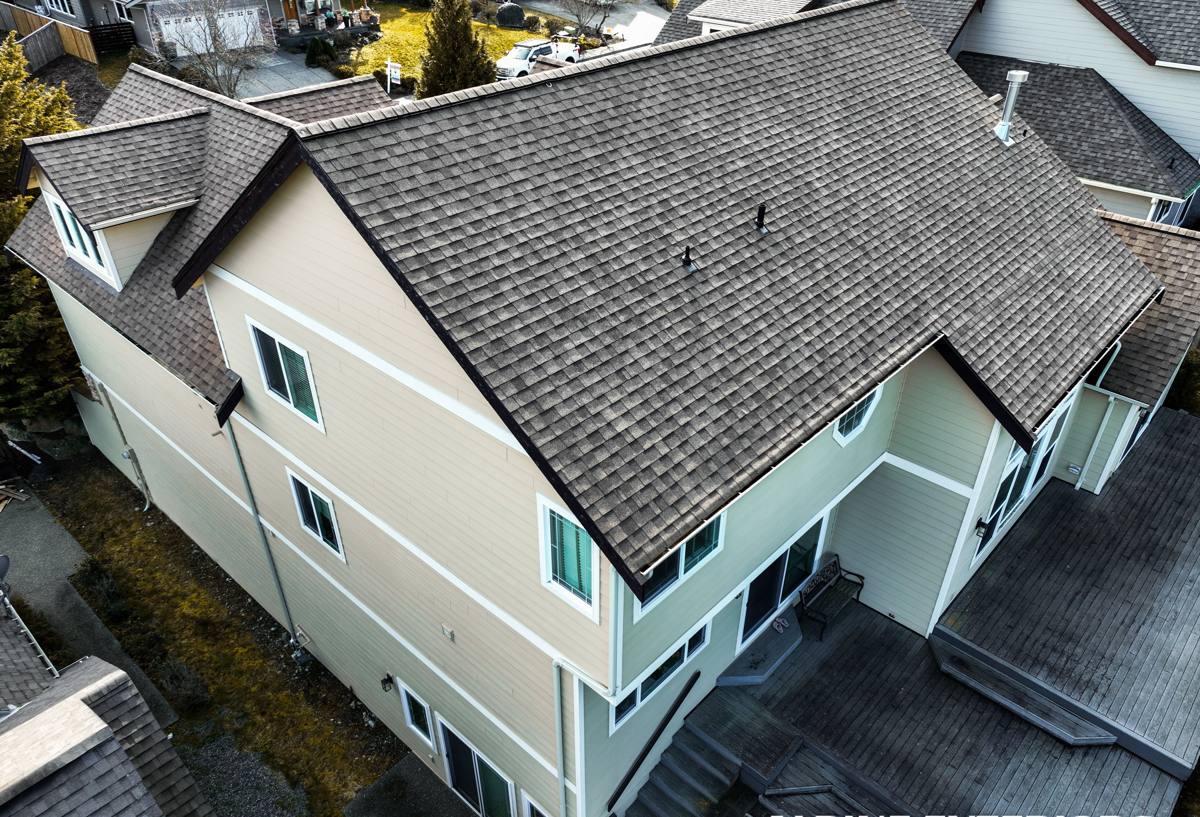
What Sunnyland's Climate Actually Does to a Deck
Salt Air and Metal Fasteners
Even a few miles inland, coastal air carries enough salt to accelerate corrosion on fasteners, brackets, and hardware that isn't rated for marine or coastal exposure. Standard zinc-coated screws and joist hangers can start showing rust streaks and pitting well before the decking itself shows any wear. Once a fastener corrodes, it loses holding strength long before it looks obviously bad, which is part of why we don't treat hardware selection as an afterthought on any Sunnyland job.
Driving Rain and Water Intrusion
Whatcom County storms don't just drop rain straight down — wind-driven rain gets pushed under boards, into fastener holes, and against ledger connections at the house. A deck that isn't detailed for driving rain will eventually let water reach the framing, the ledger flashing, or the house's wall assembly behind it, and that's where the expensive damage happens, not on the deck surface itself.
The Long Moss Season
Moss and algae need shade, moisture, and time, and Whatcom County gives them all three for a good stretch of the year. Composite decking resists rot the way wood can't, but it still needs the right surface texture, airflow underneath, and gap spacing to shed water and dry out between storms. Boards installed too tight, over poor drainage, or in deep shade without any ventilation will grow moss just as readily as an old wood deck does.
What a Correct Composite Decking Installation Requires Here
Substructure and Drainage
The framing underneath a composite deck matters as much as the boards on top. In this climate we build substructures with attention to slope, so water actually moves off the deck instead of pooling under it, and we keep enough clearance between the ground or a lower surface and the joists so air can circulate. Composite boards don't rot, but the joists, beams, and ledger board underneath usually aren't composite, and those still need to be protected from standing moisture.
Fastening and Board Selection
We use fasteners and structural hardware rated for coastal or marine-grade exposure on every Sunnyland project, not just the jobs closest to the water, because salt air doesn't respect a hard line on a map. Board selection matters too — some composite lines handle moisture cycling and surface texture retention better than others, and we'll walk you through the honest trade-offs (price, warranty terms, color retention, surface grip when wet) rather than pushing whatever's easiest to install.
Ledger and House Connection Detailing
Where the deck attaches to the house is the single most common source of hidden water damage on any deck, regardless of material. Correct flashing at the ledger board, proper fastener spacing, and a small air gap or drainage path behind the ledger keep wind-driven rain from tracking into the house's wall assembly. This detail doesn't show once the deck is finished, which is exactly why it's worth asking a contractor how they handle it.
Composite vs. Other Decking Materials for This Climate
There's no single "best" decking material for every home — it depends on budget, maintenance tolerance, and how much shade and moss exposure the specific site gets. Here's how the common options compare for a Sunnyland yard:
| Material | Moisture & Rot Resistance | Moss/Algae Behavior | Maintenance | Typical Lifespan |
|---|---|---|---|---|
| Composite decking | Very good — won't rot or absorb water like wood | Resists staining but still needs airflow and periodic cleaning | Occasional washing; no staining or sealing | 20-30+ years |
| Pressure-treated wood | Fair — treatment slows rot but doesn't stop it | Prone to moss and algae without regular treatment | Annual cleaning, periodic staining/sealing | 10-15 years typical in this climate |
| Cedar | Good naturally, but surface weathers | Moss-prone in shaded, damp spots without upkeep | Regular sealing to hold color and resist moisture | 15-20 years with upkeep |
| PVC/vinyl decking | Excellent — fully moisture resistant | Resists staining well | Low; occasional washing | 25-30+ years |
Composite lands in a strong middle position for most Sunnyland homeowners: meaningfully lower maintenance than wood, more natural look and feel than most PVC products, and good long-term performance against the specific stresses — rain, humidity, and moss pressure — that this area produces.
Our Installation Process
- On-site assessment. We look at sun exposure, shade patterns, existing drainage, and the condition of any structure the new deck will attach to or replace.
- Framing and substructure plan. We size and slope the substructure for this site's drainage needs, not a generic layout.
- Ledger and flashing work. If the deck attaches to the house, we detail the ledger connection to keep wind-driven rain out of the wall assembly.
- Coastal-rated hardware installation. Joist hangers, structural screws, and connectors go in rated for this climate's salt air exposure.
- Composite board installation. Boards are installed with correct gapping for expansion, drainage, and airflow underneath.
- Final walkthrough. We go over care basics with you before we consider the job done.
Moss, Mold, and Algae Prevention
No decking material is completely immune to moss in a climate with Whatcom County's rainfall and cloud cover, but composite decking gives you a real advantage: it doesn't provide the organic material for moss and mold to feed on the way untreated wood fibers do, so growth tends to stay on the surface rather than working into the material itself. That means routine cleaning — a stiff brush and a mild cleaner, or an occasional gentle pressure wash at the right distance and pressure setting — is usually enough to keep a composite deck looking right through a normal moss season. The bigger factor is design: decks with poor airflow underneath or heavy year-round shade will always need more attention than ones we've detailed for drainage and ventilation from the start.
What Maintenance Actually Looks Like
Composite decking is genuinely lower maintenance than wood, but "low maintenance" isn't "no maintenance," especially in this climate. A realistic yearly routine looks like:
- Sweep debris (leaves, needles, moss spores) off the deck regularly during fall and winter
- Wash the surface with a mild cleaner and soft-bristle brush once or twice a year, more often in heavily shaded areas
- Check that gaps between boards stay clear so water keeps draining properly
- Inspect visible fasteners and railing hardware once a year for corrosion or loosening
- Trim back overhanging vegetation that keeps sections of the deck shaded and damp
- Confirm gutters and downspouts near the deck aren't dumping extra water onto it
Cost Factors for a Sunnyland Composite Deck
Composite decking costs more upfront than pressure-treated wood and less than most PVC systems, but the real cost variation on a given project usually comes down to site-specific factors more than the boards themselves:
| Factor | Why It Affects Cost |
|---|---|
| Deck size and shape | More cuts, corners, and framing complexity add labor time |
| Height and railing requirements | Elevated decks need more substructure and code-required railing work |
| Existing structure condition | Removing and hauling off an old deck, or repairing damaged framing underneath, adds scope |
| Board tier and brand | Composite lines vary in price based on warranty length, color technology, and surface finish |
| Site access and drainage grading | Sites that need extra grading or drainage work to keep water moving cost more to prep correctly |
We'll give you an itemized, honest number after seeing the site — we're not going to quote a per-square-foot price over the phone that doesn't hold up once we see what's actually there.
Why a Crew That Already Works Sunnyland Matters
A contractor who works regularly in this specific part of Whatcom County already knows which fastener grades hold up against the local air, how much slope a substructure needs given this area's rainfall, and where moss tends to build up fastest based on sun exposure and tree cover in established neighborhoods like Sunnyland. That's not something you get from a crew that mostly works drier inland regions and treats every job the same way. It shows up in details you won't notice until years later — the ledger flashing that never leaked, the hardware that never rusted, the boards that never grew a moss carpet in the shaded corner.
If you're considering a new composite deck or replacing an aging one in Sunnyland, we're happy to come take a look and give you a straightforward, no-pressure estimate — just fill out the form below and we'll get in touch.