 Whatcom County
 Bellingham's Exterior Challenge: Salt Air, Rain, and Moss
Homes in Bellingham sit in one of the more demanding exterior environments in Washington State. Proximity to Bellingham Bay and the Salish Sea means salt-laden air moving inland on a regular basis, and that air doesn't just make things feel damp — it actively works on building materials. Salt accelerates corrosion of fasteners and metal trim, and it settles into porous or wood-based siding products where it holds moisture against the surface long after a storm has passed.
Layer on top of that the driving rain typical of a Pacific Northwest marine climate, where wind off the water pushes precipitation sideways into wall assemblies rather than letting it fall straight down, and you have a recipe for chronic moisture exposure. Whatcom County's long, mild, wet stretch from fall through spring means many homes go months without a real drying period. That's exactly the environment where moss, algae, and mildew take hold on north- and west-facing walls, roof valleys, and anywhere shade keeps a surface from ever fully drying out.
None of this is unusual for the region — it's simply what exterior materials in Bellingham have to be built to handle. The products and installation details that work fine in a drier climate often fall short here, which is a big part of why we've standardized on one siding system for every home we work on in Whatcom County.
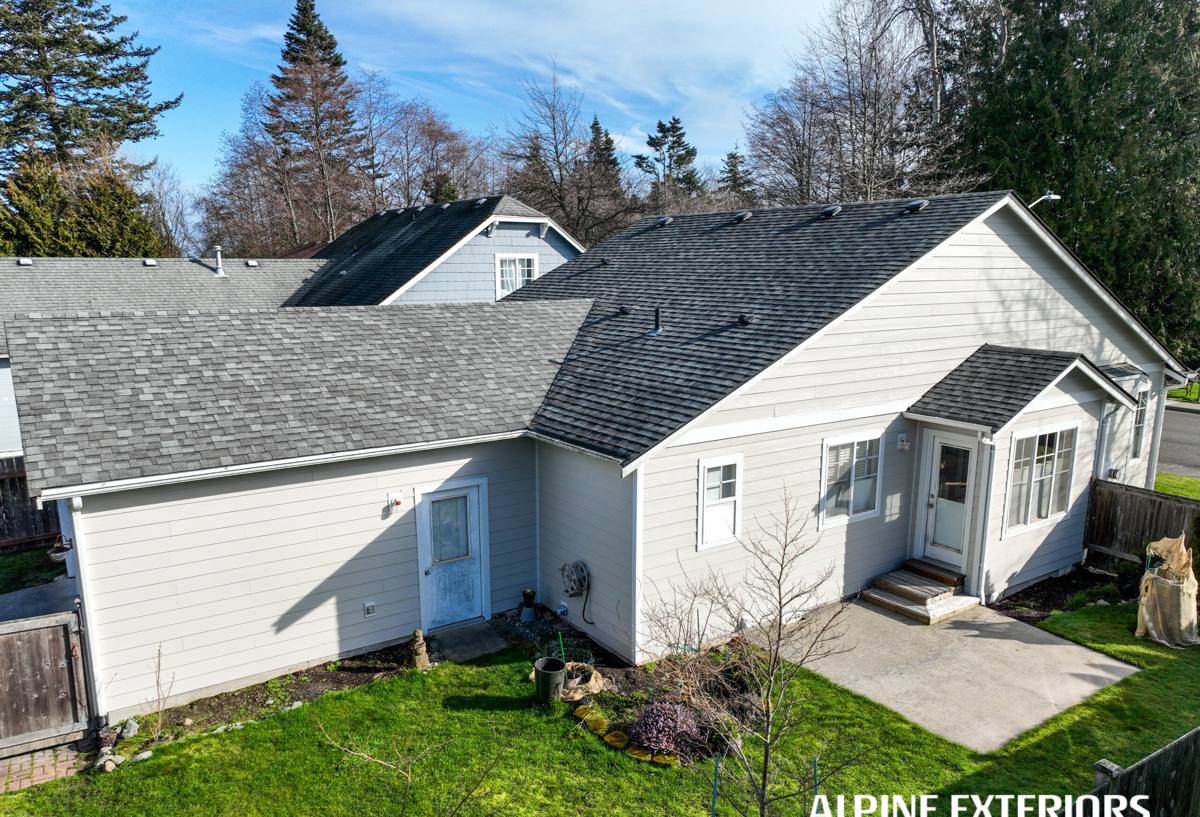
Why We Only Install James Hardie Fiber Cement Here
We install James Hardie fiber cement siding exclusively. We don't offer vinyl, LP SmartSide, primed spruce, cedar, or other fiber cement brands, and that's a deliberate professional standard, not a lack of options. In a climate like Bellingham's, the material choice matters as much as the installation.
Fiber cement is non-combustible and dimensionally stable in a way wood-based and engineered-wood products aren't — it doesn't swell, delaminate, or invite the same moisture-driven decay when exposed to repeated wetting and drying cycles. James Hardie's ColorPlus factory-applied finish is baked on under controlled conditions, which gives it more consistent coverage and a stronger bond than field-applied paint, and Hardie backs its products with a strong, transferable warranty when installed to their specifications. In a market where salt air and driving rain are simply part of the deal, that combination is what has kept us from offering alternatives we don't fully stand behind.
We're upfront that other products have real strengths — vinyl is inexpensive and low-maintenance in the right climate, engineered wood siding can look great when it's well-maintained and kept dry. But we've made a business decision to install one system, install it correctly every time, and be accountable for how it performs on Whatcom County homes specifically.
What "Climate-Engineered" Means in Practice
James Hardie makes region-specific product lines, including HZ5 formulations engineered for cold, wet climates like ours. The difference isn't cosmetic — it affects how the board handles moisture cycling and freeze-thaw stress over decades, not just how it looks the day it's installed.
Signs Your Siding Is Losing the Fight
Because Bellingham's climate is unforgiving, siding problems here tend to show up earlier and more visibly than they would in a drier region. Homeowners should watch for:
- Persistent moss or dark streaking on siding that doesn't get much direct sun
- Soft spots, bubbling, or visible swelling, especially near the bottom courses and around window and door trim
- Paint that's peeling or alligatoring faster than a normal repaint cycle would suggest
- Gaps opening up at seams, corners, or where siding meets trim, roofline, or foundation
- A musty smell near exterior walls, which can indicate moisture getting behind the siding rather than just sitting on top of it
- Fastener staining — rust streaks bleeding down from nail or screw heads
Any one of these on its own might be minor. Several showing up together, especially on the same wall, usually means the siding is no longer doing its job as a weather barrier and it's worth having someone take a real look before it turns into a bigger repair.
The Hardie Lines We Work With
James Hardie offers several board profiles and lines, and which one fits a given home depends on the style of the house, the look the homeowner wants, and practical factors like sun and moisture exposure on each elevation.
| Product | Typical Use | Notes for Whatcom County |
|---|---|---|
| HardiePlank lap siding | Most common horizontal siding, wide range of styles | Available in HZ5 formulation suited to our wet, cool climate |
| HardiePanel vertical siding | Modern look, board-and-batten style | Works well on accent walls and contemporary designs |
| HardieShingle | Textured, shingle-style siding | Popular on Craftsman and cottage-style homes in the area |
| HardieTrim | Window, door, and corner trim | Pairs with the siding for a consistent, sealed exterior system |
Every one of these comes with the option of factory ColorPlus finish, which matters in a climate where field-applied paint has to survive extended wet seasons before it ever gets a chance to fully cure.
Roofing, Windows, and Decks: The Whole Envelope Matters
Siding doesn't work in isolation. A home's exterior is a system, and in a climate that pushes water sideways and keeps everything damp for months at a time, weak points in any part of that system show up as problems somewhere else. We handle roofing, windows, and decks alongside siding for that reason — flashing details at rooflines and window openings are often where water actually gets behind a wall, not through the siding field itself.
A roof that's shedding granules or has failing flashing can send water down behind siding that's otherwise in good shape. Windows with degraded seals or poor flashing integration do the same. And decks attached to the house create ledger connections and transitions that need to be detailed correctly, or they become a moisture entry point right at the wall. When one crew understands how all four of these systems interact, the details get handled correctly the first time instead of becoming someone else's problem down the line.
Decks in a Wet Climate
Whatcom County's wet season is hard on decks specifically — ledger boards, structural connections, and any wood-to-wall transition need careful flashing and enough of a drainage plane to keep water moving away from the house rather than pooling against it.
What Correct Installation Looks Like Here
Fiber cement siding performs the way it's designed to only when it's installed to manufacturer specification, and that matters even more in a marine climate where every gap or shortcut gets tested by weather almost immediately. Correct installation in Bellingham means proper clearance from grade and roof lines, correctly lapped and fastened boards, sealed and flashed penetrations, and attention to how water is meant to drain at every horizontal surface — window sills, trim boards, and butt joints included.
It also means respecting manufacturer fastening and clearance requirements rather than treating them as optional. A lot of premature siding failure isn't a material problem at all — it's a workmanship problem that a good material can't fully compensate for. That's a big part of why we're selective about the crews we put on a job and why we don't cut corners on flashing details just because they're less visible than the finished wall.
What a Bellingham Siding Project Typically Involves
| Factor | What It Affects |
|---|---|
| Home size and wall complexity | More corners, gables, and trim details mean more labor and material |
| Extent of existing damage | Rot or moisture damage found during tear-off adds repair scope |
| Siding profile and finish | Lap width, texture, and ColorPlus color selection affect material cost |
| Trim and accent work | Window trim, corner boards, and accent panels add detail and cost |
| Access and site conditions | Sloped lots, tight lot lines, and landscaping can affect labor time |
We give homeowners an honest, itemized estimate after actually looking at the home — broad national averages don't account for Whatcom County wage rates, permitting, or what a particular house needs, so we'd rather walk the property than quote a number that doesn't hold up.
Why a Local Crew Matters
A crew that works in Whatcom County regularly understands things a traveling or out-of-area contractor doesn't have reason to know: which elevations take the worst weather in a given neighborhood, how local permitting and inspection processes work, and what kind of moisture and moss issues actually show up on homes here versus in a drier part of the state. That local knowledge shapes real decisions — where extra flashing attention is warranted, which product line fits a given exposure, and how to sequence a project around our wet season instead of fighting it.
It also means accountability. A local company has a reputation in the community that depends on the work holding up over years, not just passing a final walkthrough.
Getting Ready for Your Estimate
- Note any areas of visible moss, staining, or moisture damage you've noticed on the exterior
- Think about which elevations get the most wind and rain exposure on your property
- Have a rough sense of your timeline, since scheduling around Whatcom County's wet season matters
- List any related concerns — roof age, window condition, deck attachment points — so we can look at the whole exterior, not just the siding
- Bring questions about product lines, colors, and warranty coverage; we'd rather over-explain than have you guessing
If your Bellingham home is showing signs of wear from the salt air, rain, and moss that come with living in Whatcom County, we're happy to take a look and talk through what we're seeing — no pressure, no obligation. Request a free estimate below and we'll walk the property with you.