 Whatcom County
 Cedar Has Real Appeal — We Won't Pretend Otherwise
Cedar siding earns its reputation honestly. It has a warm, natural grain that no manufactured product fully replicates, it smells good fresh off the truck, and it's been used on homes in the Pacific Northwest for well over a century. Western red cedar in particular has natural oils that resist decay better than most softwoods, and a well-built cedar home can look genuinely beautiful for its first several years. If you're weighing cedar for a home in Bellingham, Ferndale, Lynden, or anywhere else in Whatcom County, you're not choosing a bad product on paper. You're choosing a product with a maintenance schedule most homeowners underestimate until they're the ones paying for it.
This page isn't an attack on cedar. It's the conversation we have with every homeowner who asks us to install it, and the reason we've standardized on James Hardie fiber cement instead. We think you deserve the same honest version before you sign a contract.
What Cedar Siding Actually Requires, Year After Year
Cedar is wood. Wood moves, absorbs moisture, and breaks down under UV exposure. None of that is a defect — it's how the material behaves — but it means cedar siding isn't a "install it and forget it" exterior. It's a surface you commit to maintaining on a schedule, indefinitely.
The realistic maintenance cycle
- Every 1-2 years: Inspect for cracked, curling, or checking boards, especially on south and west-facing walls that take the most sun and weather.
- Every 2-4 years: Re-stain or reseal the entire exterior. Clear or semi-transparent finishes fail faster than solid-body stains, especially in wet climates.
- Every 5-8 years (sometimes sooner): Full repaint or heavy-duty refinish once the wood has grayed, checked, or started absorbing water at the seams.
- Ongoing: Recaulking joints, trim, and butt seams as the wood expands and contracts through wet winters and dry summers.
- As needed: Spot replacement of individual boards that have rotted, split, or been damaged by moisture or pests.
None of this is optional maintenance you can skip without consequence. Skip it, and cedar's biggest advantage — its natural resistance to decay — starts working against you, because untreated or under-treated wood in a wet climate rots from the inside out, often before it looks bad from the street.
Why Whatcom County's Climate Is Especially Hard on Cedar
Every siding material gets tested by weather, but Whatcom County stacks several tough conditions on top of each other. Salt air off the Salish Sea and Puget Sound corridor accelerates the breakdown of wood fibers and finishes. Long stretches of driving rain — the kind that comes in sideways off the water during fall and winter — pushes moisture into seams, end grain, and nail holes that a sunnier climate would never stress in the same way. And the region's long moss season, running from late fall well into spring, means organic growth has months of cool, damp conditions to take hold on any horizontal surface or shaded wall.
What that combination does to cedar specifically
Moss and algae don't just sit on the surface — their root structures hold moisture against the wood, which is exactly the condition that leads to rot underneath a finish that still looks intact from a few feet away. Salt-laden air degrades stain and sealant film faster than inland climates, shortening the "every 2-4 years" refinish window closer to every 2 years on exposed elevations. And the sheer number of wet days each year means cedar rarely gets a long dry stretch to fully release the moisture it's absorbed, which is the mechanism behind most of the cupping, splitting, and soft-spot problems we get called out to look at.
The Moisture Problem Underneath the Finish
The visible signs of cedar aging — graying, checking, a chalky finish — are cosmetic. The problem that actually costs homeowners money is what's happening behind the boards. Cedar siding relies on its finish and its installation detailing (flashing, house wrap, proper gapping) to keep bulk water out of the wall assembly. When a finish fails quietly — and it does fail quietly, well before it looks obviously bad — water starts getting behind boards and into fastener holes. In a climate with this many wet months per year, that moisture doesn't get a long enough dry period to fully evaporate before the next rain arrives.
The result is rot that often isn't visible until a board is soft enough to push a screwdriver through, or until it shows up as a stain or bulge on interior drywall. By that point you're not looking at a refinish — you're looking at torn-off sections, sheathing repair, and full board replacement, which is a far more expensive project than the maintenance you were trying to avoid.
Cedar vs. James Hardie: The Maintenance and Cost Comparison
We install exclusively James Hardie fiber cement siding, and the honest reason comes down to what each material asks of a homeowner over 20-30 years of ownership in this climate.
| Factor | Cedar Siding | James Hardie Fiber Cement |
|---|---|---|
| Refinish cycle | Every 2-4 years (stain), 5-8 years (paint) | ColorPlus factory finish rated 15+ years before repaint is typically needed |
| Moisture behavior | Absorbs and releases water; prone to cupping, checking, rot | Engineered to resist moisture-driven swelling and rot |
| Insect vulnerability | Susceptible to carpenter ants, wood-boring beetles, and rot fungi | Non-organic material; not a food source for insects |
| Fire behavior | Combustible | Non-combustible fiber cement |
| Moss/algae resistance | Low — organic surface holds growth | Higher — factory finish resists organic growth better than raw or stained wood |
| Warranty | Typically finish/product warranty only; labor and maintenance are the owner's responsibility | Strong transferable manufacturer warranty on the product itself |
What that means over the life of ownership
Add up cedar's refinishing labor, the periodic board replacements, and the caulking touch-ups over two or three decades, and the total cost of ownership regularly exceeds what homeowners expect when they see the lower up-front price tag. Hardie costs more to install than cedar in most cases, but it's engineered specifically for climates like this one — Hardie's HZ5 product line, for instance, is formulated for regions with more moisture and freeze-thaw cycling — and it shifts the maintenance burden from "constant" to "occasional."
Insects, Rot, and the Hidden Repair Costs
Wood siding, even naturally rot-resistant species like cedar, is still a food source and habitat for carpenter ants, certain beetles, and moisture-loving fungi once its protective finish starts to break down. In a region with this much annual rainfall, that finish breakdown happens faster than in drier climates, which shortens the window before pest and rot risk becomes real. Homeowners often don't discover an active problem until a contractor pulls a board during a routine inspection or repair and finds soft, discolored wood or active insect galleries underneath. Fiber cement doesn't remove pest risk from a home entirely — trim, framing, and other wood components still need attention — but it removes the siding itself as a food source and moisture reservoir.
A Practical Checklist: What You're Actually Signing Up For With Cedar
If you're still considering cedar after reading this, go in with clear eyes. Here's what ongoing ownership actually involves:
- Budgeting for a full refinish (stain or paint) every 2-4 years, sooner on sun- and rain-exposed elevations
- Annual inspection for cracking, cupping, and finish failure, especially after the wet season
- Regular cleaning to remove moss, algae, and mildew before it takes hold on north-facing or shaded walls
- Recaulking seams, trim joints, and butt joints as the wood moves seasonally
- Budgeting for spot board replacement when rot or insect damage is found
- Verifying that flashing, house wrap, and gapping details were installed correctly, since cedar's performance depends heavily on installation quality
- Understanding that most cedar product warranties don't cover labor, finish failure, or maintenance-related damage
Why We Standardized on James Hardie Instead
We made a decision as a company to install one product family — James Hardie fiber cement — rather than offer cedar, vinyl, or engineered wood alongside it. That's not because cedar can't look good on a home. It's because we've seen what this specific climate does to wood siding over the years we've been working on homes throughout Whatcom County, and we'd rather build something that holds up with minimal upkeep than sell a product we know will need constant attention to avoid costly repairs.
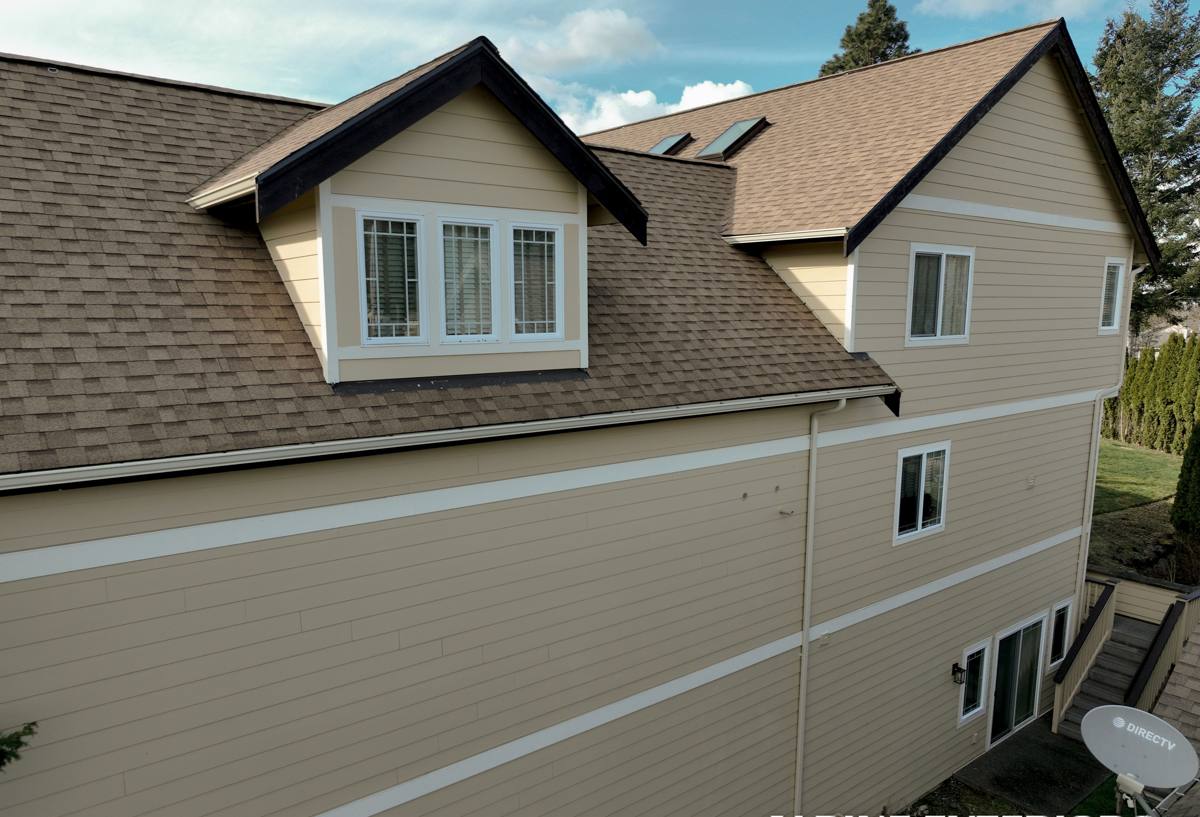
Hardie's fiber cement is non-combustible, engineered specifically for wet, moisture-heavy climates in its HZ product lines, and finished at the factory with ColorPlus technology so the color coat is baked on rather than field-applied — which is a meaningfully different, more durable process than staining or painting wood on site. It carries a strong transferable warranty, which matters if you sell the home before you'd otherwise plan to reside it. And it holds a consistent, dimensionally stable appearance year after year without the recoating cycle cedar demands.
When Cedar Might Still Make Sense
We're not going to tell you cedar is never the right call. If you specifically want the natural wood look, understand and accept the maintenance commitment, and plan to stay actively involved in upkeep — or hire someone to do it on schedule — cedar can serve you well, especially on accent areas or gables rather than full exteriors. What we won't do is install it and let you find out about the maintenance schedule later. If full-wood siding is genuinely what you want, we'd rather be honest that it's outside what we install than sell you something we can't stand behind.
Get an Honest Opinion on Your Home
Every home and every wall exposure in Whatcom County takes weather a little differently — a covered porch wall performs nothing like an exposed western gable catching the full brunt of a winter storm. If you're deciding between cedar, another siding material, or James Hardie for a new install or a re-side project, we're happy to walk your home, look at your specific exposures, and give you a straight answer about what will actually hold up. Reach out for a free, no-pressure estimate — there's no sales pitch, just an honest look at your home and your options.