 Whatcom County
 Siding for Silver Beach Homes
Silver Beach sits in one of the greener, wetter corners of Whatcom County, and the homes here show it. Roofs grow moss faster than roofs a few miles inland. Siding stays damp longer after a storm because the tree cover and lake-adjacent air slow down drying time. Homeowners who've lived here a while already know their houses face a different set of pressures than a house out in the flats near Lynden or up in the drier foothills. Siding that isn't built for this kind of sustained moisture exposure tends to show it early — in swelling, in soft spots at the bottom courses, in paint that won't hold.
We work throughout Whatcom County, and Silver Beach is one of the neighborhoods where we spend real time on the details other crews skip: flashing at every horizontal joint, correct starter strip height off the foundation, and caulking only where caulk is actually supposed to go instead of using it to cover up a bad cut. Those details matter more here than they do in a dry climate, because Whatcom County gives moisture months at a time to find every gap you left it.
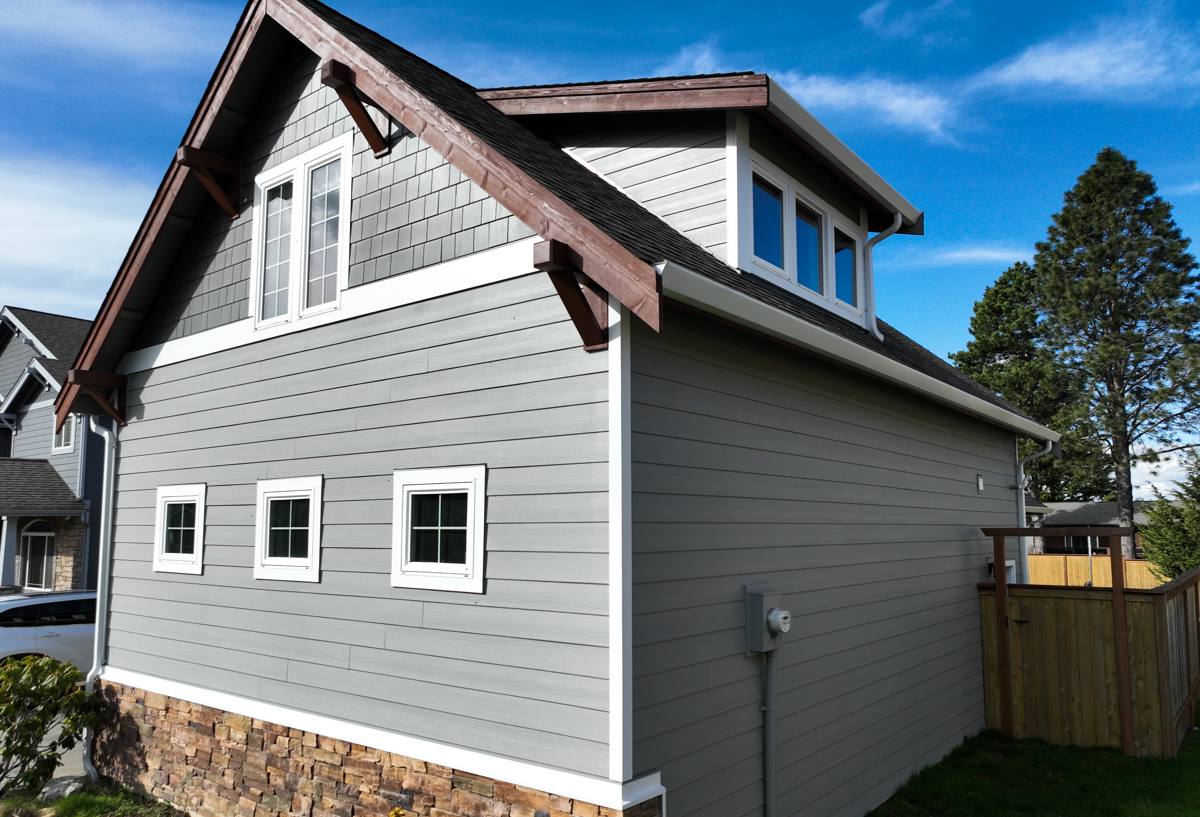
What This Climate Does to a House
The Pacific Northwest marine climate that defines Whatcom County brings long stretches of low-intensity rain rather than short violent downpours. That sounds gentler, but it's actually harder on building materials — wood-based products soak for days instead of hours, and they rarely get a real chance to dry out before the next system rolls through. Add in driving wind off the water during fall and winter storms, and siding faces near-constant wind-driven rain pushing at seams and laps that a calmer climate would barely test.
Moss and algae growth is the most visible sign of all that moisture. It's not just a cosmetic problem — moss holds water against a surface, and on materials that aren't dimensionally stable, that trapped moisture is what starts rot, delamination, or swelling at the edges. A house near Silver Beach that gets shaded by mature trees, which is common in this area, will see moss and algae pressure that a wide-open lot across town simply won't.
The Three Climate Stressors We Design Around
- Sustained moisture exposure — long rain events with limited drying time between storms
- Wind-driven rain — water pushed sideways into laps, corners, and trim joints instead of just running down
- Moss and organic growth — shaded, humid conditions that keep surfaces damp and feed growth on porous materials
Why We Only Install James Hardie Fiber Cement
We made a deliberate decision years ago to install one siding product line: James Hardie fiber cement. We don't install vinyl, LP SmartSide, Cemplank, Allura, primed spruce, or cedar. That's not a marketing position — it's a standard we hold because of what we've seen these products do, or fail to do, in exactly this kind of climate.
Vinyl siding is affordable and low-maintenance in the sense that it doesn't need painting, but it's a petroleum-based product that expands and contracts with temperature swings, can crack in cold snaps, and has seams that rely on overlap rather than a sealed surface — not ideal in a region that gets sustained wind-driven rain. Engineered wood products like LP SmartSide use wood strand technology with a resin binder, which is a real improvement over old-school wood siding, but it's still wood at its core, meaning any breach in the factory coating gives moisture a path into a material that can swell and deteriorate. Cedar is a beautiful, honest material, but it demands ongoing maintenance — refinishing, caulking, and vigilance — that most homeowners underestimate until the siding is a decade old and showing it.
Fiber cement products like Cemplank and Allura are chemically similar to James Hardie's product, but we've standardized on Hardie specifically for its ColorPlus factory finish, its consistency across product lines, and the depth of its installation documentation and warranty backing. We'd rather install one product exceptionally well than juggle several and install all of them adequately.
What James Hardie Gets Right for This Climate
- Fiber cement is non-combustible and doesn't provide fuel or a food source for mold and rot the way wood-based sidings can
- It's engineered specifically for different climate zones — the HZ5 product line is formulated for regions with more moisture and temperature swings
- ColorPlus factory-applied finish is baked on in a controlled environment, giving more consistent adhesion and color retention than field-applied paint
- It holds its shape in wet-dry cycles far better than wood-based or vinyl products, which reduces the gaps and cracks that let water in over time
Comparing Siding Materials for Whatcom County Conditions
| Material | Moisture Behavior | Maintenance | Our Position |
|---|---|---|---|
| Vinyl | Doesn't absorb water, but seams and laps can let wind-driven rain behind panels; brittle in cold | Low, but limited repair options if cracked | Not installed |
| LP SmartSide / engineered wood | Good factory treatment, but vulnerable at any coating breach; wood core can swell | Moderate — caulk and touch-up over time | Not installed |
| Cedar | Absorbs and releases moisture naturally; performance depends heavily on finish upkeep | High — refinishing every few years | Not installed |
| Cemplank / Allura (fiber cement) | Similar composition to James Hardie | Low | Not our product line |
| James Hardie fiber cement | Dimensionally stable, engineered for regional moisture exposure | Low | What we install |
Roofing, Windows, and Decks in the Same Climate
Siding doesn't work in isolation, and a Silver Beach home is a full exterior system exposed to the same rain and moss pressure on every surface. Roofing in this area needs attention to moss prevention and proper ventilation, because a roof that's constantly damp underneath its shingles ages faster and can push moisture problems down into the siding and soffits below. We handle roof installation and repair with that in mind, not as a separate afterthought from the siding work.
Windows are one of the most common failure points on older homes in wetter parts of Whatcom County. A window that isn't flashed correctly, or has failed seals, becomes a direct path for water into the wall cavity — often invisible until the siding or interior trim around it starts showing damage. When we replace siding, we look hard at window flashing details, because new siding installed around a bad window flashing just hides the problem for a few more years instead of fixing it.
Decks in this climate face their own version of the same issue: standing water on top and no ventilation underneath. We build and repair decks with drainage and material choice as priorities, not just appearance, since a deck that traps moisture underneath will rot from below long before the visible surface looks bad.
What a Local Crew Actually Changes
A lot of siding problems in this region don't come from bad materials — they come from installation details that don't account for local conditions. Flashing height, house wrap integration, kickout flashing at roof-wall intersections, and starter strip clearance off grade all matter more in a climate that gives water months to find a weak point. A crew that installs siding across many different climates might not think twice about a detail that's optional in a dry region but essential here.
Working throughout Whatcom County day in and day out means we see the same failure patterns repeat on older homes — and we build our installation process specifically to avoid them. That's less about brand loyalty and more about pattern recognition: we know what breaks first in this climate, and we install to prevent it rather than react to it later.
A Practical Pre-Estimate Checklist for Homeowners
- Check for moss or algae buildup on siding, especially on shaded north- and west-facing walls
- Look for soft spots, bubbling paint, or visible swelling near the bottom courses of siding
- Inspect caulk lines at trim and window edges for cracking or gaps
- Note any dark staining below window sills, which can indicate a flashing or seal issue
- Check gutters and downspouts for proper drainage away from the foundation and siding
- Ask any contractor for their specific approach to flashing and moisture management, not just the product name they're installing
Getting Started
Every home near Silver Beach carries its own mix of sun exposure, tree cover, and age, and that changes what it actually needs. If you're noticing moss buildup, soft siding, or just want a second opinion on aging exterior materials, we're happy to take a look. We offer free, no-pressure estimates and can walk through siding, roofing, windows, or decks — whatever the house actually needs, explained in plain terms.