 Whatcom County
 Two Fiber Cement Products, One Category, Different Company Behind Them
If you've been pricing out siding in Whatcom County, you've probably heard "fiber cement" thrown around as a single category, as if every board on the market performs the same way once it's nailed to a wall. It doesn't. Fiber cement is a manufacturing process, not a brand, and the company standing behind that process matters as much as the material itself. Allura and James Hardie both make fiber cement lap siding, panels, and trim. Both resist fire, rot, and pests better than wood or vinyl. On paper, a spec sheet comparison can look close enough to call a coin flip.
We don't install Allura. This page explains why, without pretending Allura is a bad product — it isn't — and without inventing problems that aren't real. Our reasoning comes down to manufacturing history, warranty structure, regional engineering, and what we've seen hold up over decades of Pacific Northwest weather, not marketing claims from either company.
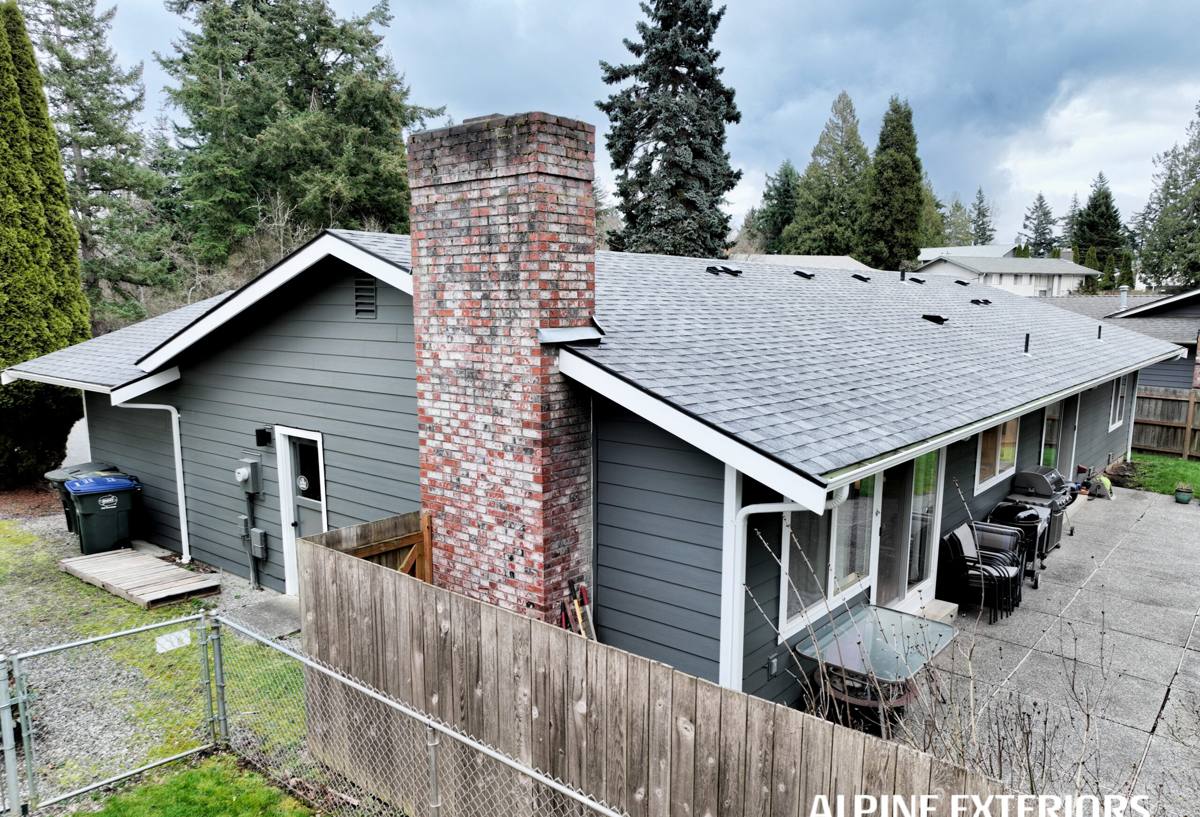
What Allura Gets Right
Allura fiber cement is a legitimate, code-compliant product. It's non-combustible, it takes paint and factory finishes reasonably well, and it's engineered to the same general fiber cement formula as most of the category: portland cement, sand, cellulose fiber, and water, autoclaved for stability. For a homeowner comparing it against vinyl or untreated wood, Allura is a real step up in durability and fire resistance.
Allura also tends to price a bit below Hardie in material cost, which is the main reason it shows up in bids at all. If your only criteria were "is this better than what I have now," Allura would clear that bar for most Whatcom County homes.
Where Our Standard Diverges: Company History and Continuity
Allura's ownership and branding have changed more than once over the years — it operated under different corporate names before settling into its current identity. That kind of corporate reshuffling isn't automatically disqualifying, but it matters a lot for a 30-to-50-year exterior product. When you buy siding, you're not just buying boards — you're buying a company's commitment to honor a warranty claim two, three, or four decades from now, and to still be making a compatible product if you ever need a matched repair panel.
James Hardie has manufactured fiber cement siding under one continuous brand and R&D pipeline since the 1980s and is the company that essentially created the modern fiber cement category in North America. That continuity is why claims get honored, matched product stays available, and installer networks stay trained on current best practices decade after decade. We'd rather stand behind a product from a manufacturer whose corporate story doesn't require an asterisk.
Why This Isn't Just Brand Loyalty
We're not James Hardie employees and we don't get anything from saying this — we're a local contractor who has to answer the phone if something goes wrong on a house we sided. When a manufacturer has changed hands or names, tracing an old warranty, matching a discontinued color, or getting a straight answer on a batch issue gets harder. We'd rather not put our name on an install where that risk sits in the background for the next 40 years.
Climate Engineering: One Size Does Not Fit the Pacific Northwest
Whatcom County sits right up against the water, with Bellingham Bay, the Strait of Georgia, and the Salish Sea all feeding a climate that's genuinely tough on exterior building materials. We get salt air rolling in off the water, driving rain that hits siding sideways during winter storms, and a moss season that can run six months or longer on north-facing walls and anything shaded by evergreens. That combination — moisture, salt, and organic growth — is a harder test for cladding than most of the country ever sees.
James Hardie engineers specific product formulations for specific climate zones, and the HZ5 line used in this region is built for exactly this kind of exposure — freeze-thaw cycling, sustained moisture, and coastal air. Allura does not offer that same tier of documented, region-specific engineering in its published product line. That's not a knock on Allura's basic formula; it's a gap in how deliberately the product is matched to a specific climate's failure modes, and it's the single biggest reason regional installers care.
What "Climate-Engineered" Actually Means on a Job Site
In practice, climate engineering shows up in things like moisture resistance additives, freeze-thaw durability testing, and finish systems designed to hold up under the specific humidity and temperature swings of the zone the product ships to. A siding board that was engineered primarily for a drier, more temperate market and then sold nationally isn't necessarily going to fail here — but it also wasn't the first thing the engineers were solving for. On a coastal Whatcom County wall that sees driving rain most winters, that difference compounds over years.
Factory Finish: ColorPlus vs. the Alternatives
How the paint gets onto the board matters almost as much as the board itself. Field-applied paint over fiber cement is only as good as the weather conditions, prep, and coat thickness on the day it was sprayed — and it's the first thing to fail, usually well before the substrate does. James Hardie's ColorPlus finish is baked on in a factory under controlled conditions, with a documented multi-coat process and a finish warranty that's separate from and in addition to the substrate warranty.
Allura offers factory-primed and some pre-finished options, but the finish warranty structure and the track record of that finish holding color and adhesion over 15-plus years of coastal sun and rain isn't backed by the same depth of field history as ColorPlus. For a homeowner, the practical difference shows up as touch-up frequency and how long the house looks good before it needs to be repainted.
Side-by-Side: What We Actually Weigh
| Factor | Allura | James Hardie |
|---|---|---|
| Core material | Fiber cement (portland cement, sand, cellulose) | Fiber cement (portland cement, sand, cellulose) |
| Fire resistance | Non-combustible | Non-combustible |
| Corporate continuity | Multiple past name/ownership changes | Single continuous brand since the 1980s |
| Climate-specific engineering | General national formulation | HZ zone system engineered per climate (HZ5 for this region) |
| Factory finish system | Primed and some pre-finished options | ColorPlus baked-on finish with separate finish warranty |
| Typical material cost | Somewhat lower | Somewhat higher |
| Local installer familiarity | Less common regionally | Widely specified and installed in Western Washington |
Moss, Salt Air, and What Coastal Exposure Does to Siding Over Time
It's worth walking through what actually happens to siding on a Whatcom County house over 20 years, because that's the timeline that separates a good product from a merely adequate one. Salt-laden air off the water accelerates corrosion on fasteners and trim hardware if they're not rated for it. Driving rain during winter atmospheric river events pushes water sideways into laps and seams, testing the caulking, flashing, and the siding's own water-shedding design far more than a light vertical rain would. And moss — which thrives in this region's mild, wet winters — takes hold fastest on surfaces that stay damp and on finishes that don't shed water cleanly.
None of these forces are hypothetical for a coastal Whatcom County property; they're the normal weather cycle here. A siding system needs a finish that resists moss growth, a substrate that doesn't wick moisture at cut edges, and a fastening system that won't corrode prematurely near the water. This is the exact use case Hardie's regional HZ engineering was built around, which is why it's our standard rather than a generic national product.
What Homeowners Should Ask Any Contractor Bidding Fiber Cement
Regardless of which brand a contractor is proposing, there are questions that separate a careful bid from a corner-cutting one. Use this checklist when you're comparing quotes:
- Is the finish factory-applied or field-painted, and what's the separate warranty on the finish versus the board itself?
- What fastener type and coating is specified, and is it rated for coastal/salt-air exposure?
- How is the manufacturer's warranty transferred if you sell the home, and is it prorated?
- Is the product's climate zone rating (if any) actually matched to Whatcom County's exposure, or is it a generic national spec?
- Does the installer carry manufacturer certification or training specific to this product line?
- What's the manufacturer's history — has the company changed names, ownership, or manufacturing location in the last 20 years?
- Is the flashing and water management detail (not just the siding itself) part of the written scope of work?
Why This Determines What We Put on Your House
We made a decision years ago to install one fiber cement system rather than quote whatever's cheapest that week. That means we turn down some jobs where a homeowner specifically wants a lower-cost product, and we're upfront about that instead of installing something we wouldn't put on our own home. James Hardie's combination of continuous corporate history, region-specific HZ engineering, factory-baked ColorPlus finish, and a transferable warranty is what convinced us it's the right standard for a coastal Whatcom County climate — not a marketing relationship, and not the cheapest option on a bid sheet.
That's also why we're honest when a product like Allura isn't a bad choice in the abstract — it's a reasonable fiber cement option in markets with milder exposure. It's just not what we've chosen to stand behind on homes that face salt air, driving winter rain, and a long moss season year after year.
Get a Straight Answer for Your Home
Every house on a bluff, a bay-facing lot, or a shaded north wall in Whatcom County has a slightly different exposure profile, and that's worth walking through in person rather than guessing from a brochure. If you'd like an honest look at what your home actually needs — and why we'd recommend Hardie's specific product line for your situation — request a free, no-pressure estimate using the form below.