 Whatcom County
 What LP SmartSide Actually Is
LP SmartSide is an engineered wood siding product — strand board or OSB substrate treated with zinc borate for insect and fungal resistance, then coated with a resin-saturated overlay and factory primer. It's manufactured to look like traditional wood lap siding or panel siding, and it's a legitimate, widely used product across the country. LP has improved the formula significantly since the OSB siding failures of the 1990s, and current SmartSide products carry a real engineering pedigree and a five-year 5/50 warranty structure.
We get asked about it often, because it's priced attractively and marketed heavily to remodelers. This page explains, in plain terms, why our crews don't install it on homes in Whatcom County — not because it's a bad product everywhere, but because of how it performs specifically in our climate, and where our professional standards land after years of working on homes here.
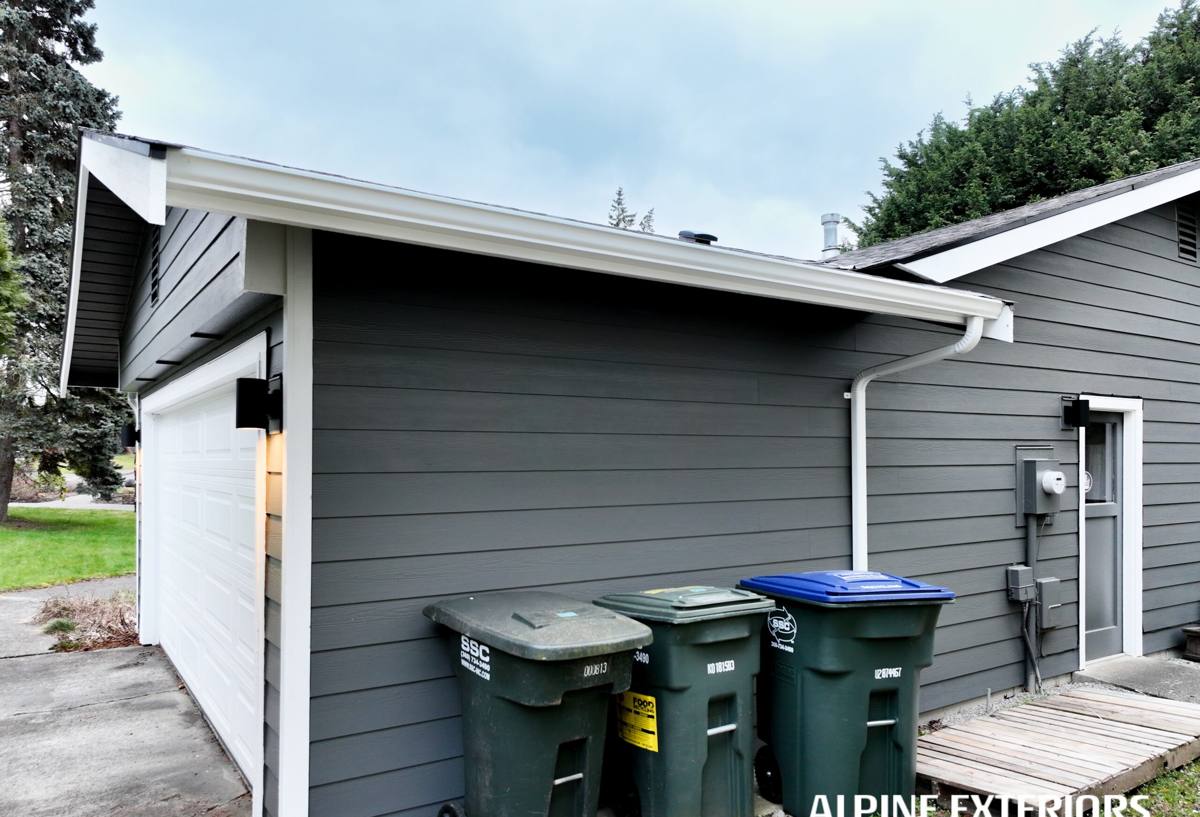
Our Climate Is the Real Issue
Whatcom County sits right on the edge of the Salish Sea, which means homes here deal with a combination most siding products were never really tested against: salt-laden air off Bellingham Bay and the Strait of Georgia, long stretches of driving rain that comes in sideways off the water, and a moss season that can run eight months out of the year on north- and west-facing walls. Wood-based siding products are engineered around moisture management — keeping water out and letting any that gets in dry out quickly. Our climate makes both halves of that job harder than in drier regions of the state.
Engineered wood siding is still, at its core, a wood product. The zinc borate treatment resists rot and insects, and the resin overlay sheds water reasonably well when the surface coating is fully intact. The vulnerability shows up at the edges — cut ends, seams, fastener penetrations, and any spot where the factory coating gets compromised during installation or over time. Once moisture gets past that surface layer and into the wood fiber substrate, it doesn't dry out quickly in a marine climate with our humidity and rainfall totals. That's the trade-off we've made a standard around.
Salt Air and Coastal Exposure
Homes closer to Bellingham Bay, Birch Bay, and the county's shoreline neighborhoods take a steady low-level dose of salt-laden moisture in the air. Salt is hygroscopic — it pulls moisture out of the air and holds it against whatever surface it settles on. On a fiber cement product, that's a non-issue because the material itself doesn't absorb and swell. On an engineered wood product, that salt film sitting against cut edges or coating breaks becomes one more mechanism working against the wood substrate over time.
Driving Rain and Wind-Driven Moisture
Storms coming off the water don't fall straight down — wind pushes rain sideways into wall assemblies, seams, and butt joints. Any lap siding product depends on correct overlap, flashing, and caulking at joints to manage that. Wood-based products are less forgiving of small installation gaps than fiber cement, because water that finds its way behind the surface coating has a substrate that's actually food for moisture damage, rather than an inert cement board.
Moss and Prolonged Dampness
Whatcom County's moss season is long, and shaded north-facing walls under mature trees can stay damp for days after a storm passes. Moss and algae growth on a wood-composite surface isn't just cosmetic — the organic growth holds moisture against the coating and can accelerate coating breakdown at a microscopic level over years. Fiber cement handles the same moss growth without the underlying material being affected the same way.
Where SmartSide Genuinely Gets It Right
To be fair, LP has made real engineering improvements. The zinc borate treatment is effective at what it's designed to do. The panels are lighter than fiber cement, which makes them easier and faster to install and less demanding on a structure's framing. It takes fasteners easily without pre-drilling, and it's genuinely less brittle to handle on a job site — fewer cracked corners during transport and install compared to cement board. For remodelers working in drier climates, or on garages, sheds, and outbuildings where a 20-30 year service life is the expectation rather than a lifetime install, it's a reasonable, cost-effective choice.
We're not going to tell a homeowner it's a scam or that every SmartSide installation fails. It doesn't. Plenty of SmartSide siding jobs, installed correctly and maintained on schedule, perform fine for their expected service life. Our decision not to install it is about what we're willing to warranty and stand behind on a home we're putting our name on in this specific climate — not a blanket condemnation of the product.
The Maintenance Reality Homeowners Don't Always Hear About
The trade-off with any wood-based siding, engineered or not, is ongoing maintenance. SmartSide needs repainting on a schedule — typically every 7-10 years depending on exposure — and caulking at seams and trim needs to be inspected and refreshed regularly. Skip that maintenance in a wet climate like ours, and the window for moisture problems narrows considerably. Fiber cement's factory-baked ColorPlus finish is warrantied for decades without repainting, which changes the entire maintenance conversation for a homeowner who doesn't want siding upkeep on their annual to-do list.
| Factor | LP SmartSide | James Hardie Fiber Cement |
|---|---|---|
| Core material | Engineered wood strand/OSB substrate | Cement, sand, and cellulose fiber |
| Moisture behavior | Resistant when coating intact; vulnerable at cut edges/seams | Non-combustible, doesn't swell or rot from moisture |
| Repainting schedule | Every 7-10 years typically | ColorPlus finish warrantied 15 years on color, no repainting needed for decades |
| Weight/installation | Lighter, faster to install | Heavier, requires cement-board tooling and technique |
| Insect/rot resistance | Zinc borate treated | Inorganic — nothing for insects or fungus to feed on |
| Typical warranty | 5-year full, prorated to 50 years | 30-year non-prorated limited warranty on most HZ products |
| Coastal/salt air performance | Dependent on coating integrity over time | Unaffected by salt exposure to the material itself |
Installation Sensitivity Matters More Than the Spec Sheet
Every siding product's real-world performance depends heavily on installation quality, but engineered wood products are less forgiving of shortcuts. Correct clearances above grade and decks, proper caulking at every penetration, back-priming of cut ends, and consistent fastener placement all matter enormously for wood-based siding in a way they matter less for an inert cement product. We've seen enough installs — not necessarily ours, but ones we've been called to look at or repair — where a missed detail at one butt joint became a multi-year moisture problem hidden behind the surface. Fiber cement gives us a wider margin for the inevitable small variances of field installation, which matters on every job, not just the ones done by careless crews.
Why We Standardized on James Hardie Instead
After years of installing and repairing siding across Whatcom County, we made a deliberate decision to install only James Hardie fiber cement. It's non-combustible, which matters given wildfire smoke seasons and general fire-safety standards. It doesn't provide a food source for insects or fungal growth because there's no organic wood fiber in the substrate. The ColorPlus factory finish is baked on under controlled conditions, resists fading and chipping far longer than field-applied paint, and comes with a real, transferable warranty that a wood composite product's prorated warranty structure doesn't match. Hardie's HZ10 product line is specifically engineered for climates like ours — the Pacific Northwest's combination of moisture, temperature swings, and marine exposure.
Standardizing on one product system also lets our crews get genuinely expert at it — the right fastener schedule, the right clearances, the right flashing details — rather than splitting attention and inventory across several product lines with different installation requirements.
What This Means for Your Project
If you've gotten a quote elsewhere for LP SmartSide and you're trying to compare it against a Hardie quote from us, the price difference usually reflects real differences in material cost, installation labor, and expected maintenance investment over the life of the siding — not corner-cutting on either side. It's worth running the numbers over a 20-30 year horizon, including repainting costs, rather than comparing install-day price alone.
- Ask any contractor quoting engineered wood siding how they handle cut-end sealing and butt-joint caulking
- Ask what the repainting interval is expected to be for your specific exposure (shaded, coastal, south-facing)
- Get the manufacturer's written warranty terms, not just a verbal summary — check what's prorated and after which year
- Ask whether the crew has manufacturer training/certification on the specific product they're proposing
- Compare total cost of ownership over 20+ years, not just the installed price
- Walk the home's exposure with the contractor — north walls, tree cover, and water tables near the shoreline all change the math
Making an Informed Decision
We'd rather lose a bid than install something we don't believe will hold up on a specific home in this climate without creating a maintenance burden the homeowner wasn't expecting. That's the honest reason behind our product standardization — not a marketing angle, but a standard built from what we've seen perform, and what we've been called out to repair, over years of work on homes throughout Whatcom County.
If you're weighing siding options for a home here — whether it's new construction, a full re-side, or storm damage repair — we're happy to walk your property, talk through what we see in terms of exposure and moisture risk, and give you a straightforward, no-pressure estimate for James Hardie fiber cement siding done to spec.