 Whatcom County
 Cordata's Exterior Challenge: Damp, Salty, and Shaded
Cordata sits in north Bellingham, close enough to Bellingham Bay and the Strait of Georgia that salt-laden air is a regular part of the weather mix, and far enough into the Whatcom County rain belt that exteriors rarely get a long dry stretch to recover between storms. That combination is harder on a home's siding, trim, and roofline than either factor alone. Salt air accelerates corrosion on fasteners and metal flashing, while driving rain off Puget Sound pushes moisture sideways into seams, laps, and butt joints that a drier climate would never test.
Add in the tree cover common to Cordata's newer developments and older established lots alike, and you get long stretches of shade that keep siding damp well after a storm has passed. That's the setup for moss, algae, and mildew growth, and it's why "siding that looks fine in June" can be hiding a very different story by the following spring.
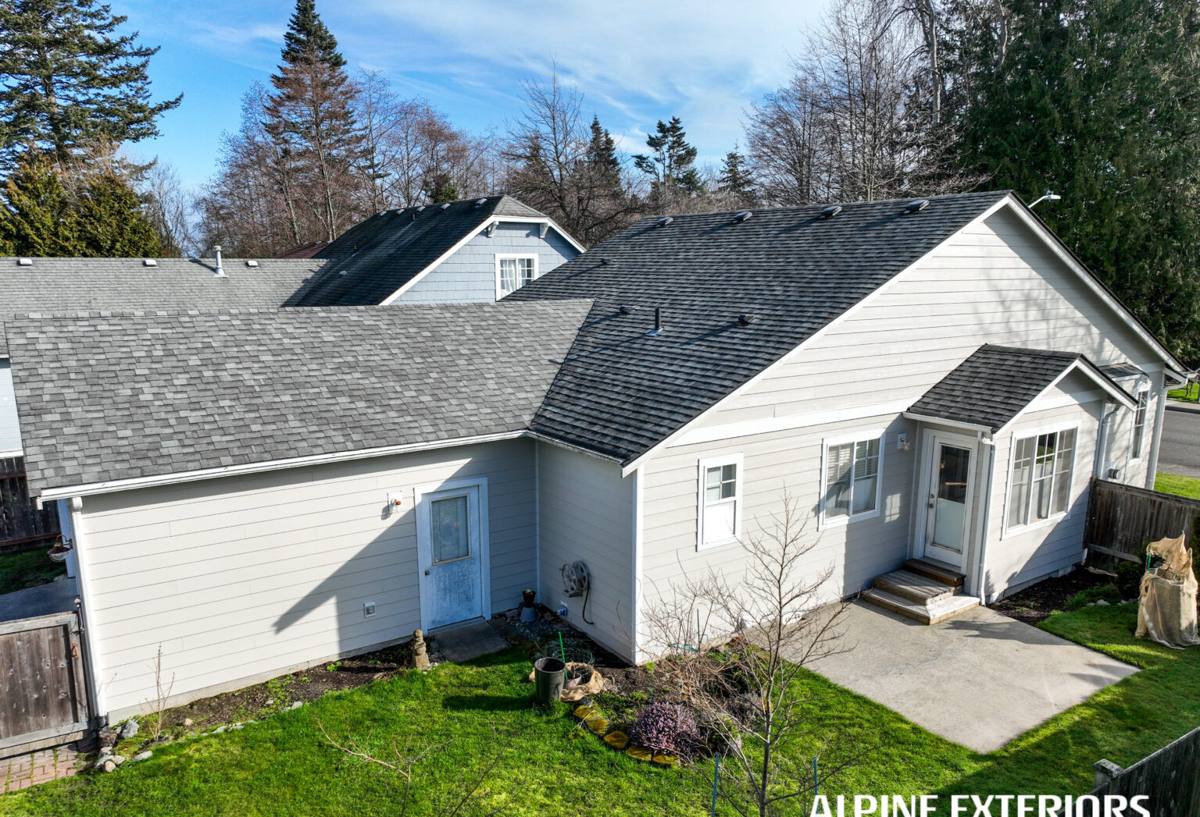
Moss Season Is a Real Thing Here — and It's Longer Than Most Homeowners Think
In Whatcom County, moss isn't a cosmetic nuisance confined to the roof. It colonizes north-facing siding, window sills, deck boards, and anywhere else moisture lingers without much sun exposure. On wood-based siding products, moss and algae growth isn't just unsightly — it holds water against the substrate, which is exactly the condition that leads to swelling, delamination, and rot over time. On a roof, moss works its way under shingle edges and lifts them, which is how a maintenance issue becomes a leak.
A siding and roofing package built for Cordata has to account for a moss season that can run from fall through late spring most years, not just a few weeks. That means product choice matters, but so does detailing: overhangs, flashing, ventilation gaps, and how trim is sealed all affect how fast moss gets a foothold and how much damage it does once it's there.
Why This Matters More on Shaded, North-Facing Walls
Homes on wooded or tightly spaced Cordata lots often have one or two elevations that almost never see direct sun. Those walls dry slower after every rain event, which means they're doing more cumulative "wet time" over a year than a south-facing wall on the same house. When we look at a home here, we pay particular attention to those shaded elevations — they're usually the first place problems show up, and often the last place a homeowner checks.
Why We Only Install James Hardie Fiber Cement Siding
We get asked why we don't offer vinyl, LP SmartSide, or other engineered wood siding products, especially since some of them cost less upfront. The honest answer is that we've made a standard for our business, and it's built around what holds up in this specific climate — not around industry averages or national marketing.
Vinyl siding can work fine in drier regions, but it expands and contracts with temperature swings, and in a marine climate with constant moisture cycling, seams and J-channels are where problems tend to start. It's also a petroleum-based product, which means it softens and can warp under sustained heat exposure and becomes brittle in cold snaps — neither extreme is common here, but the freeze-thaw and wet-dry cycling we do get is its own kind of stress test. Engineered wood products like LP SmartSide use wood strand substrates with a resin binder, which is a real improvement over old-style hardboard, but the product is still wood-based at its core. Any breach in the factory coating — a nail pop, a cut edge, a scratch during installation — creates a path for moisture into a substrate that swells and can eventually delaminate if it isn't caught and resealed quickly. In a region where a compromised edge might not fully dry out for weeks, that's a maintenance burden we'd rather not hand a homeowner.
James Hardie fiber cement siding is cement, sand, and cellulose fiber. It doesn't have an organic substrate for moisture to feed on, and it's non-combustible, which matters given Washington's increasing wildfire seasons even on the wetter west side of the state. Hardie's HZ5 product line is engineered specifically for regions like ours, with moisture and freeze-thaw performance built into the formulation rather than added as an afterthought. The factory-applied ColorPlus finish is baked on under controlled conditions, so it resists the fading, chipping, and moss-friendly texture breakdown that field-applied paint develops over time, and it carries a stronger, clearly defined warranty than what you typically get with site-painted trim.
None of this means other products are junk — they have real uses and reasonable price points. It means that for a Whatcom County exterior that has to survive salt air, driving rain, and a long moss season year after year, we don't think they're the right call, and we'd rather turn down that install than sell a homeowner something we don't believe in.
Beyond Siding: Roofing, Windows, and Decks for Cordata Homes
Siding doesn't work in isolation — it's one piece of a home's exterior envelope, and in this climate the pieces need to work together. We handle roofing, window replacement, and deck construction alongside siding work because moisture problems rarely respect trade boundaries. A roof leak at a valley can show up as a stain on interior siding trim two rooms away. A failing window seal can rot the wall framing behind perfectly good siding. A deck ledger board attached without proper flashing can quietly rot the rim joist it's bolted to.
Handling all four trades under one roof means we can look at a Cordata home's exterior as a whole system — how water moves off the roof, around the windows, down the walls, and away from the deck — instead of patching one component and leaving the next weak point for someone else to find later.
Windows and Moisture Management
Older single-pane or early dual-pane windows common in some Whatcom County homes are frequently a bigger source of drafts and moisture intrusion than the siding around them. When we're already opening up a wall for siding work, it's often the right time to evaluate window flashing and, where it makes sense, replace units that are past their useful life.
Decks in a Wet Climate
Outdoor living space matters in the Pacific Northwest, rain or not, and Whatcom County decks take a beating from the same moss and moisture cycle as siding. Proper board spacing, ledger flashing, and material selection all affect how long a deck lasts before it needs major repair.
What a Proper Installation Actually Involves
Fiber cement siding performs the way it's supposed to only when it's installed to manufacturer spec, and in a climate like ours the details that get skipped on a rushed job are exactly the ones that cause failures. A correct install includes a weather-resistant barrier behind the siding, proper flashing at every window, door, and horizontal trim transition, correct fastener type and placement (fiber cement requires specific nail or screw patterns to avoid cracking and to maintain warranty coverage), and the right gap and caulking approach at butt joints and corners so water has somewhere to go instead of somewhere to sit.
We also pay attention to clearance — siding installed too close to grade, a deck surface, or a roofline gives moisture a shortcut to the bottom edge of the material, which is a common failure point regardless of what siding product is used.
Comparing Siding Options for a Whatcom County Home
| Factor | Vinyl | Engineered Wood (LP SmartSide) | James Hardie Fiber Cement |
|---|---|---|---|
| Moisture tolerance | Doesn't absorb water, but seams can let water behind panels | Wood-based substrate; vulnerable if factory coating is breached | Cement-based; not an organic food source for moisture damage |
| Fire resistance | Combustible | Combustible | Non-combustible |
| Finish durability | Can fade; color is through the material but texture degrades | Factory primed or coated; touch-up needed at cuts and damage | Factory-baked ColorPlus finish; long color/finish warranty |
| Performance in marine climate | Adequate; seam and expansion concerns | Adequate if maintained; edge sealing is critical | Purpose-engineered HZ5 line for wet, coastal-adjacent regions |
| Typical upfront cost | Lower | Mid-range | Higher, offset by longevity and warranty |
Signs a Cordata Home May Need Siding, Roofing, or Trim Attention
- Moss or dark green streaking on north-facing or shaded siding, especially where a wall meets a roofline or fence
- Soft or spongy trim boards, particularly around window and door casings
- Paint that's bubbling, peeling, or chalking faster than it should on newer paint jobs
- Visible gaps or separation at siding seams, corners, or butt joints
- Musty smell or interior staining near exterior walls, which often points to a moisture path from outside
- Roof shingles with moss growth along the edges or in valleys, especially after a wet winter
- Deck boards that stay damp long after rain has stopped, or a ledger board area that looks discolored
Why a Local Crew Matters in Whatcom County
A crew that works Whatcom County homes regularly knows what a Cordata roofline typically deals with by February, which elevations tend to hold moisture longest, and how the local permitting and inspection process runs in Bellingham and the surrounding unincorporated county. That familiarity shows up in small decisions — where extra flashing gets added, how ventilation is handled behind siding, what fastener spacing actually holds up here — that a crew unfamiliar with this specific climate might not think twice about.
It also means accountability. A local company has a reputation in the community to maintain, and a warranty claim doesn't involve chasing down a crew that's moved on to a different region.
Getting Started
If your Cordata home's siding, roof, windows, or deck are showing signs of wear from another Whatcom County winter, we're happy to take a look and give you a straightforward read on what's actually going on — no pressure, no hard sell. Fill out the form below to schedule a free estimate.