 Whatcom County
 Edgemoor: A Neighborhood Shaped by Water and Trees
Edgemoor sits close to Bellingham Bay, wrapped in mature evergreen canopy and defined by the kind of quiet, wooded streets that made people want to build here in the first place. That same setting is exactly what makes exterior maintenance a different animal than it is a few miles inland. Proximity to saltwater, dense tree cover, and the marine weather that rolls off the Salish Sea all put real, sustained stress on siding, roofing, trim, and windows — stress that shows up slowly, as soft spots, streaking, or moss creep, long before most homeowners notice anything is wrong.
We work throughout Whatcom County, and Edgemoor is one of the areas where we spend the most time explaining why a home is aging the way it is, not just patching the symptom. The short version: salt air, driving rain, and a long moss season all take their toll, and the materials and installation details that work fine in a drier, more sheltered part of the county often don't hold up the same way here.
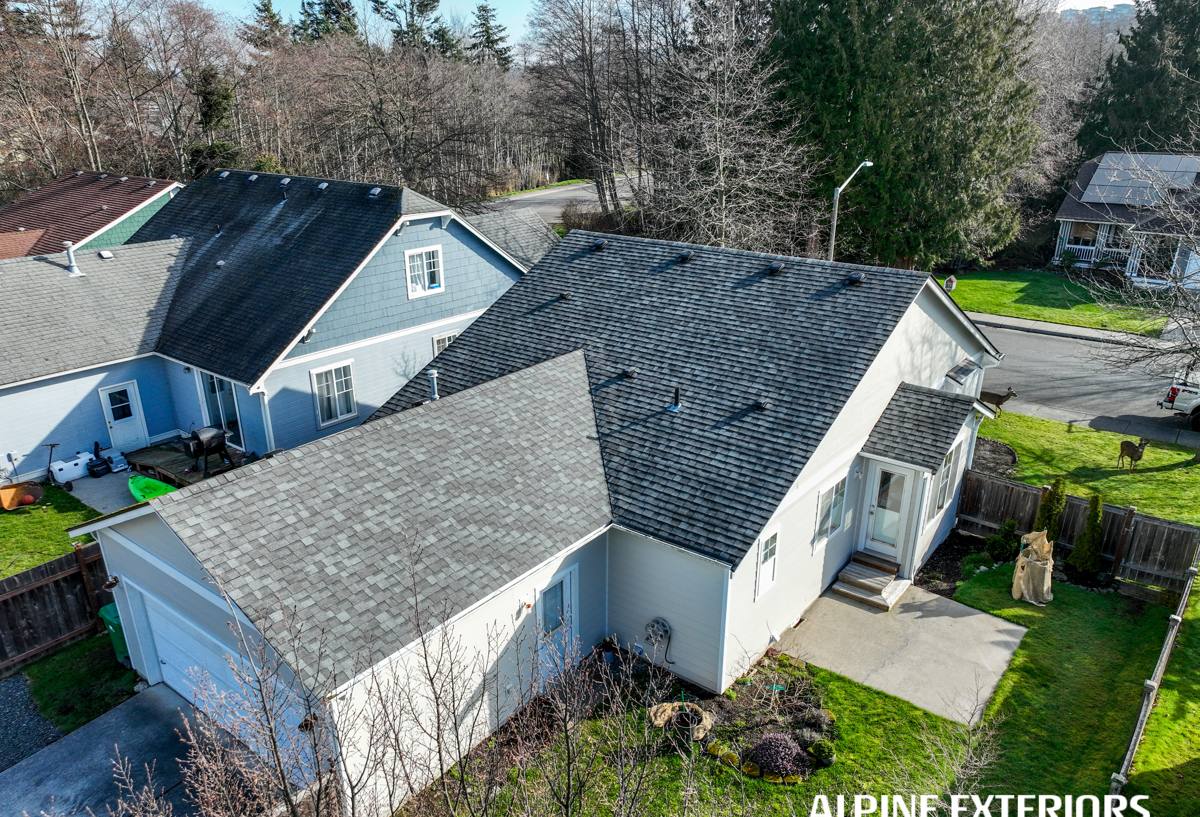
What the Local Climate Actually Does to a House
Salt Air and Metal Fatigue
Homes within a mile or two of Bellingham Bay live in a mild salt-air environment. It's nowhere near as aggressive as an oceanfront property on the outer coast, but it's persistent — and persistence is what matters. Salt-laden moisture accelerates corrosion on exposed fasteners, flashing, gutter hardware, and any metal trim that isn't properly coated or protected. Over years, that shows up as rust streaking down siding, corroded nail heads telegraphing through paint, and flashing that fails quietly at seams you can't see from the ground.
Driving, Wind-Driven Rain
Whatcom County gets a lot of rain, but what matters more for siding is the direction it comes from. Storms moving in off the water push rain sideways against west- and southwest-facing walls, forcing water into laps, seams, and butt joints that would stay dry in a straight-down rain. Siding that isn't installed with correct overlaps, gapping, and flashing details will eventually let that wind-driven moisture behind the cladding — and once water gets behind siding, the damage is happening to sheathing and framing, not just the visible surface.
Shade, Moss, and a Long Growing Season
Edgemoor's tree cover is a big part of its character, but it also means many homes get limited direct sun on at least one or two elevations. Shaded, damp surfaces are exactly where moss, algae, and mildew take hold, and Whatcom County's mild, wet climate gives them most of the year to do it. Moss on a roof is a maintenance issue; moss and algae staining that gets a foothold on siding is often a sign the surface is staying wet longer than it should, which shortens the life of paint, caulking, and the substrate underneath.
Why Product Choice Matters More Here Than Elsewhere
In a drier, sunnier climate, a homeowner can get away with a wider range of siding products and still see decent results. In a setting like Edgemoor — shaded, damp, salt-influenced — the gap between a good exterior material and a mediocre one shows up faster and more visibly. This is why we standardized on James Hardie fiber cement siding for every installation we do, and why we don't install vinyl, LP SmartSide, Cemplank, Allura, or primed wood species like spruce or cedar as our primary product.
| Material | How it tends to perform in salt air / heavy shade / driving rain |
|---|---|
| Vinyl siding | Doesn't rot, but seams and panels can warp or loosen with sustained moisture cycling; wind-driven rain finds its way behind loose panels more easily than with a rigid, fully fastened product. |
| LP SmartSide (engineered wood) | Wood-based core is more moisture-sensitive than fiber cement; in consistently damp, shaded conditions, edge swelling and finish failure show up sooner if caulking and paint maintenance lapse even briefly. |
| Cedar or primed spruce | Beautiful when new, but real wood in a wet, shaded microclimate needs disciplined, ongoing refinishing to keep moisture out — the maintenance burden is real and constant. |
| Cemplank / Allura fiber cement | Similar core material to Hardie, but we've standardized on one manufacturer, one factory finish system, and one warranty structure so every job we do is consistent and easy to service. |
| James Hardie fiber cement | Non-combustible, dimensionally stable, resists moisture-driven warping and rot, and comes with a factory-applied ColorPlus finish engineered to hold color and resist the fading and staining that shaded, damp walls are prone to. |
We're not saying every one of those other products is a bad product in every setting. We're saying that for Whatcom County's marine climate — and Edgemoor's shaded, water-adjacent lots in particular — the trade-offs stopped making sense for us to install and stand behind.
James Hardie: The System We Install
James Hardie fiber cement is a cement-and-cellulose composite engineered specifically for climates like ours. A few things matter more than the marketing:
- HZ5 engineering: Hardie's HZ product lines are formulated for specific climate zones, including the wetter, cooler Pacific Northwest — this isn't a one-size-fits-all product.
- ColorPlus factory finish: baked-on finish that resists the fading, chalking, and moss-friendly surface degradation that field-applied paint struggles with over time in shaded, damp conditions.
- Non-combustible core: fiber cement doesn't feed a fire the way wood-based products can, which matters for insurance considerations as much as safety.
- Dimensional stability: it doesn't swell and shrink with moisture cycling the way engineered wood or solid wood can, which keeps joints and caulk lines tighter for longer.
- Transferable warranty: a real, manufacturer-backed warranty that follows the house if it sells, which matters in a desirable neighborhood like Edgemoor where resale is often part of the equation.
Installation Details That Matter in This Climate
Fiber cement siding is only as good as the installation behind it. In a driving-rain, salt-air environment, the details that get skipped on a rushed job are exactly the ones that fail first:
- Correct starter strip, flashing, and weather-resistive barrier integration behind every plane of siding
- Proper fastener type and placement to resist both wind load and long-term corrosion
- Adequate clearance and flashing at grade, decks, and roof-to-wall intersections where wind-driven rain concentrates
- Correct gapping and sealant at butt joints and around windows and doors, sized for the product and the exposure
- Kick-out flashing at roof-wall intersections to direct water away from siding instead of behind it
Skipping any one of these doesn't usually cause an immediate, visible problem. It causes a slow one — moisture intrusion that shows up as a soft spot or a stain two or three years later, after the crew that installed it is long gone.
Roofing, Windows, and Decks — The Rest of the Building Envelope
Siding doesn't work in isolation. A roof that's holding moss, a window that's failed at the seal, or a deck ledger that's trapping water against the wall all put stress back onto the siding around them. We handle roofing, windows, and decks alongside siding for exactly this reason — an exterior is one connected system, and treating it that way is how you actually stop the cycle of moisture problems instead of chasing them one at a time.
Roofing
In a shaded, moss-prone setting like Edgemoor, roof maintenance and moss management directly affect how much water ends up running down and behind your siding at eaves and valleys.
Windows
Window flashing integration is one of the most common sources of hidden water intrusion we find when we open up a wall — it has to be done in the right sequence relative to the siding, not as an afterthought.
Decks
Deck ledger boards and any point where a deck attaches to the house are high-risk spots for trapped moisture against siding and framing if they aren't flashed correctly.
Why a Local Crew Matters
A crew that works across Whatcom County regularly understands, without being told, that a shaded lot near Bellingham Bay needs different flashing attention than a sunny, exposed lot further inland. That's not a sales pitch — it's the difference between a crew pattern-installing siding the same way on every job and a crew that adjusts detailing to the actual exposure of the wall in front of them. Local also means we're not far away if a warranty question or a maintenance question comes up years down the road.
A Simple Homeowner Checklist
- Check north- and west-facing walls for moss, algae streaking, or persistent green staining
- Look at caulk lines around windows and butt joints for cracking or gaps
- Check for rust streaking below fasteners, flashing, or gutter hardware
- Feel for soft spots near the base of walls, around deck ledgers, and below window sills
- Note any areas that stay visibly damp longer than the rest of the house after a rain
Get an Honest Look at Your Home
If you're in Edgemoor or elsewhere in Whatcom County and want a straight assessment of what your siding, roof, windows, or deck actually need — not a sales pitch — we're glad to come take a look. The estimate is free, there's no pressure, and you'll get a plain explanation of what we see and why. Use the form below to get started.