 Whatcom County
 Siding Built for Blaine's Waterfront Climate
Blaine sits at the far northwest corner of Whatcom County, wedged between the Strait of Georgia and the Canadian border, with Semiahmoo Bay and Drayton Harbor shaping the local weather as much as any inland forecast does. Homes here take a different kind of beating than houses twenty miles inland. Marine air carries salt onto siding, trim, and fasteners year-round. Wind off the water drives rain sideways into wall assemblies that were never designed for it. And the long gray stretch between October and April keeps everything damp long enough for moss and algae to get a foothold and stay there. If you own a home in Blaine, you already know this. What you may not know is how much of it comes down to the siding material itself.
We're a Whatcom County exterior contractor working siding, roofing, windows, and decks across the region, and Blaine is squarely inside our regular service area. We're not commuting in from Seattle or subcontracting the work out — this is a crew that deals with Whatcom's weather patterns on every job, and that experience shapes how we spec and install every exterior we touch.
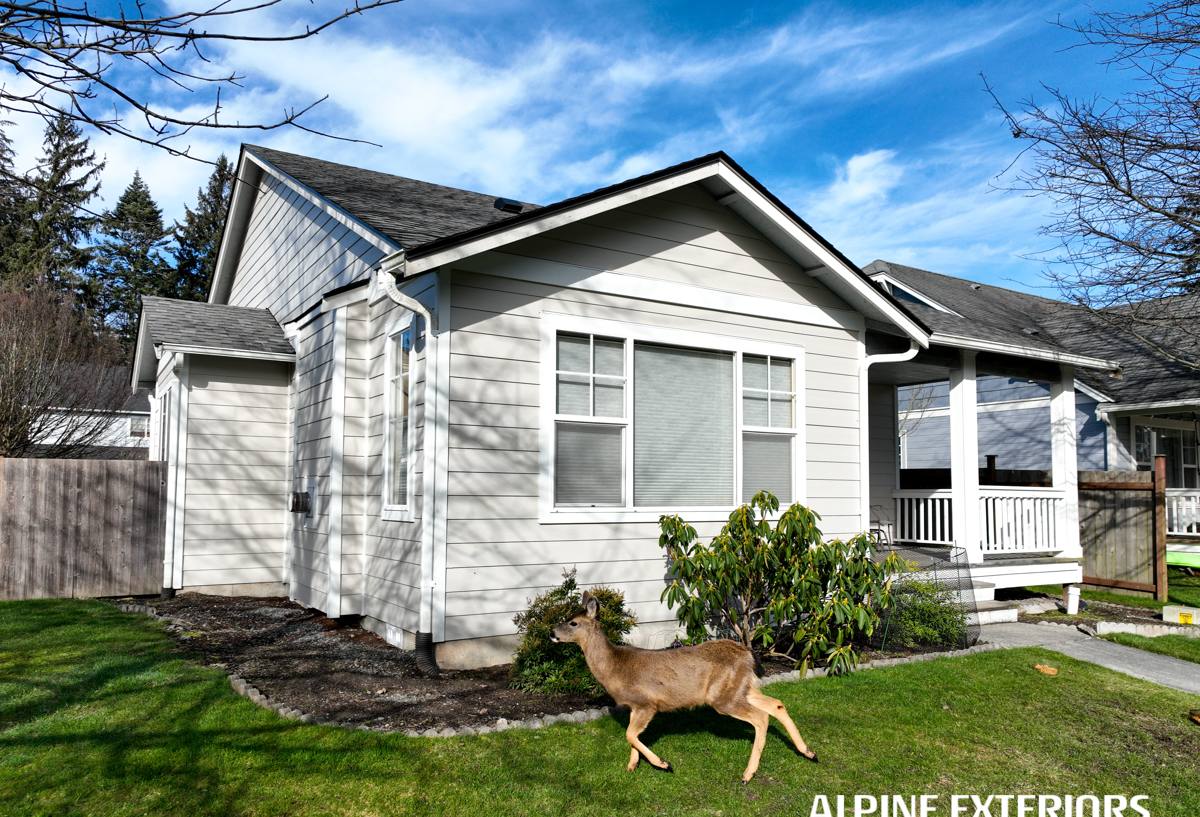
What Salt Air and Coastal Rain Actually Do to a House
Salt air isn't just an inconvenience you wipe off the windows. Airborne salt is corrosive to fasteners, flashing, and any metal component on the exterior of a house, and it accelerates the breakdown of many siding finishes faster than manufacturers' standard test data (usually run away from the coast) would suggest. Combine that with the wind-driven rain common along Semiahmoo Bay and Drayton Harbor, and you get two compounding problems:
- Moisture intrusion: horizontal rain, pushed by wind off the water, finds gaps at butt joints, trim, and penetrations that would stay dry in a calmer climate.
- Accelerated finish wear: salt residue plus UV and moisture cycling breaks down paint film and substrate coatings faster, especially on south- and west-facing walls that catch both sun and weather.
Neither of these problems is solved by caulk alone. They're solved by choosing a siding material that's dimensionally stable when wet, a finish that's engineered to hold up to UV and salt exposure, and an installation that respects proper flashing, clearances, and drainage — not just a good-looking wall on install day.
Why We Install Only James Hardie Fiber Cement
We've made a deliberate decision as a company: we install James Hardie fiber cement siding, and we don't install vinyl, LP SmartSide, Cemplank, Allura, primed spruce, or cedar. That's not a marketing line — it's a standard we hold to because of what we've seen these products do (and not do) in exactly the kind of climate Blaine sits in.
The trade-offs with other materials
Vinyl siding is inexpensive and easy to install, and in a mild, dry climate that can be a reasonable trade-off. In a salt-air, high-wind-driven-rain environment, vinyl's weak points show up faster: it can warp or distort with temperature swings, its seams and laps are more forgiving of water intrusion than they should be, and it doesn't offer the impact or fire resistance homeowners increasingly want on the coast.
Wood-based composite siding like LP SmartSide uses an engineered wood strand core with a resin-saturated overlay. It performs well in a lot of climates, but wood-based products are inherently more sensitive to sustained moisture exposure than fiber cement — and sustained moisture is exactly what a marine, high-rainfall location like Blaine delivers for months at a time. Any breach in the factory coating or field-cut edge sealing becomes a longer-term liability here than it would be somewhere drier.
Cedar is a beautiful, genuinely traditional Pacific Northwest siding material, and we understand why homeowners want it. But natural wood requires an ongoing maintenance commitment — refinishing, caulking, moisture monitoring — that most homeowners underestimate, and in a moss-prone, salt-exposed environment that maintenance burden only grows. Primed spruce carries similar issues without the character that draws people to cedar in the first place.
Other fiber cement brands, like Cemplank or Allura, are chemically similar to what we install. Our decision to standardize on James Hardie specifically comes down to their ColorPlus factory-applied finish (baked-on, not field-applied, and backed by its own finish warranty), their HZ5 product formulation engineered for harsher climate zones, and a long, consistent manufacturing track record that gives us confidence in how the product performs a decade or two after installation — not just on day one.
What James Hardie gets right for this climate
| Concern in Blaine | How Hardie fiber cement addresses it |
|---|---|
| Salt air corrosion | Non-corroding cement composite substrate; we pair it with corrosion-resistant fasteners and flashing |
| Wind-driven rain | Rigid, dimensionally stable panels that hold tight laps and joints when properly installed with correct flashing and drainage gaps |
| Moss and algae growth | Non-organic substrate doesn't feed moss the way wood-based products can; factory finish resists staining longer |
| UV and finish breakdown | ColorPlus factory finish is baked on and warrantied separately from the substrate itself |
| Fire exposure | Non-combustible material, a growing consideration as wildfire smoke seasons reach even wet coastal counties |
Moss Season Is Longer Here Than People Realize
Whatcom County's wet season stretches well beyond what most homeowners plan for, and Blaine's proximity to the water keeps humidity elevated even on days without active rainfall. That combination — moisture, shade from mature trees, and mild temperatures — is exactly what moss and algae need to establish themselves on north-facing walls, under eaves, and anywhere airflow is restricted. Once moss takes hold on a porous or wood-based siding surface, it holds moisture against that surface, which accelerates rot and finish failure underneath it. Fiber cement doesn't stop moss from landing on a wall, but it doesn't feed it or absorb moisture the way organic materials do, and a factory finish resists staining longer than field-applied paint on wood siding.
Roofing plays into this too. A roof that sheds water cleanly and a siding system with correct clearances and drainage planes work together — if one is failing, the other takes on more load. That's part of why we handle siding, roofing, windows, and decks as one exterior system rather than treating them as separate trades that don't talk to each other.
How the Job Works, Start to Finish
Every home in Blaine is different — orientation to the water, tree cover, existing wall condition, and age of the house all change what a job actually involves. But the process holds to the same standard on every project:
- On-site assessment: we look at existing siding condition, moisture history, trim and flashing details, and how exposed the home is to wind and salt off the water.
- Tear-off and sheathing check: removing old siding lets us inspect what's underneath — sheathing, house wrap, and any signs of prior moisture damage — before anything new goes on.
- Weather-resistive barrier and flashing: this layer, done correctly, is what actually keeps wind-driven rain out. It matters more than the siding brand.
- James Hardie installation to manufacturer spec: correct fastener spacing, clearances above grade and roof lines, and joint treatment, all specific to Hardie's published installation guidelines.
- Trim, caulking, and final detailing: the places most siding failures start — inside corners, window returns, penetrations — get the closest attention.
Why a Local Whatcom County Crew Matters
A siding job installed to spec in Bellingham or Everett isn't automatically installed to spec for Blaine. The clearances, flashing details, and fastener choices that hold up fine in a sheltered inland lot can fall short on a home taking direct wind off Semiahmoo Bay or Drayton Harbor. A crew that works this area regularly knows which walls need extra attention to flashing and drainage, which sides of a house take the worst weathering, and how the local moss and algae pattern actually behaves through a Whatcom County winter — not from a manual, but from having done the work here before.
There's also a practical side to being local: warranty service, a follow-up question about caulking, or a request to look at a trim detail a few years down the line is a short drive for us, not a scheduling problem.
What This Means for Your Project
If you're planning a siding project in Blaine, a few things are worth thinking through before work starts:
- Get a clear look at what's happening under your current siding, not just what it looks like from the curb — moisture problems in a marine climate are often worse than surface appearance suggests.
- Ask any contractor exactly which fastener and flashing materials they're using; in a salt-air environment, the wrong hardware undermines even a good siding choice.
- Consider your home's orientation to the water — walls facing prevailing wind and rain may benefit from extra detailing at trim and penetrations.
- Think about siding, roofing, and windows together rather than in isolation; water management is a whole-house system, not a single product.
- Ask what warranty coverage actually includes — both the material warranty and any workmanship warranty from the installer.
Roofing, Windows, and Decks Alongside Your Siding
Because we handle all four trades, a siding project is often a natural time to address a roof nearing the end of its service life, windows that are no longer sealing well against driving rain, or a deck that's been absorbing the same moisture exposure as your walls. Coordinating this work under one crew means fewer contractors moving through your property, and it means the flashing and water-management details between roof, walls, and window openings actually get planned as a system instead of patched together by separate trades on separate schedules.
Get a No-Pressure Estimate
If you're weighing your options for siding, roofing, windows, or decks on a home in Blaine, we're happy to come take a look and give you an honest read on what your house actually needs — no pressure, no inflated urgency, just a straight assessment from a crew that works this coastline regularly. Fill out the form below to get started.