 Whatcom County
 Why Siding Wears Differently in Lynden
Lynden sits in a part of Whatcom County where weather doesn't let up for long. Homes here deal with a long wet season, driving rain that comes in sideways during winter storms, and enough moisture in the air most of the year to keep moss and algae established on north-facing walls and anything shaded by trees or fences. Add the faint but real salt influence that reaches inland across Whatcom County from the Strait of Georgia and Puget Sound, and you've got a climate that's genuinely hard on exterior materials — not because any one factor is extreme, but because the combination rarely stops.
Siding that isn't built for this cycle — wet, humid, brief dry spells, wet again — tends to fail from the inside out. Moisture gets behind panels or into seams, stays there because drying windows are short, and the damage shows up as soft spots, bubbling paint, or rot in the sheathing long before the siding itself looks obviously bad from the curb. That's the core problem a proper siding replacement in Lynden has to solve: not just putting up new material, but stopping the moisture cycle that wore out the old siding in the first place.
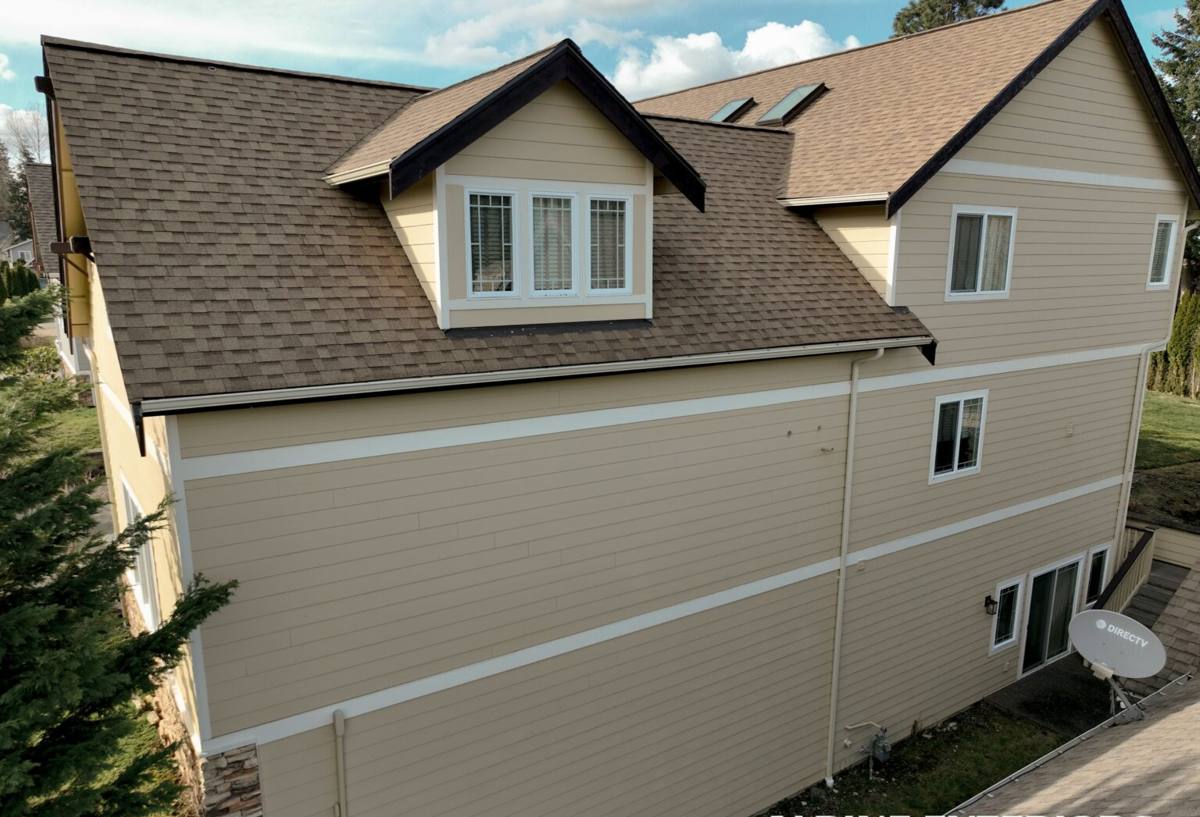
Signs a Lynden Home Needs Siding Replacement, Not Just Repair
Not every siding problem calls for a full replacement, but there's a point where patching stops making sense. Some signs to watch for:
- Soft or spongy spots when you press on the siding, especially near the bottom courses or around windows
- Paint that keeps failing within a year or two of repainting, even with a quality product
- Persistent moss or algae growth that comes right back after cleaning
- Visible warping, cupping, or separation at panel seams
- Rising energy bills with no other explanation — often a sign the wall assembly behind the siding is compromised
- Siding that's original to a home 25+ years old, particularly wood-based products that were never designed for this many wet cycles
If you're seeing two or more of these, it's worth having someone look at the wall assembly, not just the surface. A siding that looks rough but is still sound underneath might only need a section repaired. Siding that looks fine but has trapped moisture behind it is a bigger problem hiding in plain sight — and that second scenario is common in Whatcom County's climate.
What a Correct Siding Replacement Actually Involves
It Starts Underneath the Siding, Not With It
The siding itself is the least important part of getting this right. What matters more is what's behind it: the sheathing, the weather-resistive barrier (WRB), and the flashing details around every window, door, and penetration. A replacement job that just strips old siding and nails up new panels over damaged or improperly wrapped sheathing is setting the next homeowner up for the same failure in half the time.
A correct tear-off includes inspecting the sheathing for rot or soft spots, replacing anything compromised, installing a proper WRB with correctly lapped seams, and flashing every opening so water sheds outward and down — never behind the barrier. In a climate that gets as much driving rain as Whatcom County does, flashing details are not optional extras. They're the difference between siding that lasts 40+ years and siding that fails in 10.
Fastening and Clearances Matter More Than People Think
Fiber cement siding has a manufacturer-specified fastening schedule, minimum ground clearance, and gapping requirements at trim and butt joints. Skipping these to save time is one of the most common ways installers void a warranty without the homeowner ever knowing until a problem shows up years later. Correct installation also means respecting expansion gaps and using the right fasteners for the substrate — details that don't show up in a photo but decide whether the job holds up.
Why We Install Only James Hardie Fiber Cement
We don't install LP SmartSide, vinyl, Cemplank, Allura, primed spruce, or cedar. That's a deliberate standard, not a lack of options. Each of those products has legitimate uses and reasonable people choose them — but for a climate like Whatcom County's, we've settled on James Hardie fiber cement as the product we're willing to put our name behind.
A few reasons that matter specifically here:
- Non-combustible — fiber cement doesn't feed a fire the way wood-based products can, which matters for insurance and peace of mind alike
- Moisture behavior — Hardie's fiber cement doesn't absorb and swell the way wood products or wood composites can when exposed to repeated wet cycles, which is the exact stress Whatcom County siding is under most of the year
- ColorPlus factory finish — baked-on color that resists fading and chipping far better than field-applied paint, which matters when your painting window is short and unpredictable
- Climate-engineered HZ product lines — Hardie makes region-specific formulations (HZ5, HZ10) engineered for different moisture and freeze exposure, and the correct one gets specified for Whatcom County's conditions
- Warranty structure — a strong, transferable manufacturer warranty that holds up when the product is installed to spec, which adds resale value homeowners don't always think about upfront
Vinyl is inexpensive but expands and contracts significantly with temperature swings and can crack in cold snaps. Wood-based composite and primed wood products need consistent maintenance and are more vulnerable to the wet-dry cycling this region puts them through. Hardie isn't the cheapest option on the shelf, but for a region where siding has to survive nearly year-round moisture exposure, it's the one we trust enough to stand behind with our own installation.
Our Process, Start to Finish
1. On-Site Estimate and Assessment
We look at the current siding, check for signs of trapped moisture or sheathing damage, and talk through what you're seeing from the inside (drafts, stains, energy bills) as well as the outside.
2. Written Scope and Product Selection
You get a clear scope of work — what's being torn off, what's being repaired underneath, which Hardie product and profile fits the home, and a real cost range, not a vague estimate.
3. Tear-Off and Sheathing Inspection
Old siding comes off, sheathing gets inspected and repaired where needed, and any rot is addressed before anything new goes up — not covered over.
4. Weather Barrier and Flashing
WRB installed with correct laps, flashing detailed at every window, door, and penetration, sealing the wall assembly against the driving rain this area gets.
5. Hardie Installation to Spec
Panels installed with the manufacturer's fastening schedule, gapping, and clearances — done right so the warranty is actually valid, not just on paper.
6. Final Walkthrough
We walk the exterior with you, point out the details, and answer questions before calling the job done.
Cost Factors for a Lynden Siding Replacement
Every home is different, but the same handful of factors drive cost up or down on most jobs. This isn't a quote — it's a way to think about where your project will likely land.
| Factor | Why It Matters |
|---|---|
| Home size and wall complexity | More square footage and more corners, dormers, and trim details mean more labor and material |
| Sheathing condition | Rot or moisture damage found during tear-off adds repair scope that can't be known until the old siding is off |
| Siding profile and texture | Lap width, shake-style panels, and board-and-batten each carry different material and labor costs |
| Trim and accessory work | Fascia, soffits, and window trim replaced alongside siding add cost but avoid mismatched future repairs |
| Access and site conditions | Steep grades, tight setbacks, or multi-story walls affect scaffolding and labor time |
| Color and finish | Factory ColorPlus finishes cost more upfront than field-painted but eliminate a repaint cycle for years |
Why Hiring a Crew That Already Works in Whatcom County Matters
Siding installation isn't uniform across the country, and a crew that mostly works drier climates can miss details that matter here. Flashing details that would be adequate in a low-rainfall region aren't always adequate where driving rain and long wet seasons are the norm. A contractor who works Whatcom County regularly has already seen what happens when those details get skipped — the callbacks, the moisture damage, the moss that comes right back — and builds the job to avoid it from the start.
Local experience also means knowing which Hardie products and clearances are appropriate for this specific climate zone, understanding how salt-tinged coastal air factors into fastener and finish choices, and having a track record you can actually check with neighbors rather than an out-of-town crew that won't be around if something needs attention later.
Maintaining Your New Siding
James Hardie siding installed correctly is genuinely low-maintenance compared to wood or wood composite, but "low-maintenance" isn't "no-maintenance." A little upkeep goes a long way in this climate:
- Rinse the exterior once or twice a year to keep moss and algae from establishing, especially on shaded or north-facing walls
- Keep gutters clear so overflow doesn't run down the siding face repeatedly
- Trim back vegetation and shrubs so walls get airflow and sunlight to dry out between rain events
- Check caulking at trim joints and penetrations every couple of years and touch up as needed
- Address any paint chips or scratches promptly to keep the ColorPlus finish protecting the substrate underneath
If your siding is showing its age or you're just planning ahead, we're happy to take a look and give you an honest read on what your home needs — no pressure, no upsell. Fill out the form below for a free estimate.