 Whatcom County
 Why Happy Valley Homes Lose Money Through Their Windows
Happy Valley sits close enough to Bellingham Bay that salt-laden air is a real factor in how fast window hardware, seals, and finishes age. Add in the wind-driven rain that comes through Whatcom County most of the year and the long stretch of gray, damp months where moss and algae get a foothold on anything that stays wet, and you have a climate that is genuinely tough on window assemblies — even good ones. Windows here don't fail because of one big storm. They fail slowly, from seals that give up a few years early, wood that stays damp longer than it should, and hardware that corrodes faster than the manufacturer's spec sheet assumed.
Energy efficiency and weather durability aren't separate issues in this neighborhood — they're the same problem. A window that's leaking air is usually also a window that's letting in moisture, and moisture is what eventually rots a jamb or fogs a sealed unit. When we talk about "energy-efficient windows" for a Happy Valley home, we're really talking about windows and installations built to keep water and air out over the long haul, with lower utility bills as the natural result.
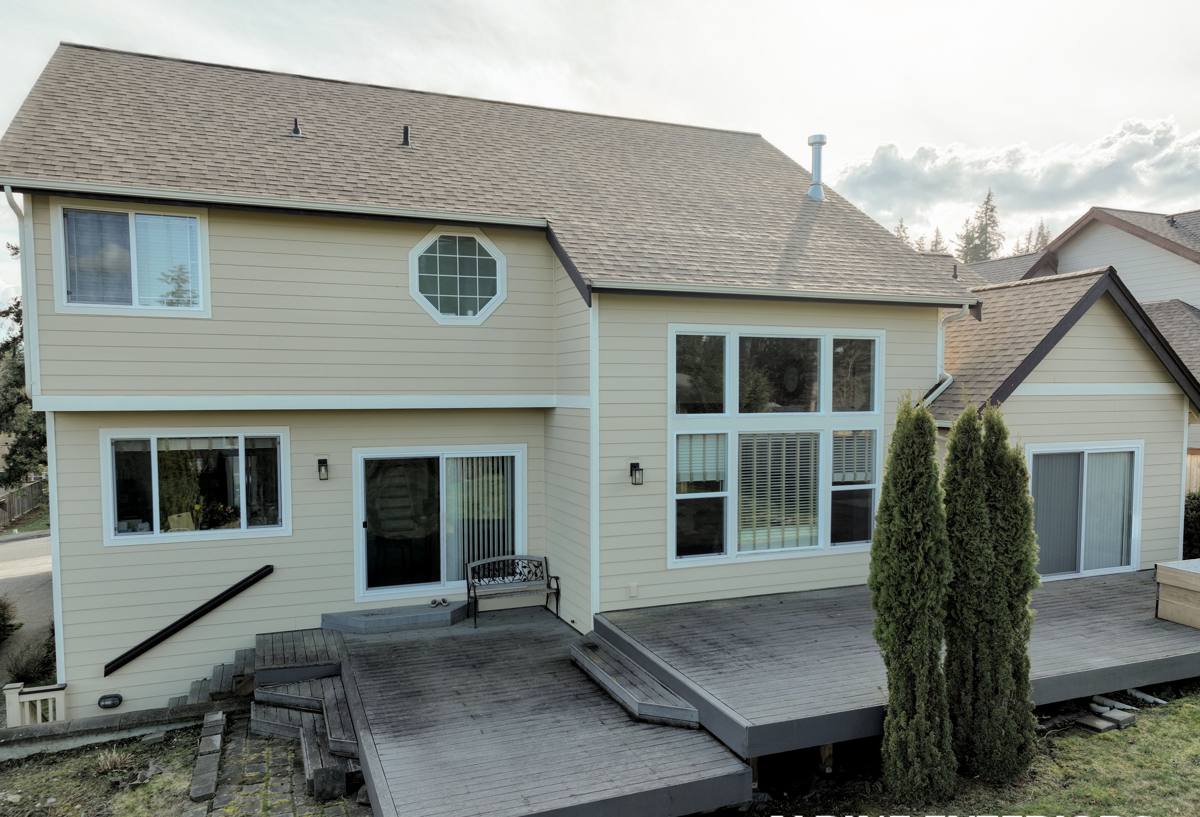
Signs Your Current Windows Are Working Against You
Most homeowners don't notice window failure until it's obvious — a foggy pane or a draft you can feel with your hand. By then, the problem has usually been developing for a while. Here's what we look for during an assessment:
- Condensation or fogging between the panes of a double- or triple-glazed unit (the seal has failed and the gas fill is gone)
- Visible daylight or a draft around the frame when the window is closed and locked
- Paint or finish that's peeling or bubbling on the interior sill — often a sign of moisture getting past the exterior seal
- Windows that are hard to open, close, or lock — frames can swell or warp from repeated wetting
- Soft or discolored wood at the sill or lower corners of the frame
- Noticeably colder rooms near windows in winter, or rooms that overheat in summer sun
- A jump in heating costs that doesn't match a change in usage
Any one of these is worth a look. Several together usually mean it's time to talk about replacement rather than repair.
What "Energy Efficient" Actually Means
U-Factor and Solar Heat Gain
Two numbers matter most on a window's energy label: U-factor and Solar Heat Gain Coefficient (SHGC). U-factor measures how well the window resists heat flow — lower is better, and it's the number that matters most for a heating-dominated climate like Whatcom County's. SHGC measures how much solar heat passes through the glass — a secondary consideration here, since our winters are cloudy more often than sunny, but still relevant on south- and west-facing walls.
Glazing and Gas Fill
Double-pane, low-E glass with an argon gas fill is the practical baseline for this climate — it balances performance, cost, and long-term reliability. Triple-pane glass performs better on paper, but the improvement is marginal in our mild-winter Pacific Northwest climate and the added weight and cost aren't always worth it unless you're dealing with road noise or an unusually exposed elevation.
The Seal Is the Whole Ballgame
A window's energy rating is only as good as its seal, both the seal between the glass panes and the seal between the frame and your wall. This is where driving rain off the Bay does the most damage over time. We've opened up plenty of window openings where the glass itself was fine but the flashing behind it had failed years earlier, letting water into the wall cavity unnoticed.
Frame Materials: What Holds Up Here
| Frame Material | How It Handles Salt Air & Rain | Maintenance | Typical Lifespan |
|---|---|---|---|
| Vinyl | Won't corrode or rot; handles moisture well | Low — occasional cleaning | 20-30 years |
| Fiberglass | Excellent — dimensionally stable, resists warping in wet/dry cycles | Low | 30-40+ years |
| Wood-clad | Good if the cladding stays intact; exposed wood is vulnerable | Moderate to high — watch seams and sills | 20-30 years with upkeep |
| Aluminum | Prone to condensation and corrosion near salt air unless thermally broken | Moderate | 20-30 years |
We don't push one material on every job. Vinyl and fiberglass are our default recommendations for most Happy Valley homes because they shrug off the moisture cycle without a maintenance schedule attached. Wood-clad windows can look great and perform well, but only if the cladding is properly detailed at every seam — we'll tell you honestly if a given product or installation approach carries more upkeep than a homeowner wants to sign up for.
Installation Is Where Energy Efficiency Is Won or Lost
A high-performance window installed poorly will underperform a modest window installed correctly. This matters more in Whatcom County than in drier climates because our rain doesn't just fall — it's frequently pushed sideways by wind, which means flashing and sealant details that would be fine elsewhere aren't good enough here.
What a Correct Install Includes
- Removing the old window and inspecting the rough opening for hidden rot or moisture damage before anything new goes in
- Proper sill pan flashing so any water that does get past the window drains back out, not into the wall
- Correctly lapped house wrap and flashing tape around the opening, shingle-style, so water always sheds outward and downward
- Backer rod and quality exterior sealant at the trim line — sized and applied correctly, not just a bead of caulk
- Shimming and squaring the unit so it operates smoothly and the seals compress evenly for years, not just on install day
- Insulating the gap between the window frame and rough opening without overpacking it, which can bow the frame
Skipping any one of these steps doesn't usually cause a problem on day one. It shows up two, five, or ten years later as a soft spot in the wall or a window that suddenly won't close right — and by then it's a bigger repair than it needed to be.
Our Process for Happy Valley Homes
1. On-Site Assessment
We look at your existing windows, the condition of the rough openings, and how your home is oriented relative to weather and sun. We'll flag anything that suggests hidden moisture damage before we ever talk product.
2. Straightforward Product Recommendations
We'll walk through frame material, glazing package, and hardware options based on what actually fits your home's exposure and your budget — not a one-size-fits-all upsell. If a premium option isn't worth the added cost for your situation, we'll say so.
3. Installation
Old windows come out, openings get inspected and repaired if needed, and new units go in with full flashing and sealant details — the steps listed above, done the same way every time, not cut short to save an hour.
4. Walkthrough and Cleanup
We test every window's operation and lock before we consider the job done, and we clean up the site so you're not left with debris or old units to deal with.
What It Costs — and What Drives the Price
| Factor | Why It Affects Cost |
|---|---|
| Frame material | Vinyl is the most budget-friendly; fiberglass and wood-clad cost more upfront but differ in lifespan and upkeep |
| Glazing package | Double-pane low-E argon is standard; triple-pane and specialty coatings add cost |
| Number and size of windows | Larger openings and full-house replacements have better per-unit pricing than one-off jobs |
| Condition of the rough opening | Hidden rot or water damage found during removal adds repair time before the new window goes in |
| Access and site conditions | Second-story or hard-to-reach windows take more labor time |
Whole-house window replacement is a meaningful investment, and pricing varies widely based on the factors above — there's no honest single number we can quote without seeing the home. What we can tell you is that the cheapest window on the market rarely ends up being the cheapest option once you count energy loss and premature failure in our climate.
Why Hire a Crew That Already Works This Neighborhood
Happy Valley's mix of older homes and newer construction, its proximity to the Bay, and Whatcom County's rain patterns aren't things you learn from a manufacturer's install guide alone. A crew that's already replaced windows in this specific area knows what to expect when they pull the trim off an older home's opening, knows which details matter most given the wind and rain exposure, and isn't guessing at how the local moss season will treat a given sill design. That local track record shows up as fewer surprises during the job and a window system that's actually built for where it's installed, not just for a generic climate zone on a spec sheet.
Keeping New Windows Performing for the Long Run
Even a correctly installed window benefits from basic upkeep in this climate:
- Rinse salt residue and grime off exterior glass and frames a couple of times a year
- Check and clear weep holes at the bottom of the frame so water can drain out
- Keep gutters and downspouts clear so runoff isn't sheeting directly across window openings
- Watch for moss or algae buildup on sills and trim, and clean it off before it holds moisture against the frame
- Re-caulk exterior trim joints if you notice cracking or gaps, rather than waiting for a leak
None of this is heavy maintenance — it's the kind of five-minutes-twice-a-year attention that keeps a good install performing the way it's supposed to for decades.
If your windows are drafty, fogged, hard to operate, or just older than they should be for this climate, we're happy to take a look. We offer free, no-pressure estimates for Happy Valley homeowners — use the form below to get started.