 Whatcom County
 Why Bellingham Siding Takes More Punishment Than People Expect
Bellingham sits close enough to the water that salt-laden air is a real factor on exterior materials, not just a coastal-town cliché. Add in Whatcom County's long, wet fall-through-spring stretch — driving rain off the Sound and Georgia Strait, low winter sun angles that leave north- and west-facing walls damp for days at a time — and you get a climate that's hard on almost every siding product on the market. Homes here also deal with a genuinely long moss season. Where drier parts of Washington might see moss as a roof problem, in Bellingham it colonizes siding too, especially on shaded walls, under eaves, and anywhere water sheets down slowly instead of shedding.
None of this is a reason to panic about siding. It's a reason to be specific about what you install and how it's installed. A product and installation method that works fine in Spokane or even Seattle's drier microclimates can underperform here if it isn't matched to what Whatcom County actually throws at a wall.
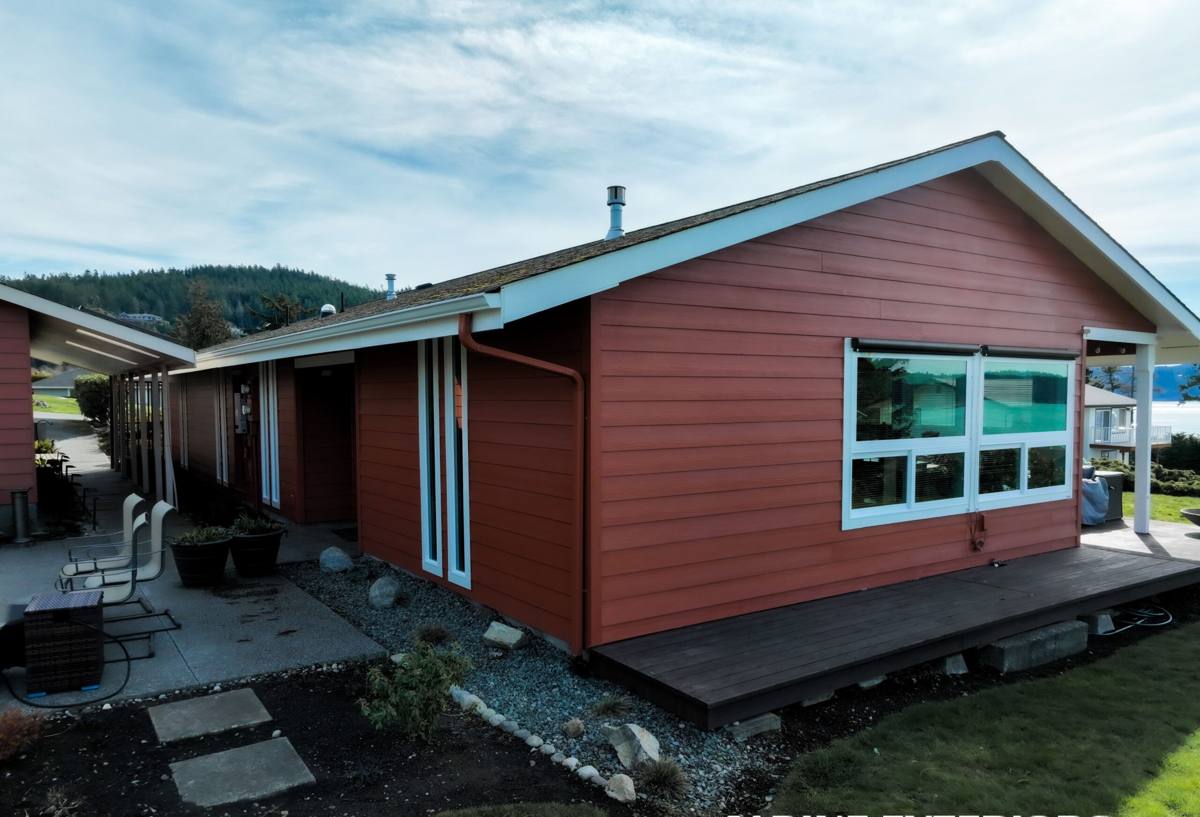
What Bellingham Homes Actually Need From Their Siding
Moisture Tolerance, Not Just Moisture Resistance
Every siding product claims to handle rain. The real question for this climate is what happens when moisture gets past the surface — through a nail hole, a hairline gap at a butt joint, a compromised caulk line. Wood-based products swell, delaminate, or rot from the inside once water gets behind them. Fiber cement doesn't behave that way. It's a cement-and-cellulose composite that doesn't absorb and swell the way wood or wood-fiber products do, and it doesn't feed rot the way organic materials can.
A Finish That Doesn't Depend on the Homeowner Repainting on Schedule
Salt air and UV both break down field-applied paint faster than most people plan for. A factory-baked finish holds its color and its bond to the substrate far longer than paint applied on-site in variable weather, which matters in a market where a lot of homeowners don't want to be back on a ladder repainting every five to seven years.
A Surface Moss Can't Get a Foothold On
Moss needs a rough, porous, consistently damp surface to establish. Smooth, factory-finished fiber cement gives it far less to grab onto than bare wood, some vinyl profiles with deep woodgrain texture, or unpainted/primed wood siding waiting on a paint job. That doesn't make a home moss-proof — nothing mounted on a house in this climate is — but it changes how fast moss establishes and how easily it comes off during routine cleaning.
Why We Install James Hardie and Nothing Else
We install James Hardie fiber cement siding exclusively. Not vinyl, not LP SmartSide, not Cemplank or Allura, not primed spruce or cedar. That's a deliberate standard, not a lack of options.
Vinyl is inexpensive and low-maintenance in the sense that it doesn't need painting, but it's a thin plastic product that becomes brittle in cold snaps, can warp near heat sources, and simply isn't rated to stop wind-driven rain the way a properly installed rainscreen assembly with fiber cement panels is. Wood-based engineered siding like LP SmartSide performs reasonably in drier climates, but its long-term track record in consistently wet, moss-prone environments like ours is the trade-off we're not willing to install behind: it's still an engineered wood product, and engineered wood and sustained moisture exposure are not a combination we want to put our name on. Cedar and primed spruce are honest, attractive materials, but they demand a maintenance commitment — sealing, painting, monitoring for rot — that most homeowners underestimate until they're five years in and behind on it.
James Hardie's HardieZone HZ10 product line is specifically engineered for climates like the Pacific Northwest — freeze-thaw cycling combined with sustained moisture exposure. It's non-combustible, holds its factory ColorPlus finish for decades rather than years, and comes with a strong transferable warranty when installed to Hardie's specification. That last part matters as much as the product itself.
What a Correct Installation Involves
Fiber cement siding is only as good as the assembly behind it. A huge share of the siding failures we get called out to inspect in Whatcom County aren't product failures — they're installation shortcuts that let moisture in behind a perfectly good material.
| Installation Element | Why It Matters in Bellingham |
|---|---|
| Rainscreen / drainage gap | Lets bulk water and vapor escape instead of sitting against the wall assembly during our extended wet season |
| Correct flashing at windows, doors, and penetrations | These are the points where driving rain off the Sound actually finds a way in |
| Proper fastener placement and type | Wrong fasteners or over-driven nails crack the board or create moisture entry points that show up years later |
| Manufacturer-spec clearances from grade, decks, and roofing | Insufficient clearance keeps siding damp longer and invites the moss and mildew this climate already favors |
| Caulking only where Hardie specifies it | Over-caulking traps moisture; under-caulking at true joints lets it in — both void warranty coverage |
Any one of these done wrong can undermine an otherwise correct product choice. This is why we treat installation as seriously as the material itself.
Our Process for a Bellingham Fiber Cement Job
1. On-Site Assessment
We look at the existing siding, sheathing condition, and specific exposure of each elevation — a north wall under fir trees and a south wall with full sun see very different conditions, and the assembly should account for that.
2. Moisture and Substrate Check
Before anything goes up, we confirm what's underneath is sound. Installing new siding over a compromised or already-wet substrate just hides a problem instead of solving it.
3. Product and Color Selection
We walk homeowners through Hardie's HZ10 panel and lap siding options and ColorPlus finishes, factoring in how a color and texture will actually read under Bellingham's gray-sky light for most of the year.
4. Installation to Manufacturer Spec
Rainscreen, flashing, fastening, and clearances installed to Hardie's published requirements — the same requirements that keep the warranty intact.
5. Final Walkthrough
We review the completed work with the homeowner, including basic care guidance specific to our climate — what to watch for during the wet months and how to keep moss from establishing.
Common Problems We See on Existing Bellingham Siding
- Moss and algae buildup on shaded, north-facing walls and under roof overhangs with poor airflow
- Caulk failure at trim and window edges after repeated freeze-thaw cycling
- Siding installed too close to grade, decks, or roof lines, keeping boards damp far longer than spec allows
- Swollen or delaminating wood-based siding where water got behind the surface
- Faded or chalking field-painted finishes that never got recoated on schedule
What Fiber Cement Siding Costs in Whatcom County
Pricing depends on the scope of the job, not just square footage. A few honest factors that move the number:
| Factor | Effect on Cost |
|---|---|
| Full tear-off vs. install over sound sheathing | Removing rotted siding or sheathing adds labor and material |
| Home elevation complexity | Multi-story walls, dormers, and cut-outs increase labor time |
| Panel vs. lap siding selection | Different Hardie profiles carry different material costs |
| Trim and flashing scope | Full trim replacement adds cost but is often necessary for a correct moisture-managed assembly |
| Access and site conditions | Steep lots, limited driveway access, or tree cover near the house can add setup time |
We give homeowners a real number after we've actually looked at the house — broad estimates without an on-site walk-through aren't worth much in a climate where the substrate condition varies so much house to house.
Living With Fiber Cement Siding Here
James Hardie siding installed correctly is genuinely low-maintenance for this climate, but "low-maintenance" doesn't mean zero attention. A short seasonal routine keeps it performing the way it's designed to:
- Rinse siding with a garden hose once or twice a year to clear pollen, salt residue, and early moss growth before it establishes
- Keep gutters clear so overflow doesn't run down the wall face during heavy fall and winter rain
- Trim back vegetation and tree limbs that shade walls and keep them damp longer than necessary
- Inspect caulking at trim and penetrations every couple of years and have it addressed before it fails, not after
- Avoid pressure-washing at close range or high pressure — it can force water behind panels and damage the finish
Why Hiring a Crew That Already Works Bellingham Matters
Siding installation isn't uniform across Washington. A crew that mostly works drier inland climates may not build in the drainage margin or flashing detail that Whatcom County's rain load actually calls for. Working in and around Bellingham regularly means we've already seen how specific exposures — waterfront lots, shaded lots under mature trees, older homes with marginal ventilation — behave over time, and we build the installation around that experience rather than a generic spec sheet.
If you're weighing a siding replacement or dealing with an existing product that's struggling to keep up with our wet season, we're happy to take a look and walk you through what a correctly installed James Hardie system would involve on your specific home. Use the form below to request a free, no-pressure estimate.