 Whatcom County
 Why Ferndale Homes Need Siding Built for This Climate
Ferndale sits close enough to the coast that salt air is part of daily life, and it sits squarely in the wet belt that defines Whatcom County winters. That combination is harder on exterior siding than most homeowners realize. Salt-laden air accelerates corrosion on fasteners and trim, driving rain off the Strait pushes moisture sideways into seams and laps that face west and south, and the long gray stretch from October through April keeps north-facing walls and shaded eaves damp for weeks at a time. Add in the moss and algae that thrive in that dampness, and you have a climate that actively works against any siding product that isn't engineered to shed water and resist organic growth.
This is exactly why we install James Hardie fiber cement siding and nothing else. It's not a marketing position — it's a professional standard we settled on after years of watching what actually holds up in Whatcom County conditions versus what looks good on a spec sheet.
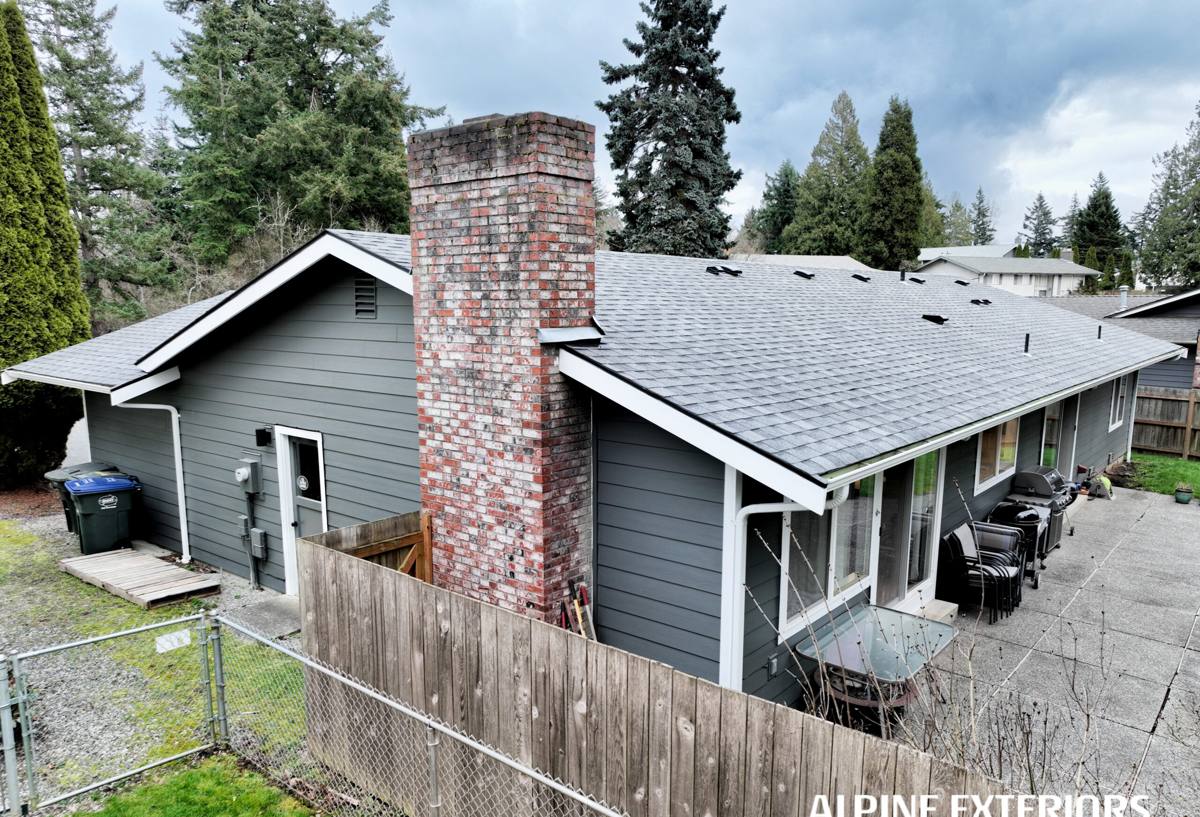
What Salt Air, Driving Rain, and Moss Season Actually Do to Siding
Salt Air and Corrosion
Homes within several miles of the water deal with airborne salt that settles on every exterior surface. Over time it accelerates rust on exposed fasteners, corrodes cheap flashing, and breaks down finishes that weren't formulated to handle it. Siding materials that rely on paint film alone for protection tend to chalk and fade faster in this environment, which means more frequent repainting just to keep moisture out.
Driving Rain
Ferndale gets weather systems that come in with real wind behind them, which means rain doesn't just fall straight down — it drives sideways into wall assemblies. Siding that depends on a tight, unbroken paint or coating layer to stay waterproof is vulnerable here, because any crack, nail pop, or unsealed joint becomes an entry point. Water that gets behind siding and can't dry out is the single biggest cause of rot, mold, and structural damage in this region.
The Long Moss Season
Whatcom County's damp, low-light winters create ideal conditions for moss and algae to establish on north- and shade-facing walls, in butt joints, and anywhere siding stays wet longer than it can dry. Organic growth isn't just cosmetic — moss holds moisture against the siding surface, which speeds up decay in wood-based products and stains finishes that aren't formulated to resist it.
Why James Hardie Is the Right Fit for Ferndale
James Hardie fiber cement is manufactured from cement, sand, and cellulose fibers, which makes it dimensionally stable and resistant to moisture-driven swelling, warping, and rot in ways that wood-based and wood-adjacent products can't match. For a Ferndale home, that matters on three fronts:
- Moisture stability: Fiber cement doesn't absorb and release water the way wood fiber products do, so it holds its shape and paint bond through repeated wet-dry cycles.
- Factory-cured ColorPlus finish: Hardie's ColorPlus finish is baked on and cured at the factory under controlled conditions, giving it better fade and chip resistance than field-applied paint — which matters when salt air is working against every finish on your house.
- Non-combustible core: Fiber cement doesn't contribute fuel to a fire, which is a real consideration as wildfire smoke and dry-season risk have become more common even in typically wet Western Washington.
Hardie also builds regional engineering into its product lines. The HZ5 formulation is designed for harsher freeze-thaw and moisture regions, and choosing the right HZ line for a specific site — factoring in sun exposure, wind exposure, and proximity to water — is part of doing the job correctly rather than just ordering whatever's in stock.
What a Correct Ferndale Installation Actually Involves
Fiber cement siding is only as good as the installation behind it. A large share of the siding failures we get called out to inspect aren't product failures at all — they're installation shortcuts that let water in behind a perfectly good material. For a Ferndale home, correct installation means:
Water Management First
Before a single piece of siding goes up, the wall needs a proper weather-resistive barrier, correctly lapped and taped, with flashing integrated at every window, door, and penetration so water is directed out and down — never trapped. Given how much driving rain this area sees, this step is not optional and it's not something you can verify after the siding is already on.
Correct Fastening and Clearances
Hardie has specific fastening patterns, nail types, and minimum clearances from grade, roof lines, and other transitions. Fasteners that aren't rated for coastal exposure will corrode faster in Ferndale's salt air, and that corrosion can eventually stain the siding face and compromise the fastener's hold.
Joint and Seam Treatment
Butt joints and panel seams are where driving rain finds its way in if they're not treated correctly — proper caulking with a compatible, paintable sealant, or engineered joint systems that shed water by design rather than relying on caulk alone.
Ventilation Behind the Cladding
A rainscreen or properly vented cavity behind the siding gives any moisture that does get past the cladding a way to dry out instead of sitting against the wall assembly — which is exactly the setup that resists the region's long wet season and reduces the conditions moss needs to take hold.
How Our Process Works
- On-site assessment: We look at your home's specific exposure — how much direct salt air, wind-driven rain, and shade it gets — and identify problem areas like north-facing walls or spots with existing moss and moisture staining.
- Product and line selection: We recommend the Hardie plank profile, texture, and HZ engineering that fits your site conditions and the look you want, along with a ColorPlus color or field-paint option.
- Tear-off and inspection: Old siding comes off and we inspect the sheathing underneath for rot or hidden moisture damage before anything new goes on — this is often where past problems get discovered and fixed.
- Water barrier and flashing: A correctly lapped weather-resistive barrier and integrated flashing go in at every opening and penetration.
- Installation to Hardie spec: Panels or lap siding are installed with the correct fasteners, clearances, and joint treatment for this climate.
- Final walkthrough: We review the completed job with you, including care and maintenance basics specific to your site's exposure.
Why a Crew That Already Works Ferndale Matters
Whatcom County isn't uniform — a home a few blocks from the water faces different salt exposure than one further inland, and a shaded lot with mature trees will hold moisture and grow moss differently than an open, sun-exposed one. A crew that already works this specific area knows which details to prioritize on which type of site, has already seen how local moisture and moss patterns show up on real homes, and understands the permitting and inspection expectations in Whatcom County. That local pattern-recognition is hard to replicate with a crew that's just passing through on a regional route.
Cost Factors for a Ferndale Hardie Project
Every home is different, but these are the main factors that drive cost on a fiber cement siding project in this area:
| Factor | Why It Matters Here |
|---|---|
| Home size and wall complexity | More corners, gables, and transitions mean more cutting, flashing, and labor time |
| Existing wall condition | Rot or moisture damage found during tear-off adds sheathing repair before new siding can go on |
| Siding profile and texture | Lap, panel, and shingle-style profiles carry different material and labor costs |
| HZ product line | Coastal and high-exposure sites may call for a higher-spec HZ formulation |
| Finish choice | Factory ColorPlus finish costs more upfront than field paint but holds up longer against salt air and UV |
| Access and site conditions | Tight lots, tall walls, or landscaping obstacles affect labor and equipment needs |
We provide a detailed, itemized quote after seeing your home in person — broad national averages don't account for your specific exposure, wall condition, or design.
Signs Your Current Siding Is Losing the Fight
- Persistent moss or algae staining that returns quickly after cleaning
- Soft spots, bubbling paint, or visible warping, especially on north-facing or shaded walls
- Rust streaks running down from fasteners or trim
- Gaps opening up at butt joints or corner boards
- Paint that's chalking, peeling, or fading faster than expected
- A musty smell near exterior walls, which can point to trapped moisture behind the siding
Any one of these on its own might be minor. Several showing up together, especially on the sides of your home that take the most weather, is usually a sign the siding assembly is no longer managing moisture the way it should.
Maintaining Hardie Siding in a Wet, Salty Climate
Fiber cement is low-maintenance, not zero-maintenance. In Ferndale's conditions, a simple annual routine goes a long way: rinse off salt residue and organic buildup with a garden hose or gentle wash, keep gutters clear so water isn't sheeting down the wall face, trim back vegetation that's shading walls and keeping them damp, and do a quick visual check of caulked joints and fastener heads for any early corrosion or gaps. Catching a small issue during a spring walk-around is far cheaper than repairing water damage that's had all winter to spread.
If your Ferndale home is due for new siding or you're seeing early signs of moisture or moss trouble, we're happy to take a look and give you a straightforward, no-pressure estimate — no obligation, just an honest read on what your home actually needs.