 Whatcom County
 Why Cordata Decks Take a Beating
Cordata sits in north Bellingham, close enough to Bellingham Bay that salt-laden air reaches the neighborhood's decks year-round, and far enough into the Pacific Northwest's wet belt that driving rain and a long moss season are just part of owning a home here. None of that is unusual for Whatcom County, but it does mean a deck built the same way you'd build one in a dry inland climate is going to fail faster than it should.
The combination is what wears decks down: salt air accelerates corrosion on fasteners and hardware, sustained rain keeps wood at a higher moisture content for more of the year than most manufacturers' warranties assume, and shaded, damp spots grow moss that holds water against the wood long after the rain has stopped. Individually, each of these is manageable. Together, over several Whatcom County winters, they're the reason we see ledger boards rotted out, joists soft to the touch, and railings that wiggle when a deck otherwise looks fine from a few feet away.
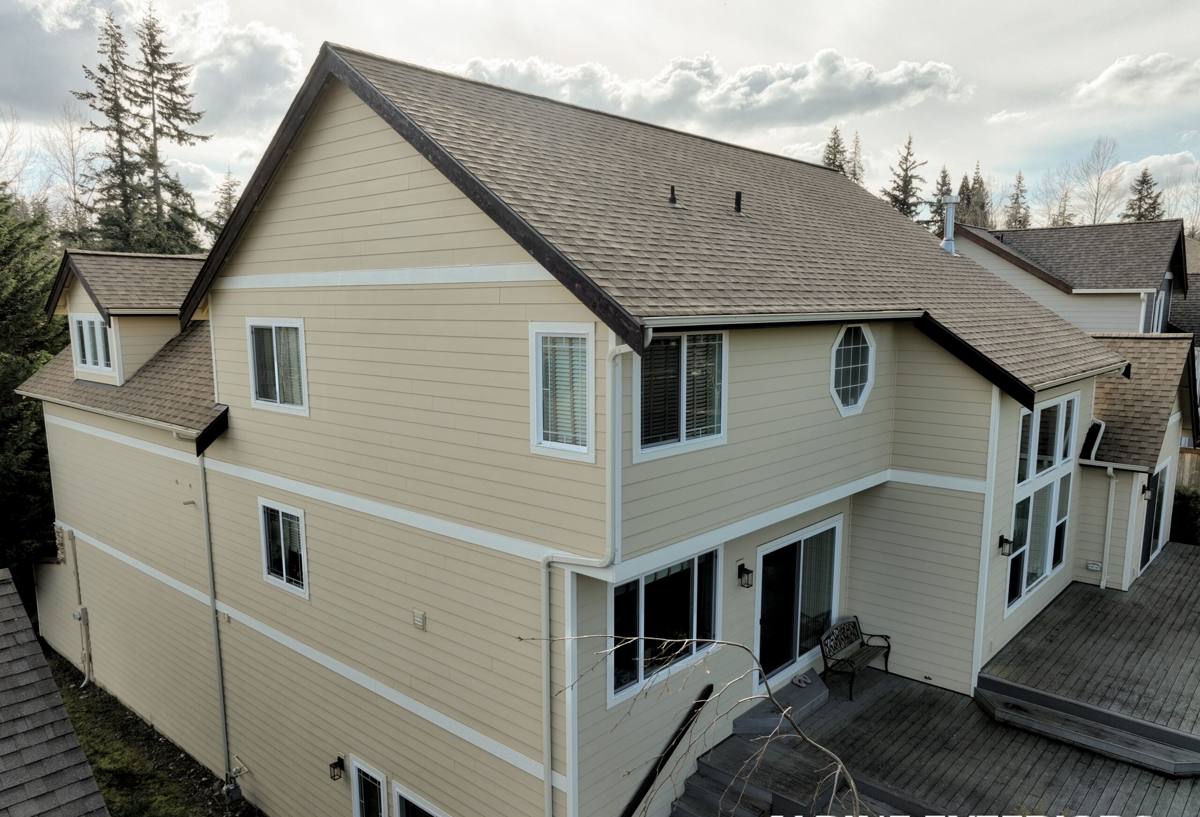
Signs Your Deck Needs Attention
Most deck problems in this area start small and stay hidden until someone steps on a soft board or leans on a railing that shouldn't move. Walk your deck and check for these:
- Boards that feel spongy, bouncy, or noticeably softer than the boards around them
- Fasteners that have popped up, are rust-streaked, or leave dark stains running down the wood
- A visible gap opening where the deck meets the house at the ledger board
- Railings or posts that flex, wobble, or feel loose when you push on them
- Moss or a slick green film that stays damp for days after rain has stopped
- Sagging between joists that you can see by sighting down the underside of the deck
- Dark streaking on the fascia board or the siding just above the deck
Any one of these is worth a look. Several at once usually means the underlying framing has been absorbing water longer than the surface suggests.
What a Correct Deck Repair Actually Involves
A repair that only replaces the boards you can see often leaves the actual problem in place. Here's what we check, and why each part matters in this climate.
Ledger Board and Flashing
The ledger board — where the deck attaches to the house — is the single most common failure point we find on attached decks in Whatcom County. If the flashing behind it was missed, undersized, or has failed over time, rain runs down the siding, behind the ledger, and straight into the rim joist and floor framing inside the wall. This damage is often invisible from outside until the ledger itself is soft.
Framing: Joists, Beams, and Posts
We probe joists, beams, and post bases with an awl or moisture meter rather than relying on how solid the deck feels underfoot. Rot in framing lumber usually starts from the inside or underneath, where moisture collects and the wood never fully dries between rains — which, in this climate, can be most of the year.
Decking Surface
Cupped, splitting, or badly weathered decking boards are usually the most visible damage but not always the most serious. We look at whether the surface problem is cosmetic or a symptom of poor drainage and airflow underneath.
Railings and Guards
Loose railings are a safety issue, not just a cosmetic one. We check post connections, baluster spacing, and overall guard height against current code, since older decks in the area were often built to standards that have since changed.
Repair vs. Rebuild: Making the Right Call
Not every deck problem calls for a full rebuild, and not every deck can be saved with a spot repair. The honest answer depends on how far the damage has spread and whether the structure underneath is still sound.
| What We Find | Repair Is Usually Enough | Rebuild Is the Better Call |
|---|---|---|
| A few soft or split decking boards | Yes — replace boards, check fasteners | No, unless framing beneath is also affected |
| Ledger rot limited to the surface | Yes — reflash and reattach | If rot extends into the rim joist |
| Loose railings, solid posts | Yes — re-secure and reinforce | If posts themselves are rotted at the base |
| Rot at multiple post bases near grade | Rarely | Yes — footings and posts are structural |
| Widespread cupping across most boards | Sometimes, if frame is sound | Often, if it signals long-term moisture exposure |
| Undersized or heaving footings | No | Yes — this is a foundation issue, not a surface one |
We'll tell you plainly which category your deck falls into, and why — including when a repair is genuinely the right, more affordable answer.
Materials That Hold Up in Whatcom County's Climate
Fasteners
Standard electro-galvanized screws and nails corrode faster this close to Bellingham Bay's salt air, which is exactly what causes the rust streaking many homeowners notice first. We use stainless steel or heavy-duty coated fasteners rated for treated lumber and coastal exposure, even though they cost more up front, because refastening the same deck in five years costs more than doing it right once.
Framing Lumber
Ground-contact-rated pressure-treated lumber belongs anywhere framing sits near soil or holds consistent moisture, not just where it happens to touch dirt. Using above-ground-rated lumber in a ground-contact situation is a common shortcut that shows up as rot years later.
Decking Surface Choices
Wood decking is more affordable and repairable board-by-board, but it needs regular cleaning and refinishing to shed water and resist moss in this climate. Composite decking costs more initially and handles moisture without swelling or splitting, but it's less forgiving of installation mistakes and, if damaged, is repaired by section rather than by a single board. Neither is the "right" answer for every home — it's a trade-off between upfront cost, maintenance tolerance, and how long you plan to stay in the house.
Our Deck Repair Process
- Inspection. We probe suspect boards and framing, check the ledger flashing, and look at post bases and footings — not just the surface.
- Written scope. You get a clear explanation of what's being repaired, what's being replaced, and why, before any work starts.
- Removal. Compromised decking, framing, or fasteners come out completely — patching over hidden rot isn't a repair.
- Rebuild. Affected sections are rebuilt with lumber and fasteners specified for this climate, not generic hardware store stock.
- Flashing and drainage correction. Where water intrusion caused the damage, we fix the flashing or drainage detail so the same failure doesn't repeat.
- Final walkthrough. We check the deck together before calling the job done.
Moss, Drainage, and Ongoing Maintenance
Moss isn't just unsightly — it holds moisture against the wood surface long after a normal rain would have dried off, which is a big part of why Whatcom County's moss season is so hard on decks. Board spacing that's too tight, poor airflow underneath the deck, and shaded, north-facing exposures all make it worse. Part of a correct repair often includes restoring proper gaps between boards and checking that the space underneath the deck isn't trapping moisture against the framing.
Between repairs, a few habits go a long way: sweep debris out of the gaps between boards regularly, keep gutters and downspouts from dumping water directly onto or under the deck, and clean off moss and algae before it has a chance to establish. If you have a wood deck, plan on cleaning and resealing on a schedule rather than waiting until the finish visibly fails.
Permits and Code Considerations
Structural deck work — replacing framing, reattaching a ledger board, or altering footings — often requires a permit through the applicable Whatcom County or City of Bellingham building department, depending on where the property falls. Cosmetic work like swapping worn decking boards on an otherwise sound frame typically doesn't. Guardrail height and baluster spacing also have specific code requirements that older decks in the area sometimes predate. We'll tell you upfront whether your repair is likely to need a permit so there are no surprises mid-project.
Why a Crew That Already Works Cordata Matters
A contractor who works this neighborhood regularly already knows the age and construction patterns common to Cordata homes, has a working relationship with local suppliers who stock the right fasteners and treated lumber, and understands how quickly Whatcom County's rain and moss season can turn a small repair into a bigger one if it sits too long. That familiarity means fewer surprises during the inspection and a repair built for the conditions your deck actually faces, not a generic fix that happens to be installed here.
If your deck has soft spots, loose railings, or just doesn't feel as solid as it used to, we're happy to take a look. Fill out the form below for a free, no-pressure estimate — we'll tell you honestly what needs fixing and what doesn't.