 Whatcom County
 Why Decking in South Hill Has to Work Harder
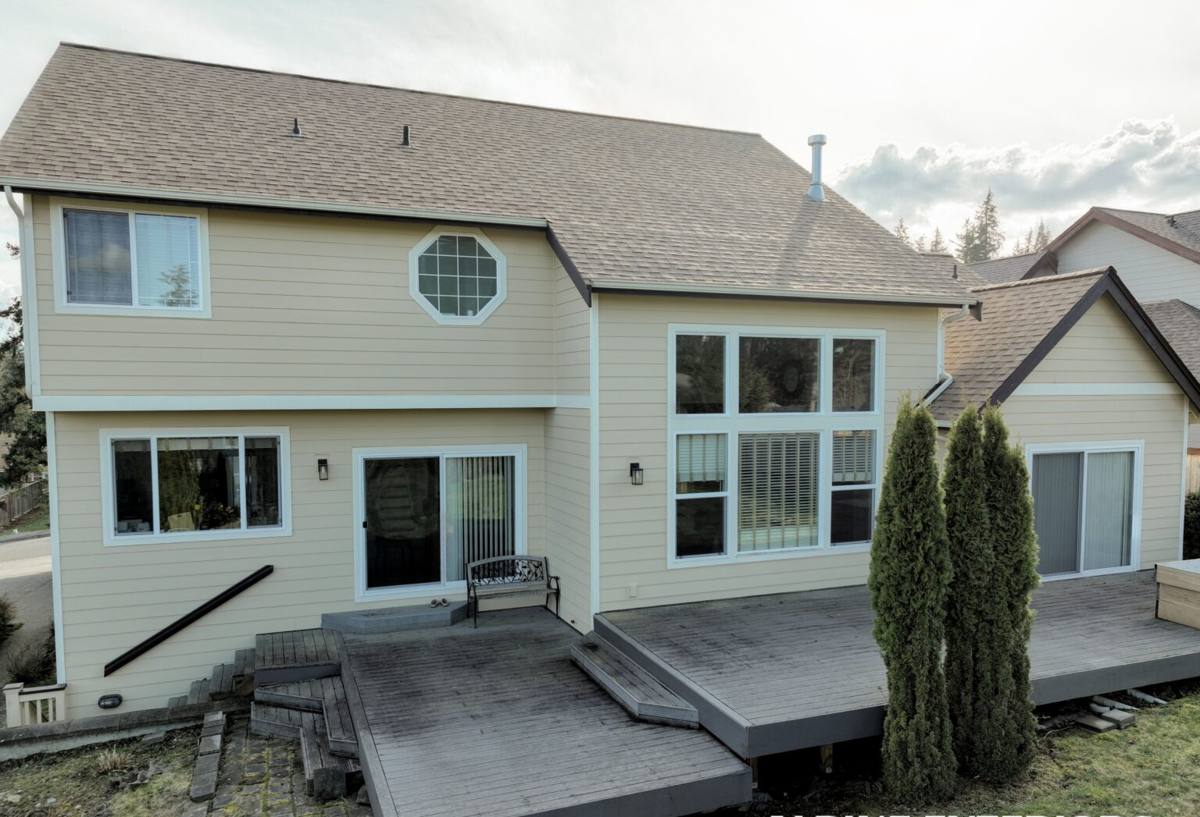
A deck in South Hill isn't just an outdoor living space — it's an exterior surface that sits low, stays wet longer than a wall or roof, and takes the brunt of whatever the weather does over a season. Whatcom County's mix of salt-tinged marine air, long stretches of driving rain, and a moss season that can run for months means a deck here needs to be built and finished differently than one going in somewhere dry and inland. We've seen what happens when a deck is installed using specs written for a different climate: cupped boards, corroded fasteners, slick green growth in the shoulder seasons, and substructure rot hiding under boards that still look fine on top.
Composite decking, done right, is one of the more sensible answers to that problem — but "composite decking" covers a wide range of products and installation quality, and not all of it holds up the same way out here. This page is about what actually matters when you're putting composite decking on a South Hill home: the climate factors, the build details, our process, and what to look for in a contractor before you sign anything.
What South Hill's Climate Actually Does to a Deck
Salt Air and Coastal Moisture
Even homes that aren't right on the water pick up salt-laden air moving in off the Sound and the Strait. Over years, that salt content accelerates corrosion on exposed metal — screw heads, joist hangers, railing brackets — and it can leave a dull film on lower-grade composite surfaces if they're not properly capped or sealed. It's a slow process, which is exactly why it's easy to underbuild for it: the deck looks fine for the first couple of years, and the damage shows up later, once it's expensive to fix.
Driving Rain and Wind-Driven Wet
Whatcom County doesn't just get rain, it gets rain that comes in sideways for days at a time. That matters for decking because water finds its way under railings, around post bases, and into any gap where flashing or drainage wasn't detailed correctly. A deck built for a drier climate might rely on gravity alone to shed water; a deck built for here needs actual drainage planning underneath the boards, not just on top of them.
Moss Season
Composite decking doesn't rot the way wood does, but it isn't immune to surface growth. Cool, damp, low-light stretches — which around here can stretch from fall through spring — are prime conditions for moss and algae to take hold on any decking surface that stays shaded and doesn't dry out between rain events. Board texture, gap spacing, and how much airflow the substructure allows all affect how much of a problem this becomes.
What a Correctly Built Composite Deck Includes
Substructure and Drainage
The framing underneath a composite deck matters as much as the boards on top, arguably more. Joists need to be spaced and sized for the specific composite product being used — composite has different span ratings than wood decking, and using wood-decking spacing under composite boards is a common shortcut that leads to bounce and premature sagging. In a wet climate, we also pay close attention to keeping the substructure ventilated and sloped so water moves through and off, rather than pooling against joists or ledger boards.
Fasteners and Flashing
Every fastener and connector on an exterior deck in this climate should be rated for the corrosion exposure it's actually going to see — that includes hidden-fastener clip systems, structural screws, joist hangers, and post hardware. Ledger board flashing where the deck meets the house is one of the most common failure points we run into on older decks, composite or wood, because water intrusion there can damage the house structure itself, not just the deck.
Board Selection: Capped vs Uncapped
Composite decking generally comes in capped and uncapped versions. Capped composite has a protective outer shell bonded to the board, which resists moisture absorption, staining, and fading better over time. Uncapped composite is typically less expensive up front but absorbs more moisture at the surface, which in a climate like this one can mean more visible growth and a rougher texture developing sooner. We install capped composite as our standard for this region — not because uncapped product is defective, but because the moisture exposure here makes the extra protection worth the cost difference for most homeowners.
Composite vs Wood vs PVC for This Climate
Every decking material is a trade-off between upfront cost, maintenance, and how it performs in wet, mossy conditions. Here's how the three most common options stack up for a South Hill install:
| Material | Upfront Cost | Maintenance in This Climate | Typical Lifespan |
|---|---|---|---|
| Pressure-treated wood | Lowest | Annual cleaning, periodic staining/sealing to fight moss and moisture damage | 10–15 years before major repairs |
| Capped composite | Mid to upper-mid | Occasional wash-down; no staining or sealing required | 25–30+ years, manufacturer-warrantied |
| Cellular PVC | Highest | Very low; fully moisture-resistant core | 25–30+ years, manufacturer-warrantied |
Wood is a reasonable choice for homeowners who don't mind the upkeep and want the lowest entry price, but in a climate that stays wet as long as this one does, that upkeep isn't optional — skip a season of sealing and moss gets a foothold fast. Composite closes most of that maintenance gap while staying more affordable than full PVC systems, which is why it's the option we recommend most often for South Hill decks.
Our Process for South Hill Deck Projects
- On-site assessment. We look at drainage, sun/shade exposure, existing structure (if it's a replacement), and how the deck ties into the house.
- Material and layout discussion. We walk through board options, color, railing systems, and layout based on how you actually use the space — not just what fits.
- Permitting and structural check. Deck work in Whatcom County often requires permitting depending on size, height, and attachment to the home; we handle that step rather than leaving it to you to figure out.
- Substructure build. Framing, ledger flashing, and drainage detailing go in first — this is the part that determines how the deck ages, even though it's invisible once the boards go down.
- Composite board and railing installation. Hidden fasteners where the product allows for a clean surface, proper board gapping for expansion and drainage.
- Final walkthrough. We go over care basics with you before we consider the job done.
Cost Factors for a South Hill Composite Deck
There's no single price that applies to every project, but the main variables that move the number are consistent from job to job:
| Factor | Why It Affects Cost |
|---|---|
| Deck size and shape | Square footage plus complexity — angles, multiple levels, and curves cost more than a simple rectangle |
| Height and structure | A second-story or elevated deck needs more substantial framing and railing than a ground-level one |
| Board tier | Entry-level capped composite vs. premium composite lines vary meaningfully in material cost |
| Railing system | Composite or metal railing systems cost more than basic options but hold up better long-term |
| Site access and existing structure | Tear-off of an old deck, difficult site access, or unexpected ledger/framing repair adds labor |
As a broad range, homeowners in this region typically see composite deck projects fall somewhere in the mid-tens-of-thousands for an average-size deck, with smaller projects lower and larger or elevated decks higher. We give exact numbers after seeing the site and hearing what you want — broad averages don't account for your specific layout or access.
Maintenance in a Marine, Moss-Prone Climate
Composite decking is lower-maintenance than wood, not maintenance-free. A few habits go a long way toward keeping a South Hill deck looking and performing the way it should:
- Sweep debris (leaves, needles, moss spores) off the surface regularly, especially in shaded areas that stay damp longer
- Rinse the deck with a hose or wash with mild soap and a soft brush a couple of times a year — avoid pressure washers on close settings, which can damage the capped surface
- Keep gutters and downspouts near the deck clear so runoff isn't dumping directly onto or under the decking
- Trim back overhanging vegetation that shades the deck and keeps it from drying out between rain events
- Check railing posts and fastener points once a year for any early corrosion or loosening
- Address any moss or algae as soon as it appears rather than letting it establish — it's far easier to remove early
Why a Crew That Already Works South Hill Matters
Building a deck that holds up to Whatcom County weather isn't a mystery, but it does take knowing what this specific climate does over years, not just what a manufacturer's install guide says for average conditions. A crew that regularly works in South Hill and the surrounding area already knows the local permitting process, has relationships with suppliers who stock the composite lines that perform well here, and has seen firsthand which fastener systems and flashing details actually hold up through a wet Whatcom County winter versus which ones look fine on installation day and fail three years later.
That local track record also means we're not guessing about scheduling around the weather — wet-season builds need different sequencing than a dry-season install, and knowing that ahead of time keeps a project moving instead of stalling out.
Get a Straightforward Estimate
If you're weighing composite decking for a South Hill home, we're happy to come take a look, talk through what your site and budget actually call for, and give you a clear estimate — no pressure, no upsell script. Use the form below to get started.