 Whatcom County
 Why Ferndale Homes Wear Out Siding Faster Than You'd Expect
Ferndale sits close enough to Bellingham Bay and the Salish Sea that salt-laden air is a real factor in how exterior materials age here, not just a coastal-town cliché. Add in Whatcom County's long wet season, where driving rain off the water pushes moisture sideways into wall assemblies rather than straight down, and you have a climate that is genuinely tougher on siding than most manufacturers' marketing photos suggest. Homes on the north and west-facing elevations, the ones catching the brunt of wind off the water, tend to show wear years before the south side of the same house.
Then there's moss. Whatcom County's mild, wet stretch from fall through spring gives moss, algae, and mildew months to establish themselves on anything that stays damp for long periods. On wood-based or wood-look siding, that's not just cosmetic. Moss holds moisture against the surface, and sustained moisture against a water-sensitive substrate is where rot and delamination start.
None of this means Ferndale homes need exotic materials. It means the material and the installation both have to be chosen with this specific combination of salt exposure, wind-driven rain, and moss pressure in mind — not a generic "siding replacement" mindset.
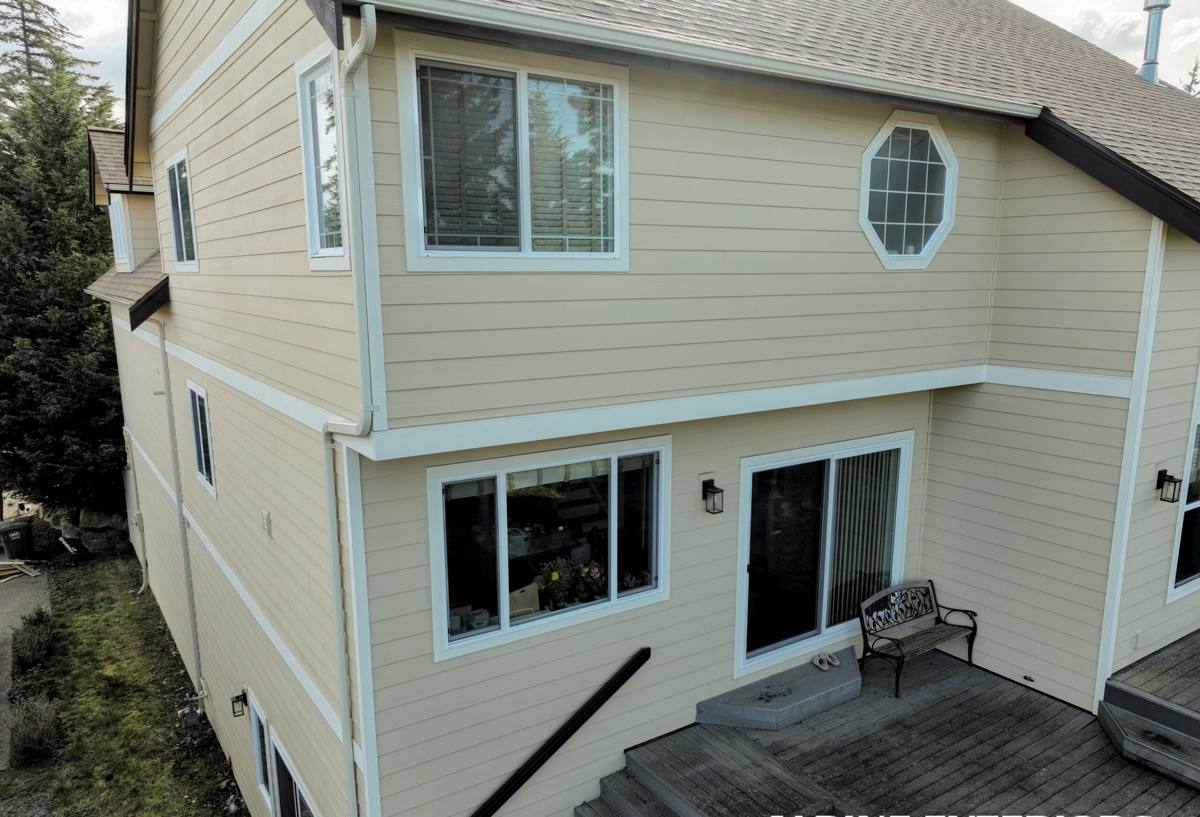
What Ferndale Siding Actually Needs to Handle
Salt Air
Salt air accelerates corrosion of exposed metal fasteners and trim, and it can degrade certain coatings and finishes faster than inland weathering would. Materials and fastening systems that aren't rated for coastal-adjacent exposure will show it first at seams, fastener heads, and cut edges.
Driving Rain
Wind off the water doesn't just wet the surface of a wall — it drives water up under laps and into any gap in the water-resistive barrier. Siding replacement here has to treat the drainage plane and flashing details as seriously as the visible siding itself, because a good-looking product installed over a compromised weather barrier will fail from behind.
Moss and Sustained Moisture
Long damp stretches mean siding needs to dry out between rain events, not stay saturated. Products that absorb and hold water are working against the climate instead of with it.
Why We Install Only James Hardie Fiber Cement
We made a deliberate decision to install James Hardie fiber cement siding exclusively, and we don't install vinyl, LP SmartSide, cedar, primed spruce, or other fiber cement brands like Cemplank or Allura. That's not a marketing position — it's a standard we hold because of what we've seen these products do over a full Pacific Northwest climate cycle.
Fiber cement itself is a well-proven category: it's non-combustible, dimensionally stable, and doesn't feed moss and mildew the way wood-based products can. Within that category, James Hardie is the manufacturer we trust for a few concrete reasons:
- HZ5 engineered product line — Hardie engineers regional product formulations for climate zones; the versions specified for the Pacific Northwest are built for sustained moisture exposure, not a one-size-fits-all mix.
- ColorPlus factory finish — a baked-on finish applied under controlled conditions, which holds up more consistently than field-applied paint, especially on a product that's going to see repeated wet-dry cycles.
- Non-combustible core — meaningful for wildfire-adjacent insurance considerations and just a sound material property.
- Track record — Hardie has decades of installed product in wet coastal climates similar to Whatcom County, which gives us confidence in how it performs long-term, not just in year one.
- Warranty structure — a strong, transferable warranty that matters to resale, since siding replacement is a decision most homeowners want to make once.
We're not going to tell you vinyl or LP SmartSide are junk — they're not, and they have their place. What we will say is that we've made a professional call to standardize on the product we believe performs best against salt air, wind-driven rain, and moss pressure over the long run, and we'd rather install fewer products well than a lot of products adequately.
What a Correct Siding Replacement Involves
Siding replacement isn't just removing old panels and nailing up new ones. Done right, in a climate like Ferndale's, it's a sequence where each layer protects the next:
- Tear-off and inspection — full removal of the old siding so the sheathing underneath can actually be inspected, not guessed at. This is where hidden rot or old moisture damage gets found.
- Sheathing repair — any soft or damaged sheathing gets replaced before anything new goes up. Covering damaged sheathing with new siding just hides a problem, it doesn't solve it.
- Weather-resistive barrier — a new drainage plane installed with proper lapping and sealing, which is the layer doing most of the real work against wind-driven rain.
- Flashing details — windows, doors, and any penetration through the wall get flashed correctly so water is directed out and down, not into the wall cavity.
- James Hardie installation to manufacturer spec — correct fastener spacing, clearances, and joint treatment. Hardie's warranty depends on installation matching their published specs, so this step is where a lot of lower-cost jobs quietly cut corners.
- Trim, caulking, and finish details — the details that determine whether the job looks clean and stays weathertight for the long haul.
Skipping the inspection and barrier steps to save time is the single most common way a siding replacement job fails early — and it's invisible until the new siding is already up.
Signs Ferndale Homeowners Should Watch For
- Persistent moss or dark streaking that returns within weeks of cleaning
- Soft spots when you press on siding, especially near the bottom courses or window trim
- Visible warping, buckling, or gaps opening up at seams
- Paint that's peeling or bubbling rather than just fading
- Musty smell or visible staining on interior walls that back up to exterior siding
- Fastener heads showing rust or corrosion staining running down the siding
Any one of these on its own might be minor. Several together, especially on the wind- and rain-exposed side of the house, usually means it's worth a real inspection rather than another round of patching.
Cost Factors for Siding Replacement
Every home is different, and we'll give you real numbers after walking your property, but the factors below are what actually move the price on a Ferndale siding replacement — useful to know before you're comparing quotes.
| Factor | Why It Matters |
|---|---|
| Sheathing condition | Hidden rot found at tear-off adds repair cost but prevents a much bigger problem later |
| Home size and complexity | More corners, dormers, and trim details mean more labor and material waste |
| Siding profile chosen | Lap width, shingle-style, and panel options within the Hardie line carry different material costs |
| Number of stories | Access equipment and labor time increase with height, especially on wind-exposed walls |
| Trim and window count | Every window, door, and penetration needs flashing labor, which adds up on detail-heavy homes |
| Existing siding type | Tear-off of certain materials (older stucco, multiple layers) takes longer than a straightforward one-layer removal |
Why Hiring a Crew That Already Works Ferndale Matters
A crew that regularly works Whatcom County knows which elevations on a Ferndale home tend to take the worst of the wind-driven rain, how much moss pressure to expect on shaded north walls, and how to sequence a job around the region's wet stretches instead of getting caught mid-project by a multi-day rain system. That's not something you can fully substitute with a generic installation manual. It shows up in small decisions — flashing details, scheduling, how tear-off is staged to keep a wall from sitting open overnight in wet weather — that add up to a job that holds up over years, not just one that looks good at handoff.
It also matters for warranty follow-through. A local crew with an established track record installing James Hardie to spec is the difference between a warranty that's backed by documented, correct installation and one that's vulnerable to a claim denial over an installation detail.
Our Process
We start with an on-site inspection and honest assessment of your current siding and sheathing condition. From there we walk you through James Hardie product and color options suited to your home, provide a clear written estimate, and schedule the work around Whatcom County's weather patterns to avoid leaving your home exposed mid-job. Every installation follows Hardie's published specifications so your warranty coverage is fully intact, not just technically in place.
If you're seeing early wear on your Ferndale home's siding, or you're planning ahead before it becomes a problem, we're happy to take a look and give you a straight answer about what your home actually needs. Reach out for a free, no-pressure estimate using the form below.