 Whatcom County
 In Sehome, the Installation Decides How Long Siding Actually Lasts
Sehome is one of Bellingham's older, established central neighborhoods, a mix of mid-century houses, earlier-era homes, and newer infill sitting on the rise of land around Sehome Hill. A lot of that housing stock has already had at least one round of exterior work done to it, and some of it is due again. The material a homeowner picks for a re-side matters, but what decides whether that siding is still doing its job in twenty years is almost always the installation itself: how the water-resistive barrier was lapped, where the fasteners landed, how much clearance was left at grade. Whatcom County's climate, salt air working inland off the Sound, driving rain that arrives sideways more often than straight down, and a moss season that can run most of the year on shaded ground, punishes a shortcut faster than a drier climate would.
This page is specifically about siding installation in Sehome, both full re-sides on existing homes and siding for new construction and additions, not spot repair. We install James Hardie fiber cement exclusively, and everything below assumes that system, since it's the only siding we install to spec on homes in this part of Bellingham.
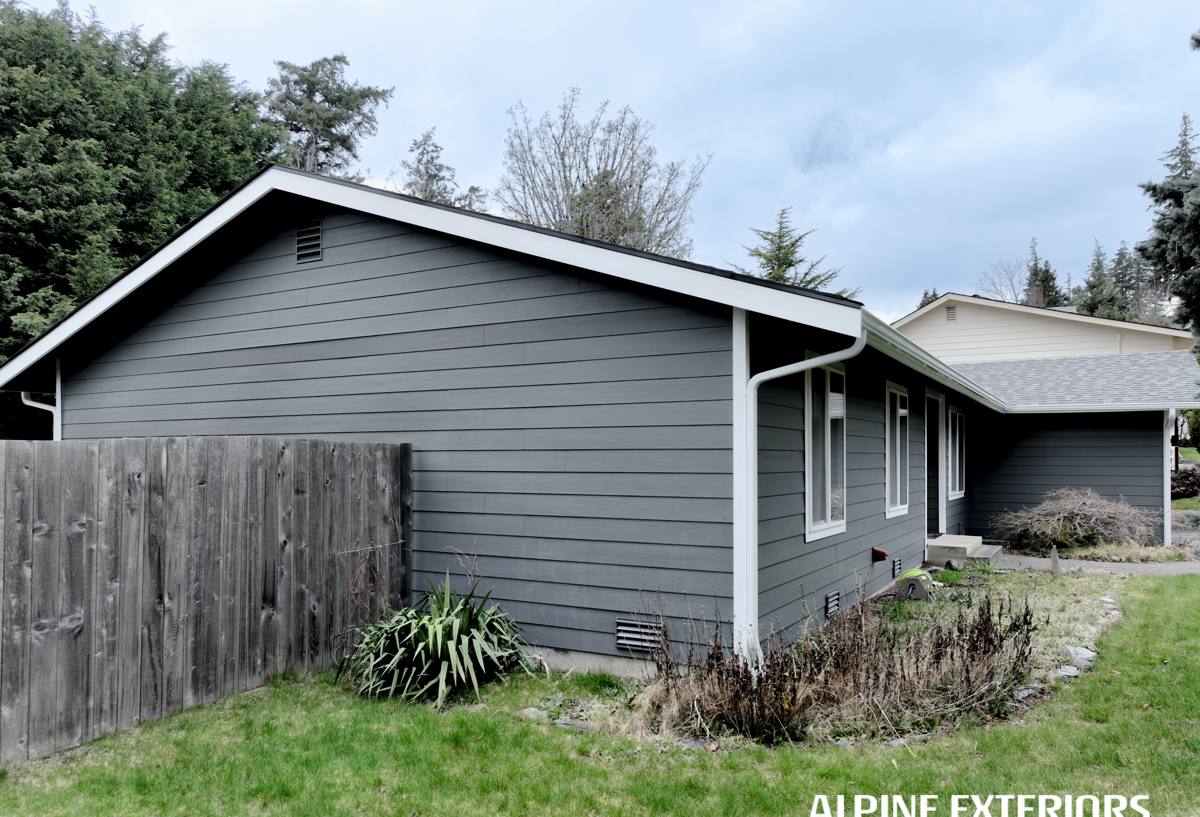
What Sehome's Climate and Terrain Ask of an Installation
Salt Air Doesn't Stop at the Waterfront
Sehome sits back from Bellingham's immediate shoreline, but it's still well within the reach of salt-laden air moving in off the Salish Sea. That air accelerates corrosion on fasteners, flashing, and any exposed metal trim, and it does it whether a house is a block from the water or a mile inland. An installation that uses standard-grade hardware because it's cheaper or more convenient is a decision that shows up a few years later as rust streaking at nail heads and loosened trim, not something you'd catch on install day.
Wind-Driven Rain and the Barrier Underneath
Rain in this region rarely falls straight down. Wind pushes it sideways into panel joints, window flashing, and the seams where trim meets field siding, which means the water-resistive barrier underneath the siding, and how carefully it's lapped and taped at every penetration, does more of the real work than the visible siding material. A barrier installed correctly sheds that wind-driven water before it reaches the sheathing. One that's rushed, or taped in the wrong order, gives water a path in that won't announce itself until there's already damage behind the wall.
Sloped Lots, Shade, and a Long Moss Season
Sehome's terrain rises toward Sehome Hill, so more lots here deal with slope than in flatter parts of Bellingham, and slope changes how water moves around a foundation and how much of it ends up sitting against lower siding courses. Add mature tree cover and the mild, moist conditions typical of this part of Washington, and you get a moss and mildew season that runs long on shaded, north-facing walls. Installation detail affects that directly: correct clearance at the bottom of the wall, a drainage plane that actually drains, and siding that isn't installed tight against trim all give a wall room to dry out between wet spells instead of staying damp continuously.
Why We Only Install James Hardie Fiber Cement
We install one siding system, and that's a professional standard shaped by what we've seen on tear-offs in exactly this climate, not a supplier arrangement.
- Non-combustible core: fiber cement doesn't feed a fire the way wood-based siding products can.
- Factory-applied ColorPlus finish: color is baked on under controlled conditions, not brushed on in the field, so it holds up longer against fading and moisture than site-applied paint.
- HZ5 formulation: Hardie's HZ5 product line is engineered for regions with sustained moisture exposure and freeze-thaw cycling, which describes Whatcom County's climate well and is what we specify on Sehome jobs.
- Dimensional stability: it doesn't swell, cup, or warp the way engineered wood can after repeated wet seasons.
- A strong transferable warranty: one of the stronger structures in the industry, provided the installation follows Hardie's published spec.
We don't install LP SmartSide, vinyl, Cemplank, Allura, primed spruce, or cedar. Those products have a place in the market and plenty of homeowners are happy with them, but we've made a professional call that in a climate with this much sustained moisture and salt exposure, standing fully behind one system beats offering a cheaper option that quietly shifts maintenance risk onto the homeowner years down the road.
What a Correct Installation Actually Involves
Tear-Off and an Honest Look Underneath
On a re-side, what's under the old siding matters as much as what goes on top of it. Given how much of Sehome's housing stock has been through at least one prior repair or remodel, we treat tear-off as an inspection step, not just demolition, checking sheathing condition, prior flashing details, and any signs of past moisture intrusion before anything new goes up. Problems found here get addressed before installation continues, not covered over.
Water-Resistive Barrier and Flashing
A continuous, properly lapped water-resistive barrier goes down first, taped and sealed at every seam, window, and door opening. Flashing at those same penetrations, and at any roof-to-wall transition, has to be visible and correctly lapped before the siding covers it up, since that's the layer doing the actual work of keeping wind-driven rain out of the wall assembly.
Fastening, Spacing, and Clearance
James Hardie publishes exact fastener type, spacing, and placement requirements that vary by product line and exposure, and following that spec, not a generalized version of it, is what keeps panels secured and keeps the manufacturer's warranty valid if something ever comes up. Clearance between the bottom of the siding and grade, decks, and roof surfaces gets documented, not eyeballed, especially on the sloped sections of a Sehome lot where drainage patterns aren't always obvious from the surface.
Field Cuts, Sealing, and Cleanup
Every field-cut edge gets sealed or primed before it's exposed to weather, since a raw cut edge is where moisture finds its way into the panel first. We keep the site protected and organized through the job and do a real cleanup at the end, not just a final invoice.
New Construction and Additions vs. Re-Siding an Established Home
Both jobs get the same attention to spec, but they start from different places. New construction or an addition means installing onto fresh sheathing and a new water-resistive barrier, with nothing hidden and no guesswork about what's behind the wall, so the work is mostly about sequencing and correct installation from the first course. Re-siding an established Sehome home, which describes most of the work we do in this neighborhood given its age, adds a discovery phase: tear-off, an honest assessment of the original construction and any prior repairs, and sometimes correcting outdated detailing, inadequate clearances, missing flashing, or a barrier that was never properly installed, before new siding can go up correctly.
Our Installation Process, Start to Finish
- Inspection and estimate: we walk the property, look at slope, shade, and existing siding condition, and give a written estimate specific to that house.
- Prep and tear-off: old siding comes off, sheathing and existing flashing get inspected, and any damage found gets scoped and addressed.
- Barrier and flashing: water-resistive barrier goes down first, flashing follows at every window, door, and penetration.
- Installation to spec: James Hardie panels go up following the manufacturer's fastening, spacing, and clearance requirements for HZ5 exposure.
- Final walkthrough: we go over the completed job with the homeowner and cover what basic maintenance looks like going forward.
Timeline and Cost Factors for a Sehome Installation
Every estimate is specific to the house, but these are the factors that consistently move both price and schedule on a Sehome installation:
| Factor | Why it matters |
|---|---|
| Square footage and number of stories | More wall area and height mean more labor and, on taller sections, more staging and access equipment |
| Trim and roofline complexity | Homes with more windows, dormers, and transitions require more flashing and detail cutting |
| Sheathing condition found at tear-off | Rot or moisture damage under old siding, more common on Sehome's older housing stock, adds repair scope before new panels go up |
| Lot slope and drainage | Sloped lots near Sehome Hill can require extra grading or drainage attention to hit correct clearance at the base of the wall |
| Product line and finish selection | James Hardie offers multiple panel styles, textures, and ColorPlus finishes at different price points |
Wet stretches also affect scheduling here more than in a drier region, since panel handling and clean field cuts both go better in dry conditions, so we build some flexibility into a project timeline rather than promising a fixed date a rainy week is likely to break.
A Checklist for a Correct Installation
Whether you're reviewing our work or getting a second opinion from another contractor, these are reasonable things to confirm before a siding installation is considered finished:
- Fasteners and hardware suited to salt-air exposure, not standard-grade material
- Documented clearance between the bottom of the siding and grade, decks, and roofing
- Flashing visible and properly lapped at every window, door, and penetration before siding covers it
- A continuous, properly taped water-resistive barrier underneath the siding
- All field-cut edges sealed or primed, not left raw
- Installation that follows James Hardie's published fastening and spacing spec for HZ5 exposure
- A final walkthrough where the crew explains what was done, not just an invoice
Why a Crew That Already Works in Sehome Matters
Installation quality on paper and installation quality on an actual wall aren't always the same thing, and the gap shows up fastest in a climate that punishes shortcuts. A crew that regularly installs siding across Bellingham's older neighborhoods, Sehome included, makes different calls on the job than one installing here occasionally between projects elsewhere: where extra flashing attention is worth the time on a hillside lot, which clearance details actually hold up through a full wet season, and which corners genuinely can't be cut regardless of schedule pressure. That judgment comes from repeated work in this specific place, not from a generic installation checklist applied the same way on every job everywhere.
If you're planning new siding for a Sehome home, or want a straightforward second opinion on whether an existing installation was done correctly, we're glad to take a look. Reach out using the form below for a free, no-pressure estimate.