 Whatcom County
 What South Hill's Weather Actually Does to a House
South Hill homes sit in a stretch of Whatcom County where three things work against siding year-round: salt-laden air drifting in off the water, long stretches of driving rain, and a moss season that can run from fall through spring. None of these are dramatic events — no single storm does the damage. It's the slow, repeated exposure that wears materials down over years, and it shows up differently depending on what the siding is made of.
Salt air is corrosive to exposed metal fasteners and trim, and it accelerates the breakdown of paint films on wood-based products. Driving rain doesn't just wet the surface of a wall — wind-driven rain pushes moisture sideways and upward, finding any gap in flashing, caulking, or lap coverage. And moss doesn't just grow on roofs; on north-facing and shaded wall sections, especially under eaves or behind landscaping, it holds moisture against the siding surface for weeks at a time, which is exactly the condition that causes rot, delamination, and paint failure in materials that aren't built to shed it.
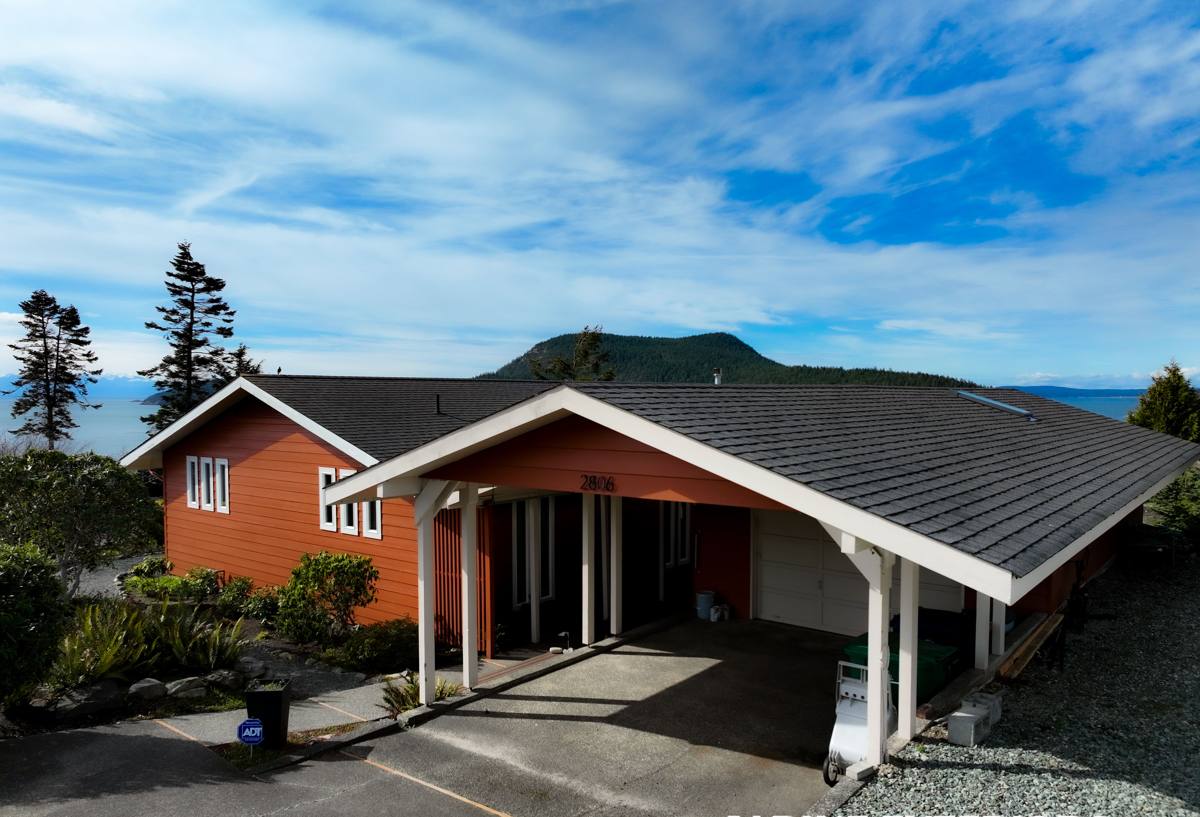
Why James Hardie Is the Right Material for This Environment
We install James Hardie fiber cement exclusively, and in an area like South Hill that's not a marketing preference — it's a practical one. Fiber cement is non-combustible and dimensionally stable, meaning it doesn't swell, cup, or crack the way wood-based siding can when it absorbs and releases moisture through repeated wet-dry cycles. That matters enormously in a climate where "dry" is relative and the material rarely gets a long stretch to fully cure out between rain events.
James Hardie also engineers its siding by climate zone. Homes in the northern Pacific Northwest generally call for the company's cold- and moisture-focused HZ10 product engineering, which is formulated with this kind of weather pattern in mind — as opposed to product formulated for hot, dry, or mixed-humid regions. We spec the version of the product that actually matches Whatcom County's conditions, not a one-size-fits-all board.
Where Other Materials Fall Short Here
We don't install vinyl, LP SmartSide, cedar, primed spruce, or other fiber cement brands, and South Hill's climate is a big part of why. Vinyl can warp and become brittle with age and temperature swings, and its seams are a long-term weak point against wind-driven rain. Wood-based products, even engineered ones, depend heavily on an intact factory coating to keep moisture out — once that coating is compromised at a cut edge, a fastener hole, or a scuff, moisture gets a foothold, and in a moss-heavy, high-rain environment that foothold doesn't dry out quickly. Cedar and primed wood need active, ongoing maintenance to keep ahead of the same moisture cycle. James Hardie's cement composition simply doesn't have the same vulnerability to sustained dampness, which is why it's the only product we put our name behind.
What a Correct James Hardie Installation Actually Involves
The siding material is only half the equation. James Hardie's own warranty coverage depends on installation that follows its published specifications, and in a high-moisture region like this, the installation details matter even more than usual. A correct job includes:
- Proper weather-resistive barrier and rain-screen detailing behind the siding, giving any moisture that does get past the surface a way to drain and dry out
- Correct flashing at every window, door, roofline, and horizontal trim transition — the single most common failure point we find on older installs
- Manufacturer-specified fastener type, spacing, and placement, not driven so tight they crack the board or so loose they work free over time
- Minimum clearance from grade, decks, and roof lines so the bottom edge of the siding isn't sitting in standing water or snow load
- Correct caulking at butt joints and penetrations, using products rated for the exposure — and knowing where caulk should not be used, since sealing the wrong joint traps moisture instead of shedding it
- Field-cut edges primed or sealed per spec so cut ends don't become the entry point for water absorption
Skipping or rushing any one of these doesn't usually cause a visible problem in year one. It shows up in year five or ten, as staining, soft spots, or paint failure at specific joints — which is exactly the kind of slow failure South Hill's climate is good at accelerating.
Our Process on South Hill Homes
1. On-Site Assessment
We start by walking the exterior and identifying the exposure profile of each wall — which sides take the worst of the driving rain, which sections stay shaded and damp longer, and where existing moss growth or paint failure is already telling us something about moisture behavior on that specific house.
2. Substrate and Moisture Check
Before any new siding goes up, we check what's underneath. If there's existing rot, compromised sheathing, or a failed weather barrier, that gets addressed first — installing new siding over a wet or damaged substrate just hides the problem instead of fixing it.
3. Install to Spec
We follow James Hardie's installation instructions for our climate zone precisely, from flashing sequence to fastener schedule, because that's what keeps the manufacturer's warranty intact and what actually keeps water out.
4. Final Walkthrough
We review the completed job against the original assessment, paying particular attention to the joints, trim transitions, and lower courses that see the most weather exposure.
ColorPlus Finish and Color Choices for This Climate
James Hardie's ColorPlus factory finish is baked on and cured under controlled conditions, which gives it better fade and moisture resistance than field-applied paint — a real advantage in an area where a job-site paint job would rarely get the ideal drying window it needs. It also means touch-up and caulk-matching is more consistent over time, since the color is manufactured, not mixed on-site.
For homes with heavier shade or moss exposure, lighter and mid-tone colors tend to show algae and moss staining less readily than very dark tones, though color choice is ultimately about the look you want for the house — it doesn't change the underlying moisture performance, which comes from the material and the installation, not the color.
What Drives Cost on a South Hill Project
| Factor | Why It Matters Here | Effect on Project |
|---|---|---|
| Existing substrate condition | Long-term moisture exposure can hide rot behind old siding | May add repair scope before installation begins |
| Wall exposure and complexity | Homes with more corners, dormers, and trim need more flashing detail | More labor time per square foot of siding |
| Product line and profile | Lap width, trim style, and panel vs. lap siding all price differently | Changes material cost per square |
| Access and site conditions | Landscaping, slope, and multi-story sections affect setup time | Can add labor and equipment cost |
| Removal and disposal | Tear-off of old siding, especially if damaged, adds a step | Adds to overall project timeline and cost |
We don't publish flat per-square-foot pricing because these factors genuinely change the number from house to house — but we'll walk your specific property and give you a real, itemized estimate, not a ballpark guess.
Why It Matters That We Already Work in South Hill
A crew that only occasionally works this part of Whatcom County has to relearn the local conditions on every job — which walls take the worst weather, how moss behaves on shaded elevations, how much clearance actually holds up over a wet winter. A crew that works this area regularly already knows those answers before the estimate walkthrough starts. That translates into fewer surprises mid-project and a finished install that's detailed for the way South Hill actually weathers a house, not a generic install pulled from a manual written for a drier region.
Ongoing Maintenance: What South Hill Homeowners Should Actually Do
Correctly installed James Hardie siding is low-maintenance, not no-maintenance. A short annual routine keeps it performing the way it's designed to:
- Rinse siding annually, focusing on shaded and north-facing walls where moss and algae collect fastest
- Keep gutters clear so overflow doesn't run down the wall face and saturate lower courses
- Trim back landscaping and tree cover that keeps a wall section damp and shaded longer than the rest of the house
- Inspect caulking at trim joints and penetrations every year or two, and re-caulk where it's cracked or pulled away
- Walk the lower courses near grade and decks periodically for any staining or softness, which can signal a drainage issue behind the siding
Warranty Protection Worth Understanding
James Hardie backs its siding with a long, transferable non-prorated warranty on the product itself, and its ColorPlus finish carries its own separate finish warranty. That coverage is tied to installation meeting the manufacturer's specifications — another reason correct installation isn't optional. A transferable warranty also adds real value if you sell the home, since a documented, properly installed Hardie exterior is something a buyer's inspector can verify.
If your South Hill home is due for new siding, we're happy to take a look and talk through what your specific walls need. Reach out for a free, no-pressure estimate — there's no obligation, and you'll walk away with a clear picture of the work and the cost either way.