 Whatcom County
 Why Siding Installation in Happy Valley Is Different From an Inland Job
Happy Valley sits close enough to Bellingham Bay and the Salish Sea that homes here deal with a specific combination of stresses most siding products were never designed around: salt-laden air moving in off the water, long stretches of driving rain pushed sideways by southwest storms, and a moss season that can run most of the year in shaded, damp spots. None of these on their own is unusual for Whatcom County. Together, over years, they're what separates a siding job that looks fine at installation from one that's still performing correctly a decade later.
Salt air is corrosive to exposed metal fasteners and trim flashing. Wind-driven rain doesn't just fall on a wall — it gets forced sideways and upward into laps, seams, and butt joints that would stay dry in a calmer climate. And moss, once established on a shaded north wall or under tree cover, holds moisture against the siding surface far longer than open sun exposure would allow. A siding installation that doesn't account for all three isn't wrong on day one — it's wrong five to ten years out, which is exactly when most homeowners aren't looking for it.
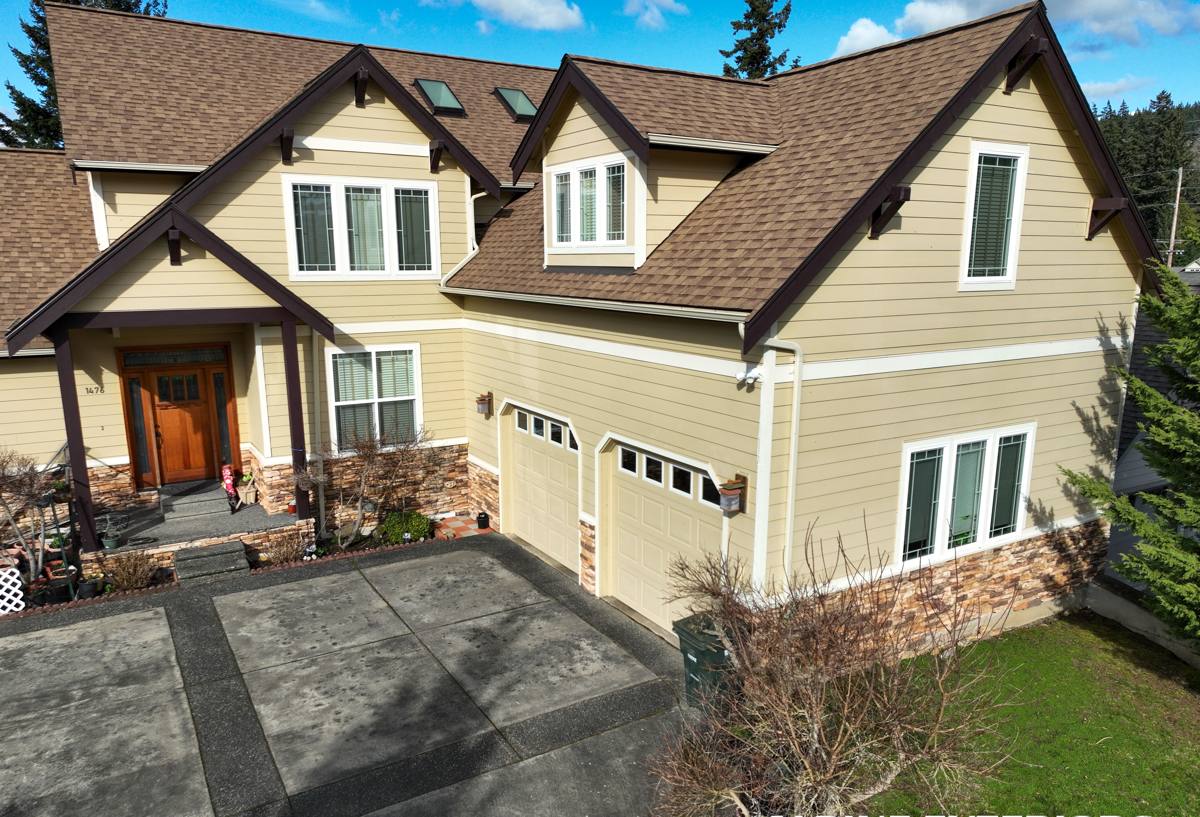
What Correct Siding Installation Actually Involves
"Installing siding" sounds like a single task, but the work that actually protects a house happens mostly in the layers homeowners never see once the job is done. A correct installation in a climate like this one comes down to a handful of details done right, in order.
The Weather-Resistive Barrier Comes First
Before a single piece of siding goes up, the wall needs a continuous, properly lapped weather-resistive barrier. Every seam, penetration, and window opening has to be flashed so that any water that gets behind the siding — and in this climate, some always will — drains back out instead of finding a path into the sheathing.
Fastening and Clearances
Fastener spacing, type, and depth all affect how well siding holds up to wind-driven rain and salt exposure. Undriven or overdriven fasteners, wrong fastener metal, and missing clearances at the ground, roofline, and deck ledgers are the small errors that turn into large repairs later. Manufacturer clearance specs — typically several inches from grade, decks, and roof surfaces — exist specifically so splash-back and moss-holding debris don't sit against the bottom course.
Joints, Caulking, and Trim Details
Butt joints, inside and outside corners, and trim-to-siding transitions are where most real-world leaks start. These need to be treated as part of the water-management system, not just the finish appearance — caulked and flashed to shed water, not just to look clean on installation day.
Common Problems We See on Older Happy Valley Siding
A lot of the siding calls we get in this area aren't about total failure — they're about slow, localized damage that's been building for years:
- Moss and algae staining on shaded walls, especially north- and east-facing sides with tree cover, that holds moisture against the surface
- Rust streaking or corrosion around fastener heads and metal trim, more pronounced the closer a home sits to open water
- Soft or delaminating spots near ground contact, roof-to-wall intersections, and deck ledgers where clearance wasn't maintained
- Caulk failure at joints and trim that was never designed to flex with this much seasonal moisture cycling
- Paint that's failed early on wood or engineered-wood products, needing recoat well ahead of a normal repaint schedule
Most of these problems trace back to a product or installation choice that didn't account for how much water this region actually sees, not to age alone.
Why We Only Install James Hardie Fiber Cement
We made a deliberate decision to install one product system — James Hardie fiber cement — and not vinyl, LP SmartSide, cedar, primed spruce, or other fiber cement brands. That's not a marketing position; it's a maintenance and moisture-behavior position.
Vinyl siding stays cheap and low-maintenance in mild, dry climates, but it can distort in temperature swings, its seams and J-channels give wind-driven rain more paths to get behind the wall, and it doesn't hold paint if a homeowner ever wants a different color. Engineered wood products like LP SmartSide use real wood strand technology and can perform well when maintained perfectly, but they're still wood-based, and wood-based siding depends on caulking and paint staying intact in a climate that stresses both constantly. Cedar and primed spruce are attractive but require an ongoing maintenance commitment — refinishing, caulking, and moisture monitoring — that most homeowners underestimate until they're a few years in.
James Hardie fiber cement is non-combustible, dimensionally stable in wet-dry cycling, and comes with a factory-applied ColorPlus finish that's baked on rather than field-painted, which matters in a climate where field-applied paint gets tested hard. Hardie's HZ5 climate-engineered product line is built specifically for regions with sustained moisture exposure like the Pacific Northwest. It won't rot, it resists moss and mildew better than wood-based products, and it carries a strong transferable warranty — but only when it's installed to spec, which is the entire reason installation quality matters as much as the product choice.
Siding Options Compared
| Material | Moisture Behavior in This Climate | Maintenance Over Time | Why It's Not What We Install (where applicable) |
|---|---|---|---|
| Vinyl | Seams and laps give wind-driven rain more entry points; can warp with heat | Low, but can't be repainted if it fades or a color change is wanted | Moisture path risk, limited long-term flexibility |
| LP SmartSide / engineered wood | Performs well if finish stays intact; vulnerable if caulking or paint fails | Moderate — needs consistent recaulking and repainting | Wood-based core means moisture management has to be perfect, indefinitely |
| Cedar / primed spruce | Attractive but absorbs and releases moisture with seasons | High — regular refinishing and caulk inspection required | Ongoing maintenance burden most owners underestimate |
| James Hardie fiber cement | Dimensionally stable, resists moss/mildew, engineered for wet climates (HZ5) | Low — factory finish holds color without repainting on a short cycle | What we install exclusively |
Our Installation Process
- On-site assessment: We look at existing siding condition, wall exposure to prevailing wind and rain, shade and moss patterns, and any trim or flashing issues before quoting anything.
- Tear-off and sheathing check: Removing old siding is when hidden rot, soft sheathing, or past water damage actually surfaces — we address it before covering it back up.
- Weather barrier and flashing: A continuous, correctly lapped barrier goes on with proper flashing at every window, door, and penetration.
- Hardie installation to manufacturer spec: Correct fastener type and spacing, proper clearances at grade and roof lines, and joint treatment built to shed water rather than trap it.
- Trim, caulking, and finish details: Corners, butt joints, and trim transitions get finished as part of the water-management system, not just for appearance.
- Final walkthrough: We go over clearances, any touch-up needs, and what maintenance (if any) the homeowner should expect going forward.
What Drives Cost on a Happy Valley Siding Job
| Factor | Why It Matters Here |
|---|---|
| Extent of tear-off and sheathing repair | Homes with long-term moisture exposure often need sheathing repair discovered only once old siding is off |
| Wall exposure and complexity | Walls facing prevailing wind and rain need more careful flashing and joint work |
| Trim and detail work | Corners, window trim, and transitions take more labor time than flat wall runs |
| Product line and finish | Hardie's plank, panel, and shingle profiles and ColorPlus finish options vary in material cost |
| Access and site conditions | Sloped lots, tree cover, and tight setbacks common in older neighborhoods can affect scaffolding and staging |
Why Hiring a Crew That Already Works This Area Matters
Siding installation isn't just about following a manufacturer's install manual — it's about knowing how a specific manual applies to a specific site. A crew that regularly works Whatcom County knows which wall orientations need extra attention to flashing, how much clearance actually holds up against the moss and moisture patterns typical of shaded, older-tree lots, and where salt exposure warrants closer attention to fastener choice. That local pattern recognition is the difference between a technically-correct-on-paper install and one that's actually correct for the house it's on.
It also matters for accountability. A contractor with an ongoing presence in the area has a reason to stand behind the work years later, not just at final walkthrough.
Before You Get a Quote: A Homeowner Checklist
- Walk your home's exterior and note any shaded walls with visible moss, algae, or dark staining
- Check clearance at the bottom of your siding — is it close to grade, a deck, or a walkway?
- Look at trim and corner joints for cracked or missing caulk
- Note any soft spots you can feel by pressing gently near the ground line or under windows
- Ask any contractor you're considering which siding brands they install and why — and whether they'll put the answer in writing
- Confirm whether a warranty is manufacturer-backed, installer-backed, or both
Maintenance After Installation
One advantage of a correctly installed Hardie system in this climate is how little ongoing maintenance it actually needs. There's no repainting cycle tied to the factory ColorPlus finish under normal conditions, and the material itself doesn't feed moss and mildew the way wood-based products can. Homeowners still benefit from an occasional gentle rinse to clear pollen, salt residue, and organic buildup, and from periodically checking that gutters and downspouts are directing water away from the wall rather than onto it. That's a materially lighter maintenance load than cedar, primed spruce, or engineered wood siding requires in this same climate.
If you're weighing a siding replacement in Happy Valley, we're glad to walk your home, point out anything the current siding is already telling you, and give you a straightforward, no-pressure estimate for what a correctly installed James Hardie system would look like on your house.