 Whatcom County
 Why Siding Repair in Lynden Is Its Own Kind of Job
Lynden sits close enough to the water and low enough in the Nooksack valley that its homes take on a specific combination of punishment: salt-tinged marine air moving in off the Strait, long stretches of driving rain that comes in sideways more often than straight down, and a shoulder-season moss window that can run from late fall well into spring. None of that is unusual for Whatcom County, but it changes what "siding repair" actually means here compared to a drier inland climate. A crack that would sit quietly for years somewhere else becomes a moisture entry point here within a season or two.
That's the lens we use on every repair call in Lynden: not just "what's damaged," but "what has this damage already let in, and what's it going to let in next winter if we don't fix it correctly."
Salt Air and Coastal Moisture
Airborne salt doesn't just affect metal fasteners and flashing — it accelerates the breakdown of caulking and paint films, which are usually the first line of defense at seams, trim joints, and panel edges. Once that sealant layer chalks and cracks, water gets behind the siding faster than it would in a purely inland climate.
Driving, Wind-Driven Rain
Whatcom County rain rarely just falls straight down for long. Wind-driven rain gets pushed sideways into laps, seams, and butt joints that were never designed to be hit head-on. A repair that only addresses the visible crack or gap, without checking how water is being driven into it, tends to fail again within a year or two.
The Long Moss Season
Shaded north and west walls, roof lines that shed onto siding, and the region's damp, mild winters all add up to a moss and algae season that can last most of the year on the wrong exposure. Moss holds moisture against the siding surface far longer than open air would, which is exactly the condition that lets minor damage turn into rot underneath.
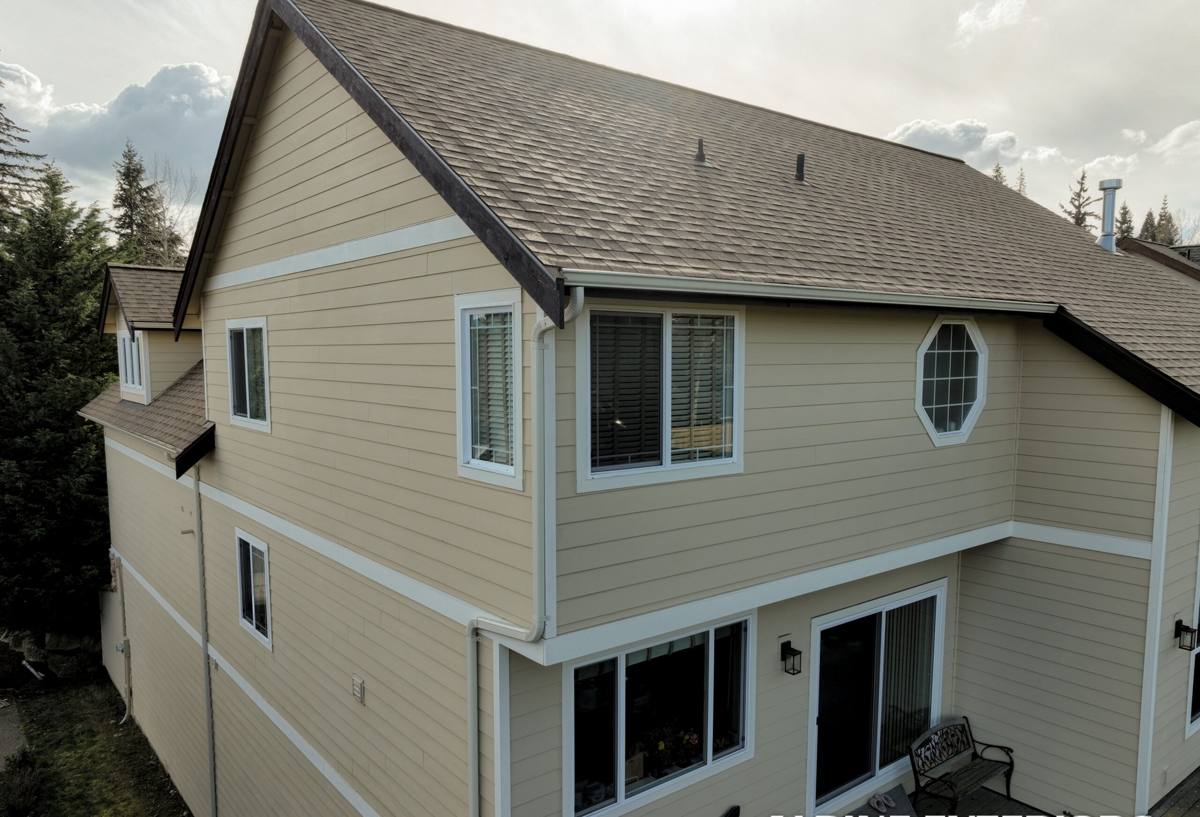
Signs a Lynden Home Actually Needs Siding Repair
Some of these are obvious from the street. Others only show up once you know where to look — usually low on the wall, under eaves, or around anything that penetrates the siding.
- Cracked, chipped, or split panels, especially near corners and butt joints
- Soft or spongy spots when you press on the siding, particularly near the base of walls
- Panels that have started to buckle, bow, or pull away from the wall
- Visible gaps at seams, corner boards, or window and door trim
- Persistent moss, algae, or dark staining that doesn't wash off
- Peeling or bubbling paint, or chalky, faded finish in isolated areas
- Water stains, musty smell, or soft drywall on interior walls near exterior siding damage
- Small gaps or holes that look like pest entry points, especially near roof lines
Any one of these can be a minor fix. Two or three showing up on the same wall usually means water has been getting in longer than the visible damage suggests.
What a Correct Repair Actually Involves
A repair that just covers the visible problem isn't a repair — it's a delay. Done right, siding repair in this climate has to address what's underneath the siding as much as the siding itself.
Checking the Water-Resistive Barrier
Behind every siding panel should be a weather-resistive barrier doing the real work of keeping water out. If a panel has been cracked or missing long enough for water to reach that barrier, we check its condition before we ever put a new panel back on. Replacing siding over a compromised barrier just resets the clock on the same failure.
Matching Material and Fasteners
Mismatched materials, mismatched fastener types, or the wrong fastener spacing are common causes of repairs that look fine for a season and then fail. Corrosion-resistant fasteners matter more here than in a lot of climates, given how much salt-laden moisture the walls are exposed to.
Sealant and Flashing Details
Seams, joints, and anywhere siding meets trim, windows, or roof lines need sealant and flashing that's actually doing its job — not just cosmetic caulk smeared over a gap. Given the driving rain this area gets, these details are usually where a rushed repair fails first.
Finish and Color Match
A repair that fixes the water problem but leaves an obvious patch isn't a complete job either. Matching finish and color, especially on factory-finished products, is part of doing the repair right — not an afterthought.
Repair Difficulty Varies a Lot by Siding Type
Not all siding repairs are created equal. The material already on the house has a big effect on how well a repair holds up, especially in a climate this wet.
| Siding Type | Typical Repair Difficulty | Color/Finish Match | Moisture Risk After Repair |
|---|---|---|---|
| James Hardie fiber cement (factory-finished) | Moderate — panel replacement is straightforward when matched correctly | Good, especially with ColorPlus finished product | Low, if the water-resistive barrier is intact |
| Vinyl siding | Low for cracks, but exact color/profile match gets harder as it fades over time | Difficult once faded — vinyl color shifts with UV exposure | Moderate — water can travel behind panels along the wall |
| Cedar or wood siding | Higher — often involves addressing rot, not just the visible board | Requires refinishing to blend | High if moisture has reached untreated wood |
| LP SmartSide (engineered wood) | Moderate, but edge sealing at the repair site is critical | Fair, depends on finish system used | Moderate to high if edges weren't properly sealed |
We repair what's already on a home when repair is the honest answer. But it's worth being direct: we only install James Hardie fiber cement siding on new work and full replacements. If a home's existing siding is a different product and repair isn't a realistic long-term fix, we'll tell you that plainly rather than patch something we don't think will hold up through another Whatcom County winter.
When Repair Makes Sense — and When It Doesn't
Repair is the right call when the damage is isolated, the underlying structure and water barrier are sound, and the siding material is still capable of performing for years after the fix. It's the wrong call when damage keeps recurring in the same areas, when moisture has clearly traveled beyond the visible damage, or when the existing material has reached the point where every repair is just buying a little more time on a system that's failing overall.
We'd rather tell a homeowner honestly that a section of wall is past reasonable repair than sell a patch we don't expect to last. That's a harder conversation, but it's a cheaper one in the long run than repeating the same fix every couple of years.
Our Process for Lynden Repair Calls
- On-site inspection of the damaged area and a check of adjacent walls for related issues
- Where accessible, a look behind the siding at the damaged section to check the water barrier and framing
- A straight answer on whether repair is the right call, or whether the section (or the wall) should be replaced instead
- A written scope and price before any work starts — no surprise add-ons once we're on the wall
- Repair using correctly matched materials, fasteners, and sealant details for this climate
- A final check of the finish match and surrounding trim before we consider the job done
Why We Only Install James Hardie
When a repair isn't the right answer and a section — or a whole wall — needs to be replaced, we install James Hardie fiber cement and nothing else. It's non-combustible, holds up to the wind-driven rain and salt air common in this part of Whatcom County, and comes with a factory ColorPlus finish that resists the fading and chalking that makes future repairs so hard to color-match on other products. We made the call years ago to standardize on one product line we trust rather than install several products with different failure patterns, and Hardie is what we stand behind.
Why a Crew That Already Works in Lynden and Whatcom County Matters
A contractor who works this area regularly already knows which wall exposures take the worst of the wind-driven rain, how long moss actually sits on shaded siding through a typical winter, and what salt-air corrosion on fasteners and flashing looks like before it becomes a bigger problem. That's not something you can fully substitute with a general inspection checklist — it comes from doing this work, on homes like yours, in this specific climate, repeatedly.
After the Repair: Keeping It From Happening Again
- Keep gutters and downspouts clear so water isn't sheeting down walls it shouldn't be
- Trim back vegetation that keeps a wall shaded and damp longer than it needs to be
- Rinse moss and algae growth off siding before it has a chance to hold moisture through the wet months
- Do a visual check of caulking at trim and seams every year or two, since it's usually the first thing to fail
- Address small cracks or gaps promptly — they're far cheaper to fix before a wet winter than after
If you're dealing with damaged, cracked, or failing siding on a Lynden home, we're happy to take a look and give you a straight assessment of whether it's a repair or something more. Reach out for a free, no-pressure estimate using the form below.