 Whatcom County
 Why Sunnyland Homes Take a Beating From the Climate
Sunnyland sits close enough to Bellingham Bay that salt-laden air is a daily fact of life, not an occasional nuisance. Add Whatcom County's long, wet fall-through-spring stretch of driving rain and the shaded, north-facing walls that never quite dry out, and you have a climate that is genuinely hard on exterior materials. Moss and algae get a long runway to establish themselves on siding, trim, and anything with a horizontal ledge to grab onto. None of this is unusual for this part of Washington — but it does mean siding choices that work fine in a drier climate can fail early here.
The neighborhood's housing stock is a mix of older character homes and newer infill, which means we see every generation of siding failure: cupped and peeling cedar, swollen hardboard, vinyl that's chalked and cracked from UV and moisture cycling, and fiber cement that was installed without the right clearances and is now wicking water at the bottom edge. The lesson from all of it is the same — in Sunnyland, the material matters less than whether it was engineered and installed for this specific combination of salt, rain, and shade.
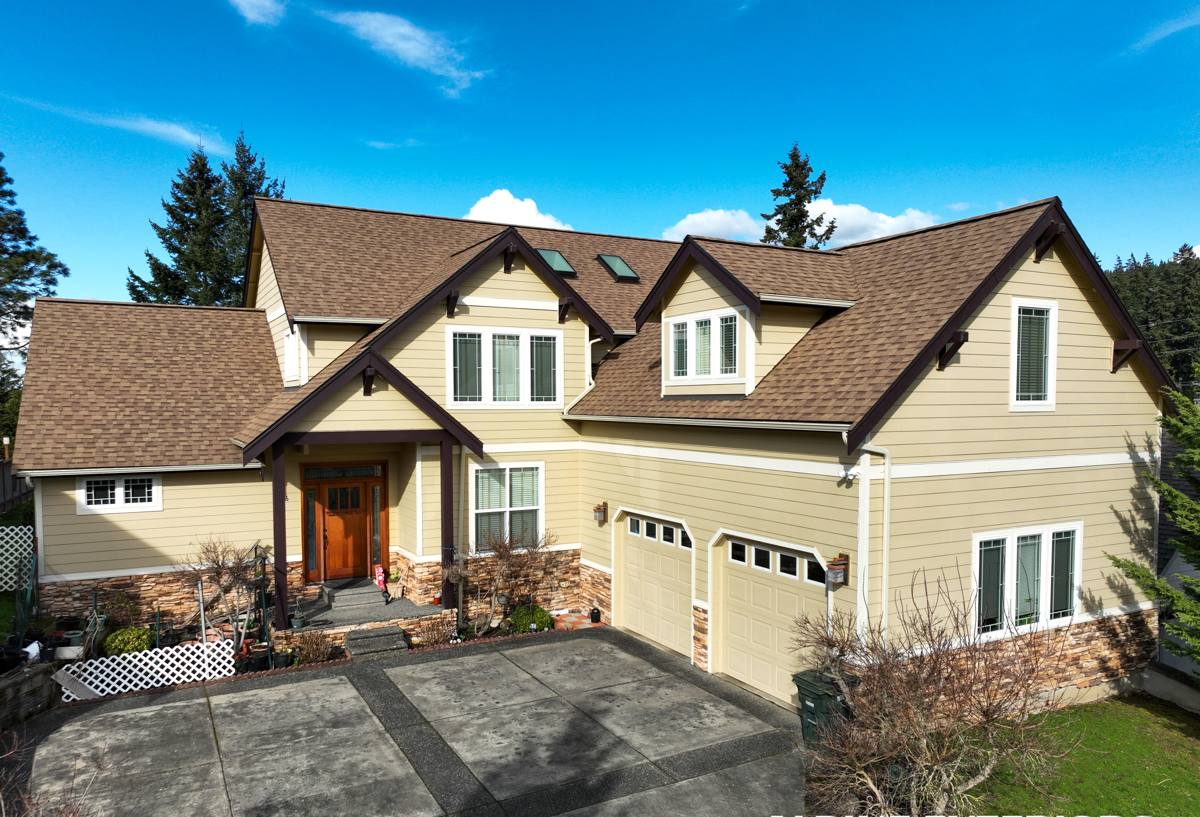
What This Climate Actually Demands From Siding
Before talking about products, it's worth being specific about what "climate-appropriate siding" means in practical terms for a Sunnyland home:
- Resistance to moisture absorption at cut edges, seams, and butt joints — the places where water actually gets in
- A factory finish that doesn't rely on the homeowner repainting every few years to stay sealed
- Dimensional stability so panels don't swell, cup, or telegraph fastener heads through the finish
- A surface that doesn't feed algae and moss the way porous or textured materials do
- Enough impact resistance to shrug off wind-driven debris during winter storms
- A product warranty that actually accounts for coastal, high-moisture exposure instead of excluding it
This is the checklist we use when we talk homeowners through material decisions, and it's the reason our company installs James Hardie fiber cement exclusively. It's not brand loyalty — it's that Hardie's engineering addresses this specific list better than the alternatives we used to install, and we'd rather stand behind one system we trust completely than juggle several we have reservations about.
Why James Hardie Fits Sunnyland Specifically
Built for wet, marine-influenced climates
James Hardie makes climate-specific product lines, and the HZ5 formulation is engineered for regions with freeze-thaw cycling and sustained moisture exposure — which describes Whatcom County's weather well. Fiber cement itself is a mix of cement, sand, and cellulose fibers, so it doesn't absorb and swell the way wood-based or engineered-wood sidings can when they sit wet for days at a time, which is a normal occurrence during a Sunnyland winter.
A factory finish that holds up to salt and UV
ColorPlus finish is baked on in a controlled factory environment rather than field-applied, which gives it better adhesion and fade resistance than a job-site paint job. In an area with salt air, that matters — site-applied paint tends to break down faster near the water, and repainting a full house every five to seven years is a real, recurring cost most homeowners don't budget for. ColorPlus is designed to go far longer between touch-ups.
Non-combustible material
Fiber cement doesn't support combustion the way wood siding or many engineered wood products do. That's a wildfire-adjacent benefit more relevant east of the Cascades, but it also matters for everyday fire safety and insurance considerations here in Whatcom County.
Dimensionally stable against moss and moisture cycling
Because it doesn't expand and contract with moisture the way wood-based sidings do, Hardie holds paint lines and caulk joints better over time. Tighter joints mean fewer places for moss spores and algae to take hold, and fewer hairline gaps for water to migrate behind the cladding.
What a Correct Installation Actually Involves
Hardie siding's long-term performance depends almost entirely on installation quality — this is the part of the story most homeowners never see until something goes wrong. A few specifics that separate a correct job from a problem waiting to happen:
| Installation Detail | Why It Matters in This Climate |
|---|---|
| Proper weather-resistive barrier and flashing behind the panels | Sunnyland's driving rain finds any gap; the barrier is the real waterproofing layer, not the siding itself |
| Correct ground and roofline clearance (Hardie specifies minimum gaps) | Splash-back and roof runoff are constant here; tight clearances trap moisture against the bottom edge |
| Factory-primed or sealed cut edges | An unsealed cut edge is the fastest way for fiber cement to absorb water and fail early |
| Correct nailing pattern and fastener depth | Overdriven or underdriven nails crack panels or leave gaps that widen with wind and moisture cycling |
| Proper caulking at butt joints and penetrations, using compatible sealant | Salt air degrades cheap caulk faster; the wrong sealant fails within a couple of seasons |
| Rain screen or drainage gap where the wall assembly calls for it | Gives moisture that does get behind the cladding a path to dry out instead of sitting against sheathing |
Every one of these is written into Hardie's installation specifications, and skipping any of them is how a premium siding product ends up performing like a cheap one within a decade.
Signs a Sunnyland Home's Siding Needs Attention
Because moss and moisture damage develop slowly, homeowners often live with early warning signs for years before addressing them. Worth checking for:
- Dark streaking or persistent moss growth on shaded or north-facing walls that pressure washing only temporarily clears
- Soft spots, especially near the bottom courses, around window trim, or where decks and porches meet the wall
- Visible cupping, warping, or separation at seams on wood or hardboard siding
- Paint that's peeling or bubbling rather than just fading — a sign moisture is trapped underneath
- Nail heads or fastener patterns showing through the surface
- Rising heating bills or drafty rooms that suggest the wall assembly behind the siding is compromised
Any one of these on its own isn't necessarily an emergency, but a couple together usually means the siding is past the point where caulk and paint will solve it.
How Our Process Works for Sunnyland Projects
We start with an on-site inspection that looks past the siding itself — checking the sheathing, trim, and flashing details for existing moisture damage before quoting anything, since that's where a lot of surprise costs come from if it's skipped. From there we walk the homeowner through Hardie's plank, shingle, and panel options and how each holds up against the specific exposure of their walls (a shaded, moss-prone north wall gets talked about differently than a sun-exposed south wall).
Because we work Sunnyland and the surrounding Whatcom County neighborhoods regularly, we already know which details matter most here — clearance at grade given local rain patterns, flashing at window and door openings, and sealant choices that hold up to salt exposure near the bay. That local repetition is what keeps a crew sharp on the details that don't show up in a quick estimate but absolutely show up ten years later.
Every installation follows Hardie's published fastening, clearance, and flashing specifications — not as an upsell, but because that's what keeps the manufacturer's warranty valid and what actually determines whether the siding performs for its full service life.
Warranty and Long-Term Value
James Hardie backs its siding with a non-prorated limited warranty that's transferable to a future homeowner, which matters both for resale value and peace of mind. ColorPlus finishes carry their own finish warranty separate from the substrate warranty, covering issues like finish adhesion and fade. Warranty coverage assumes installation to Hardie's specifications — another reason installation quality isn't optional, it's what keeps the warranty enforceable if a claim ever comes up.
What to Expect Cost-Wise
Every project's cost depends on the home's size, existing wall condition, and how much repair the sheathing needs before new siding goes on. Rather than quote a number that won't apply to a specific house, here are the factors that actually move the price:
| Cost Factor | Why It Varies |
|---|---|
| Existing siding removal and disposal | Multiple layers or hazardous old materials add labor and disposal cost |
| Sheathing and framing repair | Moisture damage found underneath old siding has to be fixed before new siding goes on |
| Product line and profile chosen | Lap, shingle, and panel styles, plus HZ5 versus standard formulations, price differently |
| Trim, corner, and soffit detailing | More architectural detail means more custom cutting and finishing |
| House complexity (stories, roof lines, dormers) | Cutting, scaffolding, and flashing work scale with complexity, not just square footage |
A proper quote requires seeing the house, but we can give a realistic ballpark on a first visit once we know the wall condition and the scope involved.
Living With Hardie Siding in Sunnyland
Once it's installed correctly, maintenance is genuinely low — an occasional soft wash to keep moss and algae from establishing on shaded walls, a yearly check of caulking at joints and penetrations, and prompt attention to anything a landscaper or pressure washer might chip. That's a meaningfully lighter maintenance load than wood or hardboard siding demands in this climate, and it's a big part of why the total cost of ownership tends to favor Hardie even though the upfront installed cost is higher than vinyl.
If you're weighing a siding project on a Sunnyland home, we're happy to take a look and talk through what your specific walls need — no pressure, no obligation. Fill out the form below for a free estimate.