 Whatcom County
 Siding Built for Happy Valley's Weather, Not Just Its Curb Appeal
Happy Valley sits inside Whatcom County's marine climate zone, which means the siding on a home here works harder than siding almost anywhere inland. Salt-laden air moving in off Puget Sound and the Strait of Georgia accelerates corrosion on fasteners and metal trim. Driving rain, often pushed sideways by wind off the water, finds every gap in flashing and caulk. And because this part of Washington rarely gets a real dry stretch, shaded siding stays damp long enough for moss and algae to take hold and stay there for months at a time. None of that is dramatic on its own, but stacked together year after year, it's exactly the combination that wears out the wrong siding material fast.
This page is specifically about James Hardie fiber cement siding installed on homes in Happy Valley — what the climate demands of it, what a correct installation looks like, and why the crew doing the work matters as much as the product itself.
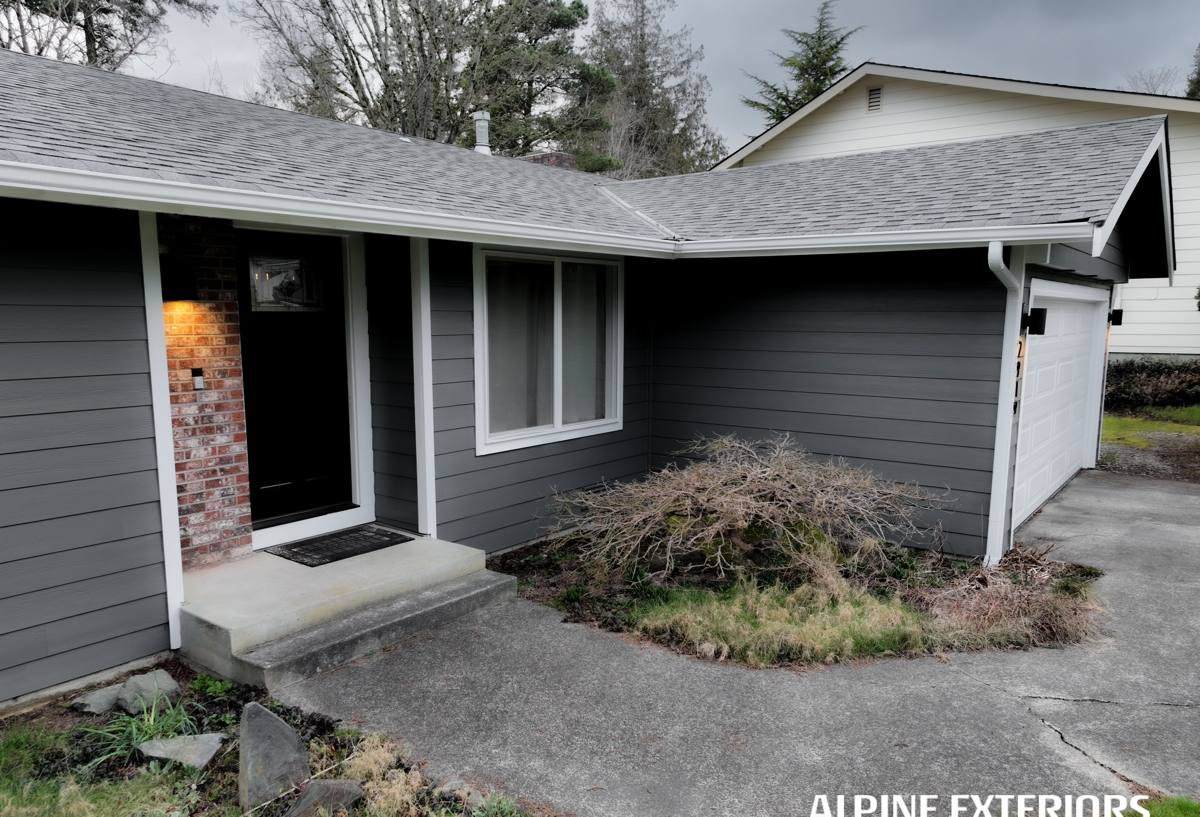
Why We Only Install James Hardie
We don't install vinyl, LP SmartSide, primed spruce, cedar, or other fiber cement brands. That's not a marketing line — it's a standard we hold because of what we've seen happen to other siding materials in exactly this climate. Vinyl becomes brittle and can warp or blow off in coastal wind gusts. Wood-based products, including engineered wood siding, depend on an intact factory coating to keep moisture out; once that coating is compromised at a cut edge or fastener hole, the substrate can swell and rot in a damp climate like this one. Cedar looks great new but requires ongoing refinishing to hold up against constant moisture exposure.
James Hardie fiber cement is cement, sand, and cellulose fiber — it doesn't have an organic substrate for moisture to break down, and it's non-combustible. Installed correctly, with the right clearances and flashing details for a wet climate, it's the product we're comfortable standing behind on homes in this area.
What "Correct for This Climate" Actually Means
Hardie board itself is engineered to handle moisture cycling, but the installation determines whether that engineering actually pays off. A few details matter more here than they would in a drier climate:
- Proper weather-resistive barrier and flashing behind every seam, window, and door opening — not just at the obvious spots
- Correct minimum clearance between the siding's bottom edge and grade, decks, roof lines, and hardscaping so splash-back doesn't sit against the board
- Butt joints and seams flashed or caulked per James Hardie's published details, not just caulked and left
- Fasteners set to the manufacturer's specified depth and spacing — overdriven nails crack the board's edge and create a moisture entry point
- Field-cut edges sealed before installation, since an unsealed cut edge is the single most common place fiber cement siding fails prematurely
Salt Air, Rain, and Moss: The Three Things We Design Around
Salt Air and Corrosion
Fasteners and trim accessories that aren't rated for coastal exposure corrode faster here than the manufacturer's general-use hardware would suggest. We use fastener and flashing materials suited to a marine environment, because a siding job is only as durable as its weakest metal component.
Driving, Wind-Driven Rain
Rain that falls straight down is a much easier problem than rain pushed sideways into a wall assembly. Happy Valley gets enough wind off the water that wind-driven rain is a real design condition, not a rare event. That's why lap coverage, joint treatment, and the weather barrier behind the siding matter more here than they would somewhere with calmer, straight-down rainfall.
Moss and Algae Season
Whatcom County's version of "siding weather" includes a long stretch — often five or six months — where surfaces that don't get direct sun or airflow simply stay damp. Moss and algae are cosmetic on fiber cement (they don't rot it the way they can degrade wood), but they do trap moisture against the surface and, over years, can accelerate coating wear if left unaddressed. Homes in Happy Valley with mature landscaping or north-facing walls see this more than homes in open, sunny exposures.
How Siding Materials Actually Hold Up Here
| Factor | Vinyl | Engineered Wood (LP-type) | Cedar | James Hardie Fiber Cement |
|---|---|---|---|---|
| Wind-driven rain resistance | Moderate — seams can allow intrusion | Depends on coating integrity | Requires diligent maintenance | Strong when flashed to spec |
| Moss/algae impact | Cosmetic only | Can trap moisture at damaged coating | Can contribute to rot if untreated | Cosmetic only |
| Coastal wind/salt exposure | Can crack, warp in gusts | Edge swelling risk if exposed | Weathers, needs refinishing | Rated for the exposure, doesn't rot |
| Fire resistance | Melts/deforms | Combustible | Combustible | Non-combustible |
| Typical repaint/refinish need | Rarely repainted | Recoat as coating wears | Refinish every few years | ColorPlus finish, no repaint for years |
The HZ5 Product Line: Built for This Region
James Hardie engineers its siding by climate zone, and homes in Whatcom County fall into the HZ5 zone — the line built for regions with significant moisture exposure and freeze-thaw potential. HZ5 products are formulated to resist moisture-related damage better than the general-purpose versions of the same siding sold in drier climates. For a Happy Valley home, that's not an upsell — it's the baseline product we start every quote from, because installing the wrong climate zone's product here is a mistake that only shows up years later.
Most Happy Valley projects use either HardiePlank lap siding for the main field, HardieShingle for accent gables or dormers, and HardieTrim for corners, fascia, and window surrounds — all finished in ColorPlus, James Hardie's factory-applied color system. ColorPlus is baked on and cured under controlled conditions, which gives it far better fade and wear resistance than a field-applied paint job, and it comes with its own dedicated finish warranty on top of the product warranty.
Our Process for a Happy Valley Job
- On-site assessment — we walk the exterior, check current siding condition, look at grading and drainage against the foundation, and note shaded or exposed walls that will need different detailing
- Moisture and substrate check — where old siding is coming off, we inspect the sheathing underneath before covering anything back up; problems found here get fixed, not buried
- Product and color selection — HZ5-rated Hardie products, ColorPlus color selection, and profile choice (lap width, shingle vs. plank, trim style) matched to the home
- Weather barrier and flashing installation — this is the step that determines long-term performance, and it's the one that gets rushed on lower-quality jobs
- Siding installation to manufacturer spec — correct fastener depth, clearances, and joint treatment throughout
- Final inspection and cleanup — walk-through before we consider the job done
What Drives Cost on a Happy Valley Siding Job
| Factor | Why It Matters Here |
|---|---|
| Home size and wall complexity | More corners, gables, and dormers mean more cutting, flashing, and trim labor |
| Current siding removal and disposal | Tear-off adds labor and disposal cost, but also lets us inspect sheathing before it's covered |
| Sheathing or rot repair | Damp climates sometimes hide moisture damage behind old siding — this is priced once we see the wall, not guessed upfront |
| Product mix | Straight lap siding is more economical than mixing in shingle accents and extensive trim work |
| Access and site conditions | Slopes, mature landscaping, and tight setbacks common in established neighborhoods can add labor time |
We give a firm, written quote after the on-site assessment — not a rough number over the phone — because the variables above genuinely change the price, and we'd rather be accurate than fast.
Maintaining Hardie Siding Through Whatcom County's Moss Season
Fiber cement siding is low-maintenance, not no-maintenance. A simple seasonal routine keeps it looking right through the wet months:
- Rinse siding gently (garden hose pressure, not a pressure washer aimed directly at seams) once or twice a year to clear moss, algae, and pollen buildup
- Keep gutters clear so overflow doesn't run down the siding face and keep it wet longer than necessary
- Trim back shrubs and branches touching the siding to improve airflow and sun exposure on shaded walls
- Check caulking at trim joints and penetrations annually and re-caulk if it's cracked or pulling away
- Confirm splash blocks or downspout extensions are directing water away from the foundation and lower siding courses
Why It Matters That We Already Work in Happy Valley
A crew that's installed Hardie siding on Happy Valley homes before already knows the local permitting expectations, the typical wall conditions in the area's housing stock, and which details actually matter in this specific stretch of Whatcom County's climate versus a generic install checklist. That's not something a crew passing through on a one-off job builds up. It also means we're not guessing at how HZ5 products perform here — we've installed them here, in this weather, and we stand behind that work with the manufacturer's warranty backing it.
If your Happy Valley home has siding that's rotting, warping, constantly growing moss, or just due for a real long-term fix, we'll come take a look and give you a straightforward, no-pressure estimate — fill out the form below to get started.