 Whatcom County
 Deck Building in Happy Valley: Built for This Climate, Not a Catalog Climate
Happy Valley sits close enough to the water and low enough in the Whatcom County rain shadow pattern that a deck here takes a different kind of beating than one built inland or in a drier state. Salt-tinged air, long stretches of driving rain off the water, and a moss season that can run from fall through spring all work on wood, fasteners, and footings in ways that a generic deck spec sheet doesn't account for. A deck built the same way you'd build one in Spokane or Sacramento will show problems here years before it should — soft boards, rusted hardware, slippery surfaces, and rot at the ledger board are the usual signs.
This page is about doing deck building right for a Happy Valley property specifically: what the climate demands, what a correctly built deck actually involves under the decking boards where nobody looks, and how we approach the job as a crew that works this area regularly rather than passing through once.
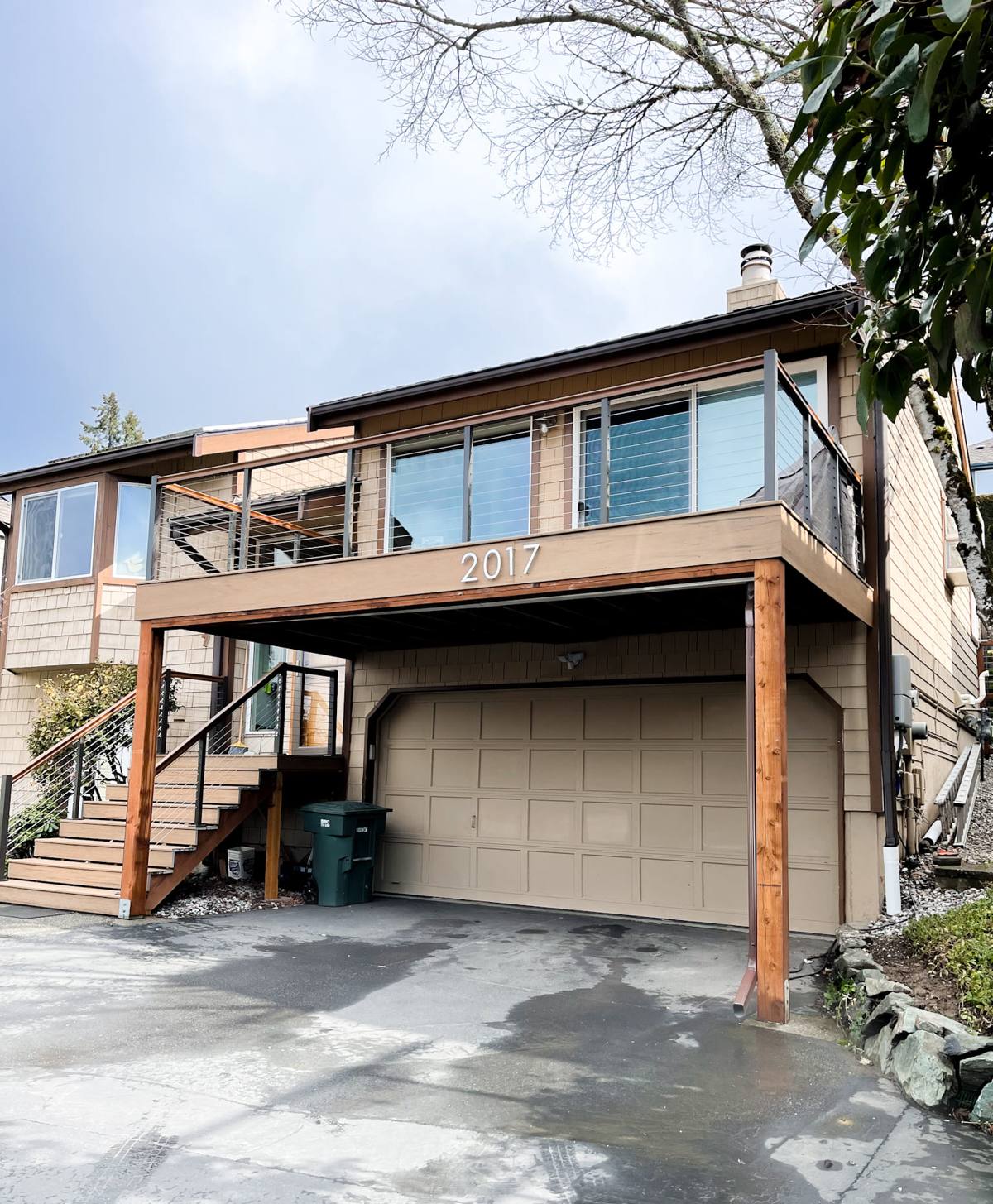
What Driving Rain and Salt Air Actually Do to a Deck
Two separate problems show up on Happy Valley decks, and they call for different responses.
Driving Rain
Wind-driven rain off the water doesn't just fall straight down — it gets pushed sideways into ledger boards, under flashing laps, and into end grain on stair stringers and railing posts. Water that would run off a flat surface elsewhere gets forced into joints here. Any gap in flashing, any fastener hole that wasn't sealed, any spot where two boards meet without a drip edge becomes a slow entry point for moisture. Over a few winters that adds up to rot you can't see from the surface.
Salt Air
Salt in the air accelerates corrosion on anything metal — screws, joist hangers, bolts, post bases. Standard zinc-coated fasteners that would last decades in a dry inland climate can start showing rust streaks and pitting within a handful of years this close to the water. Once a fastener corrodes, it loses holding strength long before it looks bad enough to worry most homeowners, which is part of why hardware selection matters more here than the decking material itself.
The Long Moss Season: Drainage and Surface Choices
Whatcom County's wet season runs long, and any horizontal wood or composite surface that doesn't dry out and get direct sun for stretches of time will grow moss and algae. On a deck this isn't just cosmetic — moss holds moisture against the board surface, and a slick, damp deck is a real slip hazard on stairs and near door thresholds.
The fix isn't a magic material that never grows moss (nothing fully avoids it in a shaded, damp Happy Valley yard) — it's a combination of decking board spacing that lets air and water through, a structure with a slight slope and clear drainage path underneath, and a maintenance routine the homeowner can actually keep up with. We factor moss exposure into the layout and material conversation up front rather than leaving it as a surprise the first wet winter.
What a Correctly Built Deck Requires
A deck that holds up in this climate is decided mostly by what's underneath the decking boards, not the boards themselves.
Footings and Framing
Footings need to go below frost depth and bear on undisturbed or properly compacted soil — this matters on Happy Valley lots with clay-heavy or poorly draining soil, where a shallow or poorly compacted footing can shift over a few wet seasons. Joists should be sized and spaced for the actual span and load, not just "what's always been done," and any joist that will see standing water needs a drainage gap or protective tape, not bare cut lumber.
Ledger Attachment and Flashing
The ledger board — where the deck attaches to the house — is the single most common failure point on decks in wet climates, because it's the hardest spot to keep water out of. A correct ledger installation uses proper flashing that laps over the house's water-resistive barrier (never tucked under it), lag bolts or through-bolts rated for the load, and a gap or flashing detail that lets any water that does get behind the ledger drain back out instead of sitting against the house framing. We won't attach a ledger without proper flashing, even if it adds a step — it's the difference between a deck lasting decades and one that rots from the house side out within a few years.
Fasteners and Hardware
Given the salt air, we use stainless steel or hot-dip galvanized fasteners and connectors rated for coastal or ground-contact exposure, not the cheapest coated screws sold at a big-box store. It costs more up front and saves the homeowner a rebuild later.
Choosing Decking Material for This Property
There's no single right answer here — it depends on budget, how much upkeep the homeowner wants to do, and how shaded or exposed the deck location is.
| Material | Upfront Cost | Moisture/Moss Behavior | Maintenance |
|---|---|---|---|
| Pressure-treated wood | Lowest | Absorbs water; needs sealing to resist rot and moss buildup | Annual cleaning and periodic sealing/staining |
| Cedar | Moderate | Naturally rot-resistant but still needs finish upkeep in wet climate | Regular cleaning; refinishing every few years |
| Composite decking | Higher | Won't rot, but surface can still grow moss/algae if shaded and damp | Periodic washing; no sealing or staining needed |
| PVC/capped composite | Highest | Most moisture-resistant option; least prone to surface absorption | Lowest — occasional washing |
We'll walk through this honestly during the estimate rather than pushing whatever has the best margin. A shaded, damp Happy Valley backyard lot changes the calculation compared to a sunnier, more exposed one — that's a conversation worth having before you commit to a material.
Our Deck Building Process
- On-site assessment — we look at drainage, sun exposure, soil, and how the deck will tie into the house before recommending anything.
- Design and material discussion — layout, railing style, decking material, and budget, with honest trade-offs explained.
- Permit handling — most attached decks in Whatcom County require a permit; we handle that process rather than leaving it to the homeowner.
- Footings and framing — built to code depth and spec for local soil and load conditions, not shortcuts.
- Ledger flashing and structural connections — done to keep water out of the house structure, not just out of sight.
- Decking, railing, and stairs — installed with corrosion-resistant fasteners and spacing that accounts for drainage and moss exposure.
- Final walkthrough — we go over basic maintenance so the deck actually reaches its expected lifespan.
What Affects the Cost of a Happy Valley Deck
| Cost Factor | Why It Matters Here |
|---|---|
| Deck size and shape | More linear footage of framing, decking, and railing |
| Height and stairs | Taller decks need more substantial footings, guardrails, and stair framing |
| Decking material | Ranges from treated wood to PVC composite, with a real cost spread |
| Site access and soil | Difficult access or poor-draining soil can add labor and footing cost |
| Ledger/house connection complexity | Older siding or unusual wall assemblies can add flashing work |
We don't quote decks off a square-footage formula alone — soil, access, and how the house wall is built all factor into an honest number.
Maintaining a Deck Through Whatcom County's Wet Season
- Sweep leaves and debris off the deck regularly in fall — trapped debris holds moisture and speeds up moss growth
- Wash the surface at least once or twice a year to remove algae and moss before it gets established
- Check railing and stair connections annually for looseness or corrosion at the hardware
- Keep gutters and downspouts clear so roof runoff isn't dumping extra water onto or near the deck
- Reseal or restain wood decking on the schedule the product calls for — don't wait until it's visibly gray and dry
- Watch the ledger board area at the house wall for any staining, soft spots, or paint failure — early signs of moisture getting behind it
Why a Local Happy Valley Crew Matters
A deck contractor who works this specific area regularly has already seen which lots drain poorly, which fastener grades actually hold up a few winters out, and where moss becomes a real problem versus a minor one. That's not something you get from a national installer passing through once. We build decks around Whatcom County as regular, ongoing work, which means we're also the ones a homeowner can call back in a few years if something needs a look — not a phone number that stops answering once the invoice is paid.
If you're planning a new deck or replacing one that's showing its age in Happy Valley, we're glad to come take a look and give you a straight, no-pressure estimate — just fill out the form below.