 Whatcom County
 Why South Hill Decks Wear Out Faster Than the Brochure Says
If you own a home in South Hill, you already know your deck takes a different beating than one two hours inland. Whatcom County sits in a stretch of Washington where marine air, near-constant fall and winter rain, and a moss season that can run six months or more all work against exposed wood and fasteners. A deck built with inland assumptions — standard hardware, minimal ventilation underneath, boards laid tight — tends to show its age in Whatcom County years before it would somewhere drier.
Deck replacement here isn't just about swapping old boards for new ones. It's about correcting the parts of the original build that never accounted for our climate in the first place: the ledger flashing, the joist protection, the fastener grade, and the airflow under the structure. Get those right and a South Hill deck can go decades between major work. Get them wrong and you're looking at soft spots, rust streaks, and slick moss-covered boards within five to ten years.
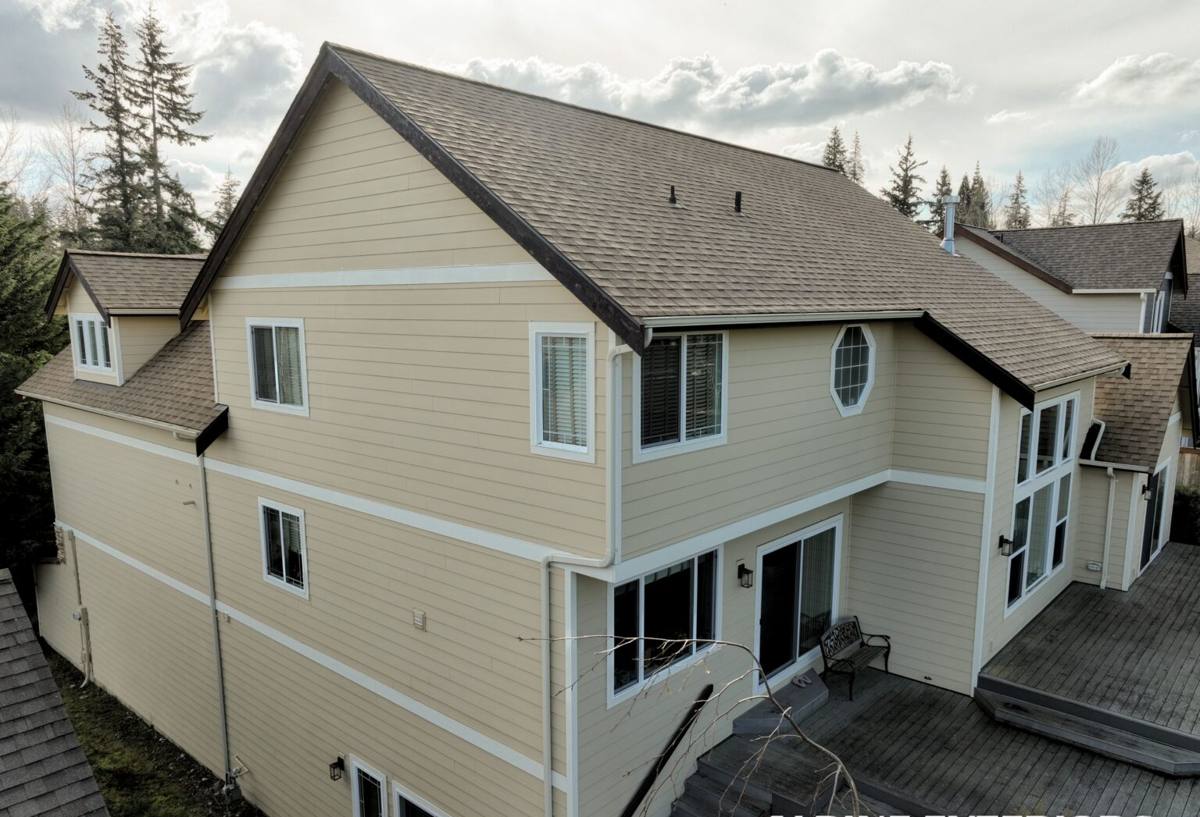
What the Whatcom County Climate Actually Does to a Deck
Salt Air and Metal Fatigue
Proximity to Puget Sound and the Strait of Georgia means South Hill homes get a steady dose of salt-laden air, especially with westerly winds. Salt accelerates corrosion in anything that isn't rated for it — deck screws, joist hangers, post bases, and railing hardware. Standard galvanized fasteners can start rusting from the inside of the wood out, which means the damage is often invisible until a board fails underfoot.
Driving Rain and Trapped Moisture
Rain in this region doesn't just fall straight down — wind-driven rain gets pushed sideways into ledger connections, under railing posts, and into any gap where flashing was skipped or done poorly. Combined with our long wet season, that means wood assemblies here spend more cumulative hours saturated than almost anywhere else in the state. Moisture that can't drain or dry out is the single biggest cause of rot in Whatcom County decks.
Moss, Algae, and the Slip Hazard Nobody Talks About
Moss doesn't just look bad — it holds moisture against the deck surface, feeds on the wood fibers as it establishes, and turns boards genuinely dangerous underfoot when wet. In a county where damp, shaded conditions can persist from October through April, moss isn't a cosmetic nuisance, it's a maintenance and safety issue that shapes which materials and board spacing actually make sense for a South Hill property.
Signs a South Hill Deck Needs Replacing, Not Just Patching
- Soft, spongy, or bouncy spots when you walk across the deck, especially near the house or stair landings
- Rust streaks bleeding down from screw heads or hardware connections
- Gaps or separation at the ledger board where the deck meets the house
- Persistent moss or algae that returns within weeks of cleaning, even on boards that look otherwise sound
- Cracked, cupped, or splintering boards on more than a small handful of spots
- Railing posts that wiggle or feel less rigid than they used to
- Visible daylight or rot at joist ends where they sit under the decking
- A deck older than 15-20 years that has never had hardware or flashing upgraded
A handful of soft boards or a loose rail can sometimes be repaired. But once you're seeing two or three of these signs together, or any rot at structural connections, replacement is almost always the more honest recommendation — patch jobs on a failing frame just move the next repair down the road a year or two.
What a Correct Deck Replacement Looks Like Here
Structure First
Before a single new board goes down, the substructure needs attention: joists, beams, posts, and footings all get inspected and, where needed, replaced or reinforced. In a climate like Whatcom County's, we pay particular attention to any wood that's been in ground contact or close to grade, since that's where rot tends to start and hide longest.
Ledger Flashing Done Right
The ledger board connection — where the deck attaches to the house — is the single most common failure point we see on older decks in this area, and it's also the connection most exposed to wind-driven rain. Proper flashing here means a continuous water-shedding path: house wrap integration, flashing tape, and metal flashing layered so water is directed away from the rim joist, not trapped behind it.
Fastener and Hardware Grade
Given the salt air off the Sound, we spec stainless steel or high-grade coated fasteners and connectors rather than standard galvanized hardware wherever it matters most — joist hangers, post bases, and ledger bolts. It costs more up front. It also means you're not chasing rust stains and failing connections in year six.
Airflow Underneath
Decks built low to the ground or with poor underside ventilation trap moisture and accelerate rot from below, where it's hardest to spot. Where grade and code allow, we build in clearance and, on lower decks, sometimes recommend a below-deck drainage system so the space underneath stays usable and dry instead of becoming a permanently damp crawlspace.
Decking Material Suited to Moss and Rain
Board choice matters as much as the frame underneath it. We'll walk through the honest trade-offs for your specific deck — sun exposure, shade, tree cover, and how much upkeep you actually want to do — rather than defaulting to whatever's cheapest or trendiest.
Comparing Decking Materials for Whatcom County Conditions
| Material | Moisture Behavior | Moss/Algae Resistance | Maintenance | Typical Lifespan Here |
|---|---|---|---|---|
| Pressure-treated wood | Absorbs and releases moisture; prone to cupping if not maintained | Low — needs regular cleaning and treatment | Annual cleaning, periodic sealing/staining | 10-15 years before major work |
| Cedar | Naturally moisture-resistant but still organic; will gray and weather | Moderate — still needs periodic cleaning | Sealing every 1-2 years to maintain appearance | 15-20 years with upkeep |
| Composite decking | Doesn't absorb water into the board itself; won't rot | Higher, but surface algae/moss can still grow on the film of grime that builds up | Occasional washing, no sealing or staining | 25-30+ years, manufacturer-dependent |
| PVC/capped polymer | Fully sealed, essentially impervious to water absorption | Highest of the common options, but still needs washing in shaded, damp spots | Low — soap and water cleaning | 25-30+ years, manufacturer-dependent |
None of these are maintenance-free in a marine climate — even the best composite or PVC board will grow a film of algae in a shaded, damp corner of a South Hill yard if it's never washed. The real difference is how much the material itself suffers from that moisture, and how much of the maintenance burden falls on you versus the board.
Cost Factors for a South Hill Deck Replacement
| Factor | Why It Moves the Price |
|---|---|
| Deck size and shape | Square footage, plus any curves, multiple levels, or built-in features add labor and material |
| Substructure condition | Rotted joists, posts, or footings found during demo mean added framing repair before decking goes on |
| Decking material chosen | Pressure-treated is the least expensive up front; composite and PVC cost more but shift long-term maintenance costs down |
| Height and access | Elevated decks, difficult site access, or decks over living space add complexity and often code requirements |
| Railing and stairs | Code-compliant railings, especially on elevated decks, are a meaningful part of total cost |
| Ledger and flashing work | Doing this correctly, especially on an older home, takes more time than a quick reattachment |
We'd rather walk your specific deck and give you real numbers than throw out a broad range that doesn't mean much until we've seen the substructure. What we can say honestly: the cheapest bid on paper is often the one skipping ledger flashing, hardware upgrades, or proper substructure repair — corners that don't show up until the deck fails again in a few years.
Our Process for South Hill Deck Replacement
- On-site assessment. We inspect the existing deck, ledger connection, substructure, and grading around the deck to understand what's actually driving the wear.
- Honest scope and estimate. You get a clear picture of what needs replacing versus what can stay, with material options explained in plain terms.
- Demo and structural repair. Old decking, damaged framing, and substandard hardware come out; joists, beams, and posts get repaired or replaced as needed.
- Ledger flashing and waterproofing. This is where we spend the extra time other crews sometimes skip, because it's the connection most exposed to our rain.
- Framing and fastener upgrades. Corrosion-resistant hardware goes in at every structural connection.
- Decking, railing, and stairs installed. Built to code, with attention to drainage and airflow underneath.
- Final walkthrough. We review the finished deck with you, including basic maintenance guidance suited to our climate.
Why a Crew That Already Works Whatcom County Matters
A deck built to a generic national spec sheet isn't necessarily built for South Hill. Local experience means knowing which connections fail first in salt air, how much ventilation clearance actually keeps moss from taking over the underside of a deck, and which flashing details hold up through a wet Whatcom County winter versus one that's dry more months than not. It also means we're not guessing at permitting or setback requirements specific to the county and the jurisdiction South Hill falls under — we've been through that process before on homes like yours.
There's also the simple matter of being around afterward. A deck replacement is a long-term investment, and it's worth working with a crew that's still local, still reachable, and still standing behind the work years down the line — not a company that worked the area for one season and moved on.
Maintaining Your New Deck Through Moss Season
- Sweep or blow off leaves and debris regularly in fall to prevent trapped moisture pockets
- Clean the deck surface at least once or twice a year with a deck-safe cleaner to keep moss and algae from establishing
- Keep gutters and downspouts clear so runoff isn't pouring directly onto or under the deck
- Trim back overhanging branches to let more light and air reach shaded sections
- Check railing connections and fastener heads annually for early signs of rust or looseness
- Reseal wood decking on the manufacturer's recommended schedule — don't wait until it's visibly gray and dry
None of this is complicated, but skipping it is exactly how a well-built deck ends up needing early attention in a climate that doesn't give wood or hardware much of a break.
Get a Straight Answer About Your South Hill Deck
If your deck is showing soft spots, rust, or moss that keeps coming back, it's worth having someone take an honest look before you decide between a repair and a full replacement. We'll walk your deck, tell you what we actually see, and put together a clear estimate — no pressure, no upsell. Use the form below to request a free estimate for your South Hill property.