 Whatcom County
 Why Deck Repair Looks Different in Birchwood
A deck in Birchwood spends its whole life outside with nothing between it and the weather — no wall, no roofline, often not even much tree cover if it faces open sky. In this part of Whatcom County, that means salt-tinged air moving in off the water, rain that gets driven sideways and forced up under boards and railings instead of just falling straight down and running off, and a moss season that settles in early and hangs on for most of the year. A deck built or repaired without those specific stresses in mind will usually still look fine the first season. The problems tend to show up a few winters later, once moisture and salt have had time to work on fasteners, framing, and surface material that wasn't specified for this climate.
This page is about deck repair specifically — not a new build — for a home in Birchwood. It covers what actually causes damage out here, how to tell a cosmetic problem from a structural one, what a correct repair job involves, and why a crew that already works this part of Whatcom County catches things a crew unfamiliar with the area might miss.
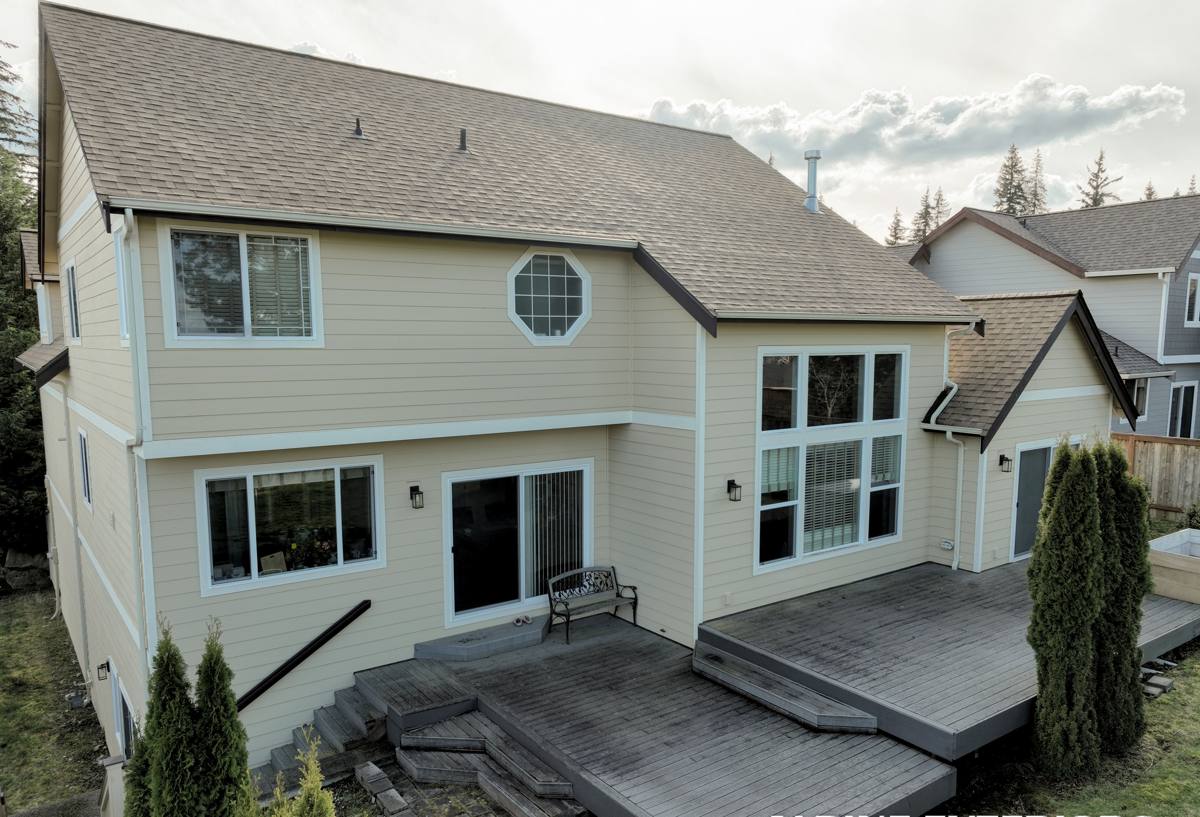
What Actually Takes a Toll on Birchwood Decks
Salt Air and Corroding Hardware
Salt-laden marine air doesn't need a storm to do its work — it settles onto exposed metal steadily, day after day, and speeds up corrosion in fasteners, joist hangers, and railing hardware well before any of that shows on the surface. A corroded fastener loses holding strength quietly. What you notice is a board that's started to lift slightly at one end, a railing that flexes more than it used to, or a faint rust stain bleeding out around a screw head. By the time it's visible, the corrosion underneath is usually further along than it looks.
Driving Rain, Wind, and Trapped Moisture
Rain in this part of Whatcom County rarely falls straight down for long. Wind pushes it sideways and up, driving it under railing caps, into ledger connections, and between boards that weren't gapped wide enough to shed water and dry out between storms. A deck that handles a calm, light rain just fine can still be taking on water at the connections the moment wind gets involved — which, out here, is most of the time.
A Moss Season That Doesn't Let Up
Mild, damp conditions give moss and algae a long growing window in Birchwood, and a horizontal deck surface is one of the first places it takes hold, since it holds water longer than a vertical wall and stays damp between rain events. Shaded decks and north-facing surfaces are usually first to show it, but even sun-exposed decking with any surface porosity will pick up moss buildup over a season or two if it isn't kept clear. Moss holding moisture against a surface is more than a cosmetic nuisance — it's one of the more common reasons boards start to soften and stay damp long after everything else around them has dried out.
Cosmetic Wear vs. Structural Problems
Not every issue on an aging deck calls for the same response, and telling the two apart correctly is the actual job of a real repair estimate — not just eyeballing the surface.
| Symptom | Usually Cosmetic | Often Structural |
|---|---|---|
| Grayed, weathered wood surface | Yes — normal weathering | Only if boards are also soft or splitting deeply |
| Squeaking or slight bounce underfoot | Sometimes — loose surface fasteners | Often — loosened joists or hangers below |
| Railing that flexes or wiggles | Rarely | Usually — loose posts or corroded hardware |
| Soft or spongy spot in decking | No | Yes — rot or trapped moisture underneath |
| Rust staining around fasteners | Cosmetic if isolated and shallow | Can point to hardware failure underneath |
| Gap or movement where deck meets house | No | Yes — ledger connection needs attention now |
| Moss or dark staining on boards | Usually — surface-level buildup | Only if boards stay soft after cleaning |
Cosmetic issues affect appearance and can generally wait for routine maintenance. Structural issues affect the deck's ability to safely hold weight, and anything involving the ledger board, joist hangers, or support posts shouldn't be deferred just because it isn't inconvenient yet.
How We Diagnose a Deck Before Recommending Anything
A repair estimate that's actually worth trusting starts with a real inspection, not a walk-around and a guess. On a Birchwood deck, that typically includes:
- Checking the ledger board connection to the house — the most common serious failure point, and the hardest one to catch from a casual look
- Probing boards and framing directly for soft spots, rather than relying on how the surface looks from a few feet away
- Inspecting joist hangers, fasteners, and railing hardware for corrosion, especially on decks with direct exposure to open air or water views
- Checking support posts and footings for movement, settling, or standing water contact underneath
- Confirming railing attachment and height meet current code, particularly on elevated decks where a failure has real consequences
- Looking at drainage, board gapping, and airflow underneath the deck, since poor ventilation there feeds nearly every other problem on this list
We walk through what we actually find — what needs attention now, what can reasonably be monitored, and what's purely cosmetic — before recommending a scope of work. If a deck doesn't need what we were originally called out for, we'll say so.
Repair or Replace: How That Decision Actually Gets Made
Homeowners often assume any deck problem means tearing the whole thing out, or the opposite — that a repair is always the cheaper, equally good option. Neither holds up consistently. The factors that actually decide it:
| Factor | Leans Toward Repair | Leans Toward Replacement |
|---|---|---|
| Substructure condition | Isolated rot or corrosion at a few joists or hangers | Moisture damage spread through much of the framing |
| Age of the structure | Mid-life, framing still sound | Near the end of its practical service life |
| Original build quality | Built to hold up against local salt and moisture exposure | Undersized framing or hardware for this climate from the start |
| Surface vs. structure | Framing solid, surface boards worn or faded | Both surface and structure are failing together |
We'll give a straight answer on which category a given deck falls into, including telling you when replacement is genuinely the more sensible path — not defaulting to whichever job happens to be bigger.
What a Correct Repair Involves
Matching Materials to What's Already There
Repairing a deck means working with the existing structure and, in most cases, the existing surface material — wood, composite, or PVC. Matching board profile, fastening method, and color or finish as closely as possible keeps a repair from looking like a patch job. On composite and PVC decking especially, discontinued colors or profiles can make an exact match difficult, and we'll say so upfront rather than after the work is done.
Hardware Upgrades, Not Like-for-Like Replacement
When we replace corroded fasteners or hangers, we use stainless steel or coastal-rated hardware suited to salt air exposure — not a straight swap with standard-grade hardware that will simply corrode again on roughly the same timeline. This is one of the places a repair either holds up for years or ends up needing to be redone sooner than it should.
Fixing the Cause, Not Just the Symptom
A soft board or a corroded hanger is usually a symptom of moisture that's had somewhere to sit — tight board gapping, poor drainage underneath, or a shaded spot that never fully dries out between rain events. Replacing the damaged part without addressing why it failed just resets the clock on the same problem. Where we can, we widen board gaps for drainage, improve airflow underneath, or adjust flashing at the ledger so the fix actually outlasts the next few wet seasons.
Keeping a Repaired Deck Ahead of Birchwood's Climate
A properly repaired deck still needs some routine attention in this climate to get its full remaining life out of it. A short list worth keeping in mind:
- Rinse the deck surface periodically to clear salt residue, pollen, and organic buildup before it works into the wood grain or cap layer
- Keep gutters, downspouts, and nearby drainage clear so runoff isn't landing on or pooling near the deck
- Sweep leaves and debris out of board gaps and corners, especially in shaded spots, so moss doesn't get a foothold to begin with
- Reseal or restain wood decking on the manufacturer-recommended schedule, not just when it starts looking gray
- Check railings and stair connections once a year for looseness, since that's often the first sign hardware is starting to work loose or corrode
- Have a soft or spongy board looked at as soon as you notice it — waiting rarely makes that kind of repair smaller or cheaper
Why Hiring a Crew That Already Works Birchwood Matters
A repair crew that already knows this part of Whatcom County isn't guessing at how much salt exposure, driving rain, and moss pressure a given deck has been under — they've seen the pattern on other decks in the same conditions and know where problems tend to start first. That shows up in a more accurate diagnosis, hardware and material choices that are actually suited to the exposure a Birchwood deck sees, and a repair scope that addresses what's actually failing rather than a generic checklist. It also means someone who can speak to local permitting and code requirements without treating your project as the first deck they've ever worked on in this kind of coastal, damp climate.
A quick checklist worth using before you hire anyone for deck repair work:
- Do they inspect the ledger board connection and probe for soft spots, not just look at the surface?
- Does the estimate separate cosmetic work from structural repair, with a clear reason for each?
- Will they use stainless steel or coastal-rated hardware, not standard-grade replacement fasteners?
- Can they explain what caused the damage, not just what they're replacing?
- Do they carry current WA contractor licensing, liability insurance, and workers' compensation?
- Have they worked on decks in Birchwood or similar parts of Whatcom County recently?
If you're seeing a soft board, a loose railing, or a deck that just doesn't feel as solid as it used to, we're glad to come take an honest look and put together a straightforward, no-pressure estimate — no assumption that repair means replacement, and no guessing about what your deck actually needs. Use the form below to request a free estimate.