 Whatcom County
 Why Fairhaven Homes Wear Out Siding Faster Than Inland Homes
Fairhaven sits close to Bellingham Bay, which means homes here take on a mix of stresses that inland Whatcom County neighborhoods simply don't deal with as often. Salt-laden air off the water accelerates corrosion on fasteners and trim, wind-driven rain pushes moisture into seams and laps that would stay dry elsewhere, and the long, damp Pacific Northwest moss season keeps north- and shade-facing walls wet for months at a stretch. Any one of those on its own is manageable. Together, they're why siding that looks fine in year six can be hiding real problems by year twelve if it wasn't installed with this specific exposure in mind.
This isn't a scare story — older siding materials in Fairhaven's setting can and do last a long time. But "last a long time" depends heavily on what the siding is made of, how it was detailed at the seams, and whether it was ever properly maintained. A siding replacement here is a chance to correct all three at once.
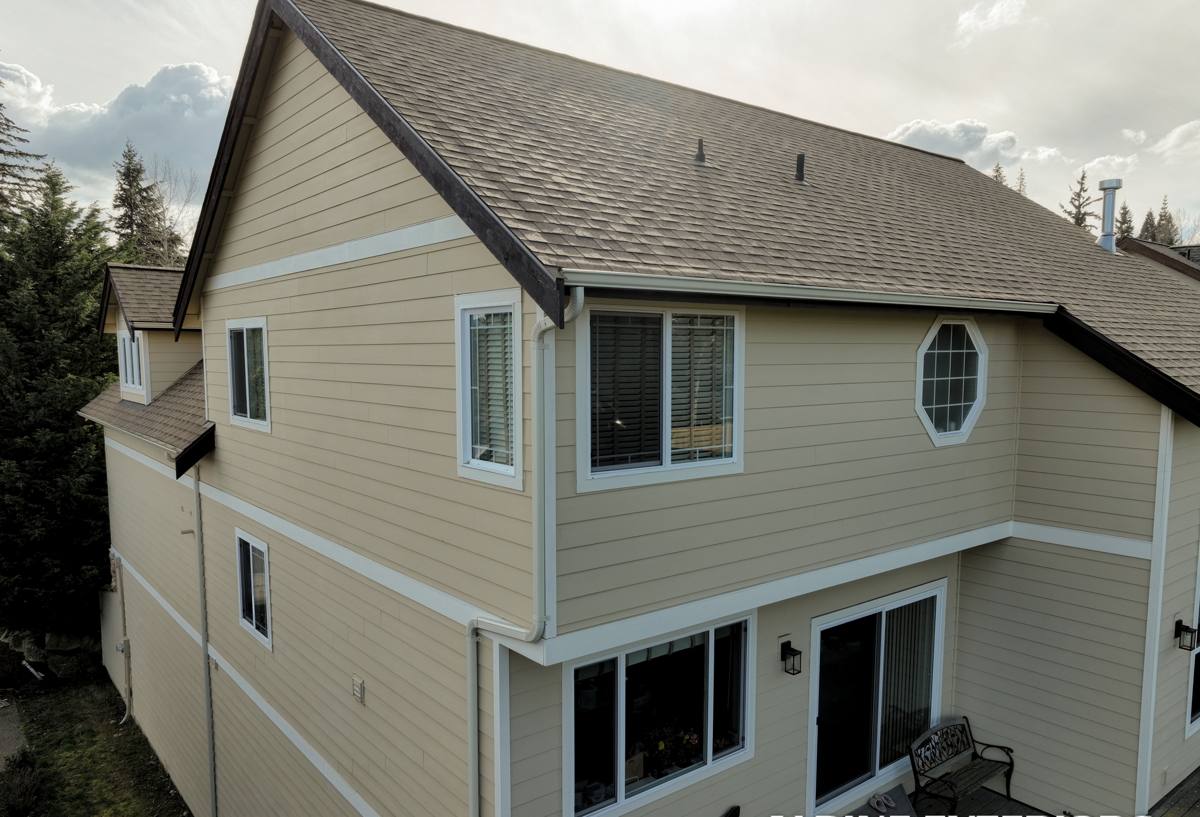
What Fairhaven's Climate Actually Does to Siding
Salt Air and Corrosion
Proximity to the water means airborne salt settles on exterior surfaces even on days without direct spray. Over years, that accelerates rust on exposed steel fasteners, staples, and any unprotected metal flashing. Corroded fasteners eventually loosen their grip on siding panels, which opens tiny gaps that water then works its way into.
Driving Rain
Storms coming off the bay don't just fall straight down — wind pushes rain sideways into wall assemblies, testing every lap, joint, and penetration. Siding that relies on caulk alone to keep water out, rather than proper shingling and flashing, fails faster under this kind of exposure than it would in a more sheltered inland yard.
Moss and Sustained Moisture
Whatcom County's wet season stretches long, and shaded or north-facing walls in Fairhaven can stay damp for weeks without direct sun to dry them out. Moss and algae take hold in that environment, and on porous or water-absorbent siding materials, sustained dampness behind moss growth is what eventually leads to rot, delamination, or paint failure — not the moss itself, but the moisture it holds against the wall.
What a Correct Siding Replacement Involves Here
A siding replacement isn't just swapping old panels for new ones. In an exposure like Fairhaven's, the work under and around the siding matters as much as the siding itself.
- Full tear-off and inspection: Removing old siding down to the sheathing lets us catch hidden rot, soft spots, or prior water damage before it's sealed back up behind new material.
- Weather-resistive barrier: A properly lapped and sealed water-resistive barrier goes on before any siding, giving the wall a second line of defense against driving rain.
- Flashing at every penetration: Windows, doors, vents, and any wall penetration get flashed to shed water outward and downward, not caulked as an afterthought.
- Correct fastener spec: Fasteners rated for coastal/corrosive exposure, driven to manufacturer spec — not overdriven, which cracks panels, and not underdriven, which lets siding work loose.
- Proper clearances: Siding held clear of the ground, roofline, and decks per code and manufacturer requirements, so it isn't sitting in standing moisture.
- Factory-finished material: A factory-applied finish holds up to salt air and damp shade far better than field-applied paint, which is the first thing to fail under repeated wet-dry cycling.
Why We Only Install James Hardie Fiber Cement
We standardized on James Hardie fiber cement siding for every job we take on, including here in Fairhaven, and we don't install vinyl, LP SmartSide, Cemplank, Allura, primed spruce, or cedar. That's not a marketing line — it's a decision based on what actually holds up under Whatcom County's coastal-adjacent, wet-heavy climate.
How It Handles This Climate Specifically
- Non-combustible fiber cement: Doesn't warp, swell, or rot the way wood-based or wood-composite sidings can when they take on sustained moisture from moss season.
- ColorPlus factory finish: Baked-on finish resists fading and holds up to salt air far longer than field-applied paint, and it comes with its own finish warranty separate from the substrate warranty.
- HZ5 product line: Hardie's HZ5 formulation is engineered for wetter, harsher climates like the Pacific Northwest, versus their milder-climate HZ10 line used in drier regions.
- Dimensionally stable: Fiber cement doesn't expand and contract with moisture the way wood or wood-composite products do, which means fewer opened seams for wind-driven rain to exploit over time.
- Strong transferable warranty: A long, transferable warranty backed by a large, established manufacturer matters if you ever sell — buyers and inspectors both recognize it.
To be fair to the alternatives: vinyl is inexpensive and low-maintenance in mild climates, LP SmartSide performs reasonably when perfectly detailed and maintained, and cedar has a look many homeowners love. Our issue isn't that these products are bad in the abstract — it's that in a salt-air, driving-rain, long-moss-season environment like Fairhaven's, they carry maintenance burdens or moisture vulnerabilities that fiber cement simply doesn't have. We'd rather install one product very well than install several products with an asterisk attached to each.
Comparing Siding Options for a Fairhaven Home
| Material | Salt Air Resistance | Moisture/Moss Tolerance | Finish Longevity | Our Take |
|---|---|---|---|---|
| James Hardie Fiber Cement | High | High — won't rot or swell | Factory-baked, long-lasting | What we install |
| Vinyl | Moderate | Moderate — can trap moisture behind panels | Fades over time, not repaintable | Not installed by us |
| LP SmartSide | Moderate | Vulnerable at cut edges if not sealed perfectly | Field or factory finish, variable | Not installed by us |
| Cedar | Low-Moderate | Needs regular sealing/staining to resist moss and rot | Requires ongoing maintenance | Not installed by us |
Our Process for a Fairhaven Siding Replacement
- On-site assessment: We walk the exterior, check for hidden moisture or rot around windows, roofline, and grade-level areas, and identify which walls take the most weather.
- Written scope and estimate: You get a clear breakdown of tear-off, sheathing repair (if needed), weather barrier, flashing, siding, and trim — no vague allowances.
- Tear-off and sheathing check: Old siding comes off, sheathing gets inspected and repaired where necessary before anything new goes on.
- Weather barrier and flashing install: Properly lapped house wrap and flashed penetrations, done before siding starts.
- Hardie panel/plank installation: Installed to manufacturer spec — fastener type, spacing, clearances, and joint treatment all matched to HZ5 requirements.
- Trim, caulking, and touch-up: Final detailing at corners, windows, and transitions, using products suited to a wet coastal-adjacent climate.
- Walkthrough: We go over the finished job with you before calling it done.
Why Hiring a Crew That Already Works Fairhaven Matters
Fairhaven's older housing stock and tight lots mean every project has its own quirks — narrow side yards, mature landscaping close to the walls, and in some cases older framing that needs a careful eye during tear-off. A crew that's worked this neighborhood before knows to check for those things up front instead of discovering them mid-project. Local experience also means knowing which wall orientations in this specific pocket of Whatcom County take the worst of the wind-driven rain and moss buildup, so we can flag anything that needs extra attention before it becomes a bigger problem down the line.
There's also a practical side: a contractor based in and around Whatcom County can respond quickly if something needs a follow-up look, and stands behind the work with a local reputation on the line — not a name that disappears after the invoice is paid.
Signs It's Time to Replace, Not Repair
- Soft or spongy spots when you press on the siding, especially near the ground or under windows
- Persistent moss or algae growth that returns within weeks of cleaning
- Paint that's peeling or bubbling rather than just fading
- Visible warping, cupping, or gaps that have opened between boards or panels
- Rust streaks below fasteners or trim
- Rising energy bills that suggest the wall assembly is no longer doing its job
One or two of these can sometimes be spot-repaired. Several at once, especially on a home that's original or hasn't been resided in a couple of decades, usually points to a full replacement being the more cost-effective path — patchwork repairs on failing material rarely hold up long in this climate.
What Affects the Cost of a Fairhaven Siding Job
| Factor | Why It Matters |
|---|---|
| Extent of hidden damage | Rot found during tear-off means sheathing or framing repair before new siding goes on |
| Home size and wall complexity | More corners, gables, and trim details mean more labor and material |
| Access and site conditions | Tight lots or mature landscaping near walls can slow staging and installation |
| Siding profile chosen | Lap, panel, and shingle-style Hardie products carry different material and labor costs |
| Trim and detail work | Corner boards, window trim, and fascia work add to scope beyond the field siding itself |
We don't quote broad ballpark numbers without seeing the home — too much depends on the condition underneath the existing siding. What we can tell you is that a correctly detailed install, done once, almost always costs less over the life of the siding than a cheaper install that needs early repairs or a premature redo.
If your Fairhaven home's siding is showing its age, or you just want an honest read on what shape it's really in, we're happy to take a look. Fill out the form below for a free, no-pressure estimate.