 Whatcom County
 Getting Windows Right the First Time in Cordata
Cordata sits in one of the wetter, damper corners of Whatcom County, close enough to Bellingham Bay to pick up salt-laden air and far enough into the marine weather pattern to see driving rain for months at a stretch. When a home is being built from the ground up, the window installation happens exactly once with open framing — there's no siding, no trim, and no finished wall to work around. That's an advantage if the flashing and water management are done correctly, and a long-term liability if they're not. Once the siding goes on, any gaps, skipped flashing tape, or improperly lapped house wrap are hidden until they show up years later as rot, stains, or a moldy smell in a wall cavity.
New-construction window work is a different trade than replacement window work. Replacement windows fit into an existing, already-flashed opening. New-construction windows go into raw framed openings and rely on the installer to build the entire water management system around them — sill pans, flashing tape, head flashing, and the tie-in to the weather-resistant barrier. In a climate like ours, that sequence matters more than the window brand on the label.
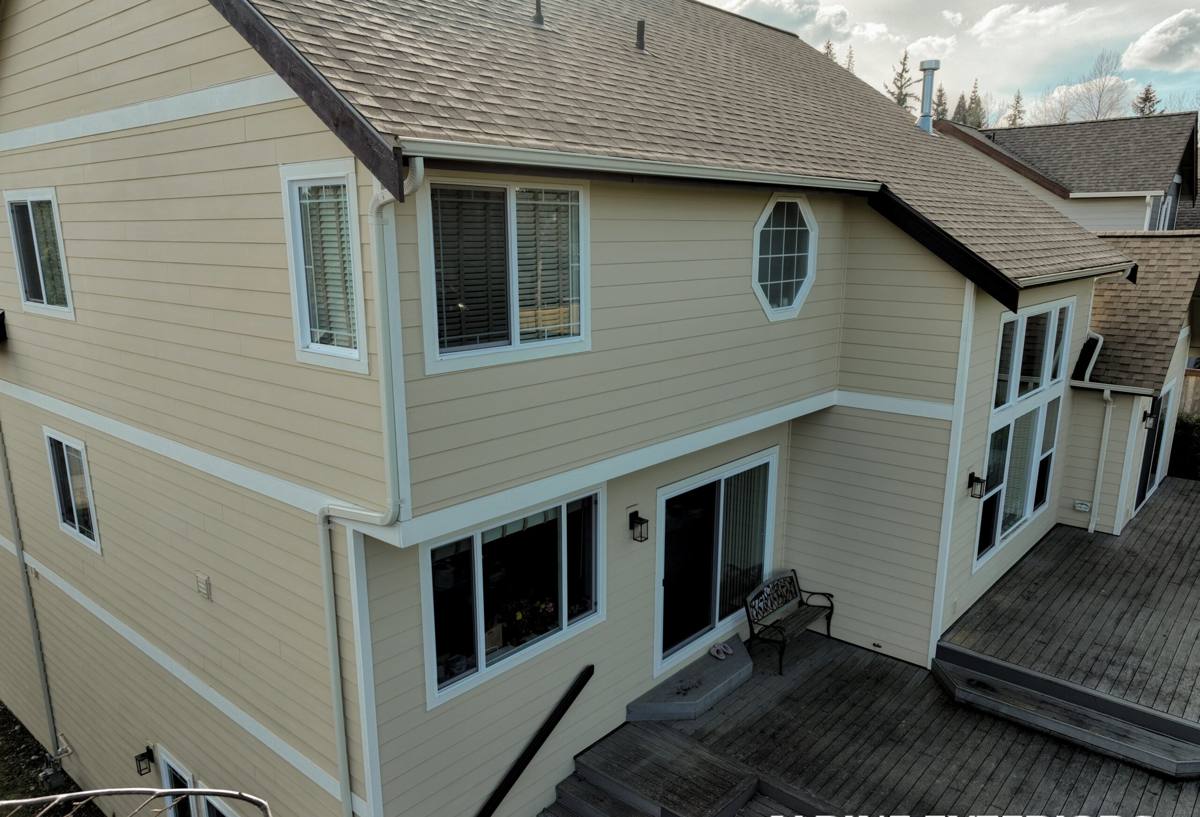
What Whatcom County's Climate Demands From a New-Build Window Install
Salt Air and Corrosion
Proximity to the Sound means airborne salt settles on window hardware, fasteners, and metal flashing over time. Fasteners and flashing components that aren't rated for coastal exposure can corrode years before the window sash itself shows any wear, so material selection at the framing stage isn't cosmetic — it affects how long the whole assembly lasts.
Driving Rain
Whatcom County storms frequently come with wind-driven rain that hits window openings at an angle, not straight down. A flat or minimal sill pan design that would be fine in a drier climate isn't enough here. New-construction openings need a sloped sill pan and properly shingled flashing layers so wind-driven water is directed back out, not pushed up under the sill or behind the flange.
Long Moss and Moisture Season
Extended damp stretches mean any wall assembly with a hidden gap stays wet longer before it has a chance to dry out. That's the core reason new-construction flashing detail work is non-negotiable here — a minor installation shortcut that might dry out fine in a warmer, drier region can stay saturated for weeks in a Whatcom County wall cavity.
What a Correct New-Construction Window Install Actually Involves
A proper install isn't just setting the window in the rough opening and running a bead of caulk around the outside. The sequence, done in order, looks like this:
- Inspect the rough opening for correct size, square, and level before the window ever arrives on site.
- Install a sloped sill pan flashing so any water that gets past the window sheds outward, away from the framing.
- Set the window with backer rod and sealant at the right points — sealing everything solid actually traps moisture rather than letting incidental water escape.
- Flash the sides and head in the correct shingle-lap order so each layer sheds onto the one below it, tying into the weather-resistant barrier above and beside the opening.
- Confirm the nailing fin is fastened per the manufacturer's schedule — under-fastening risks air and water infiltration, over-fastening or misplaced fasteners can void the warranty.
- Insulate the gap between the window frame and rough opening with a low-expansion foam or backer material, never packed tight enough to bow the frame.
- Interior air seal and trim only after the exterior water management is confirmed complete.
Any one of these steps skipped or rushed is the kind of thing that doesn't show up on a walkthrough — it shows up as a stain on drywall two winters later.
Choosing the Right Window for a Cordata New Build
Frame material matters more here than in a lot of the country because of the salt air and sustained moisture exposure. There's no single correct answer for every home — it depends on budget, the home's design, and how much upkeep the owner wants to take on.
| Frame Material | Moisture/Salt-Air Behavior | Maintenance | Typical Trade-Offs |
|---|---|---|---|
| Vinyl | Doesn't corrode; performs well in damp coastal air | Low | Budget-friendly; frame color/style options more limited |
| Fiberglass | Very stable in moisture and temperature swings; low expansion/contraction | Low | Higher upfront cost; strong long-term value in wet climates |
| Wood-clad | Good performance if the cladding and flashing are correct; wood core still needs protection from bulk water | Moderate | Attractive interior wood look; relies heavily on install quality |
| Aluminum | Prone to condensation and corrosion in salt air unless thermally broken | Moderate to high | Slim sightlines; generally not our first recommendation this close to the water without a thermal break |
We'll walk through these trade-offs honestly during the estimate rather than steering every job toward one product line — the right call depends on the home's exposure, the budget, and what the builder's plans call for.
Energy Code and Performance Considerations
Washington's energy code sets minimum U-factor requirements for new construction, and those requirements are stricter than a lot of homeowners expect. On a new build, window performance also affects whether the rest of the building envelope calculation passes inspection — it's not an isolated decision. We check proposed window specs against the current code requirements before ordering, so there's no surprise at final inspection.
Beyond the code minimum, a few performance details are worth planning for specifically because of our climate:
- Condensation resistance rating — matters given our extended damp season and temperature swings between inside and outside air
- Low-E glass coating matched to solar orientation — west and south-facing openings behave differently than north-facing ones
- Proper egress sizing for bedroom windows, which is a life-safety code item inspectors check closely
- Multi-point locking hardware, which holds a sash tighter against wind-driven rain than single-point latches
Our Process for New-Construction Window Work in Cordata
We work directly with builders and general contractors, so our process is built around fitting into a construction schedule without becoming the bottleneck:
- Plan review — we look at the window schedule and rough opening sizes before framing is finalized, catching sizing conflicts early.
- Product selection — we walk the homeowner or builder through frame material and performance options suited to the site's exposure.
- Coordinated install timing — windows go in after the weather-resistant barrier is up but before siding, so flashing integration is done in the correct order, not patched afterward.
- Installation — sill pan, flashing, fastening, and air sealing done to manufacturer spec and current code.
- Documentation — we photograph flashing details before they're covered by siding, so there's a record of what's behind the wall if it's ever needed later.
- Final check — operation, seal, and hardware function verified before we consider the job complete.
Why It Matters to Hire a Crew That Already Works in Cordata
New-construction window installation done wrong is expensive to diagnose and fix once siding is up — it usually means pulling trim and siding back off to get at the flashing. A crew that already works around Whatcom County understands the exposure differences between an open, wind-facing lot and a more sheltered one, knows what local building inspectors are checking for at framing and final inspections, and is used to coordinating with the general contractors who build in this area. That familiarity shows up in fewer callbacks and fewer surprises at inspection, not in anything flashy — it's just steady, correct work done the same way every time.
Installation Quality Checklist
If you're a homeowner working with a builder, or a GC bringing in a window sub, these are the items worth confirming on any new-construction window job in this climate:
- Sloped sill pan flashing installed under every window, not just spot sealant
- Flashing shingle-lapped correctly with the weather-resistant barrier, top layer over bottom
- Fasteners and flashing tape rated for coastal/salt-air exposure
- Nailing fin fastened per manufacturer's schedule, not just "enough to hold it"
- Backer rod and sealant used at joints designed to seal, with room left for incidental drainage where the window design calls for it
- Window U-factor and performance specs checked against current Washington energy code before ordering
- Photos taken of flashing details before siding covers them
If you're building in Cordata or elsewhere in Whatcom County and want a straight answer on window options, timing, and what your specific lot's exposure calls for, we're happy to walk the plans with you. Reach out for a free, no-pressure estimate using the form below.