 Whatcom County
 Siding Installation Built for Ferndale's Weather, Not Just Its Looks
Ferndale sits close enough to Bellingham Bay and the Strait of Georgia that salt-laden air is a real factor in how exterior materials age here, and it sits far enough north and west that winter rain systems roll through for months at a time. Add in the shaded, damp conditions that let moss and algae take hold on north-facing walls and roof lines, and you have a climate that is genuinely tough on siding. A siding installation in Ferndale isn't just a cosmetic upgrade — it's a decision about which material and which installation details will actually hold up against salt exposure, driving rain, and a moss season that can run from October through April.
We install James Hardie fiber cement siding exclusively, and this page walks through what Ferndale homes specifically need from a siding system, what a correct installation involves, and how our process protects the work for the long haul.
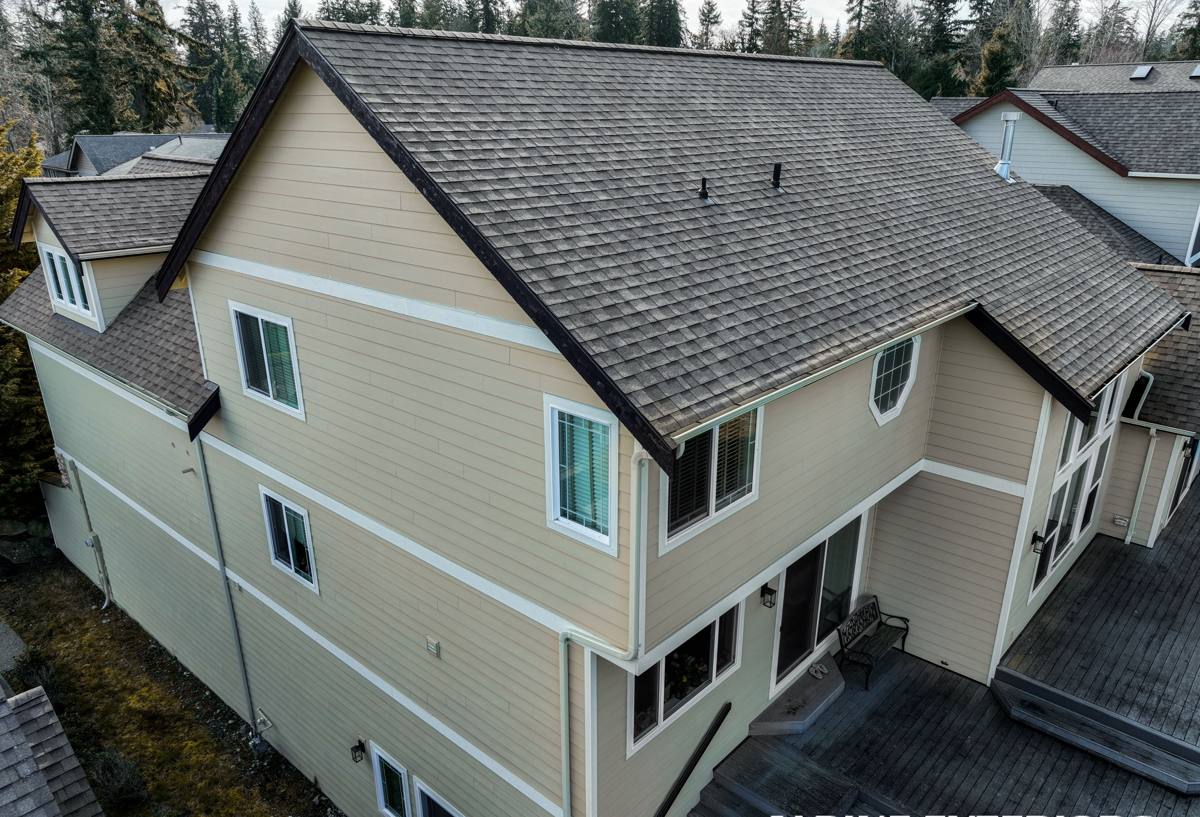
What Whatcom County's Climate Actually Does to Siding
Salt Air
Homes closer to the water deal with airborne salt that accelerates corrosion on fasteners, flashing, and any metal trim components. Salt exposure also speeds up the breakdown of paint films and can pit or discolor lower-grade cladding materials over years of exposure. Materials and fasteners that aren't rated for coastal-adjacent conditions age faster here than they would inland.
Driving Rain
Whatcom County gets wind-driven rain, not just straight-down rain. That matters because wind pushes water sideways into laps, seams, and penetrations that a calm-weather installation might get away with cutting corners on. A siding system's water-shedding details — how each course overlaps the one below it, how corners and trim are flashed, how windows and doors are integrated — carry more weight in a driving-rain climate than in a dry one.
Moss and Sustained Moisture
Shaded walls, especially north- and east-facing elevations under mature trees, stay damp for extended stretches. That's the environment moss and algae need to establish. Beyond the cosmetic staining, sustained surface moisture is hard on any siding material that can absorb water or swell, and it keeps the wall assembly behind the siding wetter for longer, which is exactly the condition a good water-resistive barrier and drainage plane are designed to manage.
Why We Install Only James Hardie Fiber Cement
We made a decision as a company to install one product system — James Hardie fiber cement — rather than carry vinyl, LP SmartSide, or other fiber cement brands. That's not a marketing position; it's a standard we hold because of what we've seen matter in this specific climate.
- Fiber cement is non-combustible, which matters increasingly as insurers and building codes pay closer attention to exterior wildfire and ember exposure.
- Hardie's ColorPlus factory-applied finish is baked on and cured under controlled conditions, which gives it better resistance to fading and chalking than field-applied paint, and it holds up well against the coastal air and near-constant damp conditions Ferndale sees.
- Hardie's HZ5 product line is engineered for climates with freeze-thaw cycling and moisture exposure like the Pacific Northwest — the substrate itself is formulated for the conditions we install in.
- Fiber cement doesn't feed mold or rot the way wood-based siding products can when moisture gets behind them, which matters directly in a region with a real moss and algae season.
- It carries a strong transferable warranty backed by a manufacturer with a long track record, rather than a shorter warranty tied to a smaller regional producer.
We're upfront that other products have their advocates and their price points. Our position is simply that after years of installing and repairing siding in this exact climate, Hardie fiber cement is the one system we're willing to put our name behind and back with our own workmanship warranty.
What a Correct Siding Installation Actually Involves
The material is only half the equation. A huge share of siding failures we get called out to inspect aren't material failures at all — they're installation shortcuts that let water in behind a perfectly good product. A correct installation in a climate like Ferndale's includes:
Water-Resistive Barrier and Drainage Plane
A continuous weather-resistive barrier goes over the sheathing before any siding goes up, and in a wet climate we install a drainage plane — typically a wrinkled or channeled housewrap or a rainscreen furring system — so that any moisture that does get past the siding has somewhere to go and can dry out rather than sitting against the sheathing.
Flashing at Every Penetration
Windows, doors, hose bibs, vents, and light fixtures all need proper head, side, and sill flashing integrated with the water-resistive barrier using a shingle-lap sequence so water is always directed outward and down, never trapped behind trim.
Correct Fastening
Hardie siding has specific fastener requirements — corrosion-resistant nails or screws, driven at the right depth and spacing, into solid backing. Overdriven or underdriven fasteners are one of the most common defects we find on prior installations, and in a salt-air environment, using the wrong fastener grade shortens the life of the whole assembly.
Proper Clearances
Siding needs clearance from grade, roof lines, decks, and patios — generally a minimum gap that keeps the bottom edge from sitting in standing water or constant splash-back. This is one of the most commonly ignored details on budget installations, and it's a direct cause of moisture damage at the bottom courses.
Caulking Only Where It Belongs
Manufacturer detailing calls for caulk at specific joints, not as a substitute for correct flashing everywhere else. An installation that relies on caulk to do the flashing's job will fail once that caulk ages, cracks, or shrinks — which happens faster under UV and salt exposure than most homeowners expect.
Our Installation Process
- On-site assessment. We look at your home's exposure — how much wind-driven rain and shade each wall gets, current siding condition, existing moisture damage, and trim/window conditions.
- Tear-off and sheathing inspection. We remove the existing siding down to the sheathing and check for rot, soft spots, or prior water intrusion before anything new goes up. Any damaged sheathing is repaired before we move forward.
- Weather barrier and drainage plane installation. A continuous water-resistive barrier and drainage layer goes on, lapped correctly from the bottom up.
- Flashing integration. All windows, doors, and penetrations are flashed and integrated with the barrier before trim and siding go on.
- Hardie siding and trim installation. Panels or lap siding are installed to manufacturer fastening and clearance specs, with corner and trim details built to shed water outward.
- Final inspection and walkthrough. We walk the finished job with you, checking seams, caulking, and clearances before we call it done.
Signs Your Ferndale Home Needs New Siding
Not every siding problem is obvious from the street. Some of the most common signs we find during assessments include:
- Soft or spongy spots when pressing on the siding, especially near the bottom courses or under windows
- Persistent moss or algae growth that comes back quickly after cleaning
- Paint or finish that's chalking, peeling, or fading unevenly, particularly on walls facing prevailing wind and rain
- Visible gaps, warping, or buckling at seams and corners
- Interior signs like peeling paint, musty smells, or staining on walls that back up to exterior siding
- Rust streaking from fasteners or trim, a common early sign of corrosion in salt-air-exposed areas
Cost Factors in a Ferndale Siding Installation
Every home is different, but the same handful of factors drive most of the cost variation we see on Ferndale jobs:
| Factor | Why It Matters |
|---|---|
| Home size and wall complexity | More square footage, dormers, and corners mean more material and labor time |
| Condition of existing sheathing | Rot or water damage found during tear-off requires repair before new siding goes on |
| Siding profile chosen | Lap siding, shingle-style panels, and board-and-batten each have different material and labor costs |
| Trim and detail work | Window and door trim, corner boards, and fascia detailing add labor beyond the flat wall area |
| Access and site conditions | Multi-story walls, tight lot lines, or landscaping obstructions affect staging and labor time |
| Drainage plane upgrade | Adding a rainscreen system for extra moisture protection adds cost but adds long-term durability, especially on shaded or wind-exposed walls |
Choosing a Contractor Who Already Works in Ferndale
Siding installation is detail work, and the details that matter most — flashing sequencing, clearance requirements, fastening specs — are exactly the ones that are invisible once the job is finished and easy to shortcut if a crew isn't used to being held to them. A contractor who already works regularly in Whatcom County has already seen how these details play out over years of local weather, not just at initial installation.
Before you hire anyone for a siding installation, it's worth asking directly:
- Are you a certified or preferred installer for the siding brand you're proposing?
- What's your fastening and flashing detail at windows and doors, specifically?
- Do you install a drainage plane or rainscreen, or just housewrap directly under the siding?
- What's covered under your workmanship warranty, and for how long?
- Can you walk me through your tear-off and sheathing inspection process before quoting a price?
A contractor who can answer these clearly and specifically, without vague reassurances, is one who's actually thought through the installation rather than just quoting a square-footage price.
Get a Straightforward Estimate
If your Ferndale home's siding is showing wear, or you're planning ahead for a replacement, we're happy to take a look and give you an honest assessment — no pressure, no inflated urgency. Fill out the form below to schedule a free estimate.