 Whatcom County
 South Hill's Climate Is Harder on Siding Than People Expect
South Hill sits close enough to Bellingham Bay that salt-laden air reaches exterior wall surfaces year-round, and it's high and exposed enough to take the full brunt of Pacific storm systems moving through Whatcom County. Add the tree canopy that gives many of the neighborhood's older lots their character, and you get a set of conditions that ages siding faster than a homeowner moving here from a drier climate would expect. None of this is unique to any one house — it's the baseline every siding product on a South Hill home has to survive, and it's why we treat this as a local specialty rather than a one-size-fits-all install.
Salt Air Off Bellingham Bay
Salt air doesn't just corrode metal — it accelerates the breakdown of paint films, gaskets, and caulk joints, and it draws moisture into any surface that isn't sealed correctly. Siding that relies on field-applied paint for its finish tends to chalk and fade faster in this kind of air than in an inland climate, which is one reason factory-cured finishes hold up better here.
Driving Rain and Wind-Driven Moisture
Whatcom County's storms rarely fall straight down. Wind-driven rain pushes water sideways into laps, corners, and penetrations — the exact spots where a siding job either holds up for decades or starts failing within a few winters. Flashing and lap details that would be forgivable in a calmer climate simply don't get away with sloppy execution here.
A Long Moss Season
Shaded, tree-covered lots — common on South Hill's hillside streets — stay damp longer after every rain, which stretches the moss and algae season across most of the year on north- and east-facing walls. Moss holds moisture against a wall surface long after the rain has stopped, which is hard on any material that isn't dimensionally stable or that absorbs water into its core.
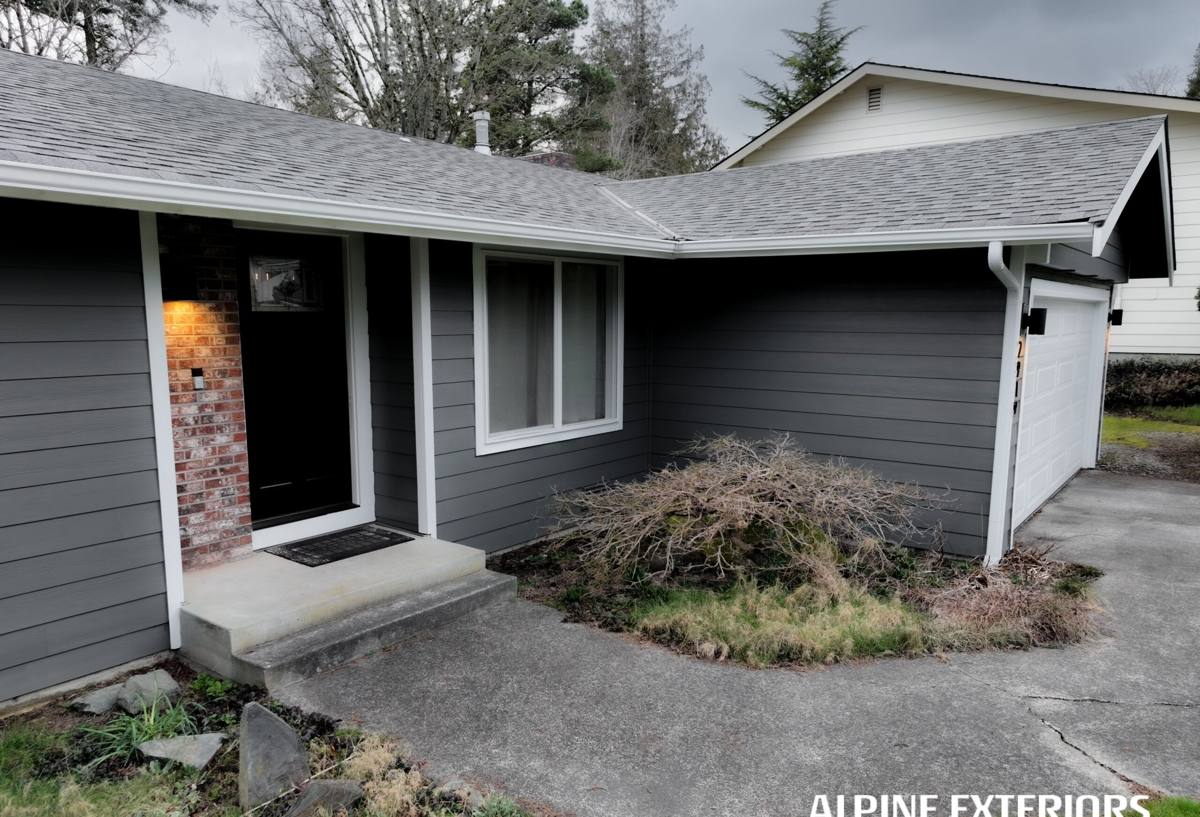
What Correct Installation Actually Involves
Good siding starts underneath the siding itself. A crew that skips the water management layer can install a beautiful-looking wall that fails from behind within a few years — and in a climate like this one, that failure shows up faster than it would somewhere drier.
Weather-Resistive Barrier and Flashing
Every wall needs a continuous weather-resistive barrier lapped correctly with window and door flashing, so any water that gets past the siding has a planned path down and out rather than into the sheathing. This is the single most common shortcut we see undone on older re-sides, and it's non-negotiable on our jobs.
A Drainage Gap Behind the Siding
In a marine climate, a small air and drainage gap between the back of the siding and the weather barrier makes a real difference. It lets bulk water drain, lets trapped moisture dry out instead of sitting against the wall, and reduces the paint and moss issues that show up first on shaded, damp elevations.
Fastening and Manufacturer Specifications
Fiber cement has specific nailing patterns, fastener types, clearances, and caulking requirements published by the manufacturer, and those specs exist for a reason — get them wrong and you can void the warranty even if the wall looks fine on installation day. We install to those specs on every job, not just the ones where someone might check.
Why We Install Only James Hardie Fiber Cement
We don't install vinyl, LP SmartSide, Cemplank, Allura, primed spruce, or cedar. That's a deliberate standard, not a lack of options. Each of those products has real strengths, but none of them holds up as consistently as James Hardie fiber cement against the specific combination of salt air, wind-driven rain, and sustained dampness that South Hill homes deal with.
Built for This Kind of Climate
Hardie's fiber cement is dimensionally stable and doesn't absorb and swell the way wood-based or wood-fiber products can when they stay damp for long stretches. It's also non-combustible, which matters to insurers and to homeowners who've watched wildfire risk creep west in recent summers.
A Factory Finish That Doesn't Rely on the Weather to Cure
Hardie's ColorPlus finish is baked on at the factory under controlled conditions, rather than brushed or sprayed on site and left to cure in whatever weather shows up that week. That matters directly here: a field-applied finish curing in South Hill's damp, cool stretches is working against the climate from day one, while a factory finish arrives already cured and backed by its own finish warranty.
A Warranty Structure Worth Reading Closely
Hardie backs its siding with a long, transferable limited warranty, and the ColorPlus finish carries its own separate coverage. Warranty terms are worth reading in full rather than taking on faith, but the structure is built around a product the manufacturer engineers specifically for regional exposure — including HZ5 product lines formulated for wetter, harsher climates.
| Property | Common Alternatives | James Hardie Fiber Cement |
|---|---|---|
| Moisture response | Can absorb water at cut edges or damaged finish; wood-based products can swell | Cement-based, dimensionally stable when installed and sealed to spec |
| Finish | Often field-applied or factory-primed only, needs repainting on a cycle | Factory-cured ColorPlus finish, separately warrantied |
| Combustibility | Varies; some products are combustible | Non-combustible fiber cement |
| Typical maintenance | Repainting, caulk renewal, moisture checks on a shorter cycle | Occasional wash and caulk check; no repainting cycle required |
Our Process on a South Hill Project
The process doesn't change because a house is on South Hill, but the attention to certain details does — particularly around moisture management and grading for shaded, sloped lots.
- Site walk and assessment — we look at existing siding condition, sheathing access points, moss and staining patterns, tree cover, drainage, and any prior repair history before quoting anything.
- Tear-off and substrate inspection — old siding comes off and the sheathing underneath gets inspected for rot or soft spots, especially around windows, corners, and low wall sections where moisture tends to collect.
- Substrate repair — any damaged sheathing or framing gets repaired or replaced before a single piece of new siding goes up. Covering a moisture problem instead of fixing it just delays the next tear-off.
- Weather barrier and flashing installation — a continuous, correctly lapped weather-resistive barrier and flashing system goes on next, sequenced with window and door openings.
- Hardie installation to manufacturer spec — siding, trim, and fasteners go on following James Hardie's published installation guidelines for clearances, fastening patterns, and caulking.
- Final detailing and cleanup — caulk joints, touch-up paint on cut edges, and site cleanup close out the job, followed by a walkthrough before we call it finished.
Signs Your Siding Is Already Losing the Battle
Because South Hill's climate accelerates certain failure modes, it's worth knowing what to look for before small problems become expensive ones.
- Persistent moss or black streaking that comes back within weeks of cleaning, especially on shaded walls
- Soft, spongy, or bubbling spots when you press on the siding
- Paint that's peeling, chalking heavily, or fading unevenly across a wall
- Visible gaps or separation at seams, corners, or trim boards
- Warping, cupping, or buckling panels
- Rising utility bills or drafts that suggest the wall assembly is no longer performing
- Interior signs like musty smells, staining, or soft drywall near exterior walls
What Drives the Cost of a South Hill Siding Job
Every quote is specific to the house, but a few factors consistently move the number on South Hill projects more than they would on a flatter, more open lot.
| Factor | Why It Matters Here |
|---|---|
| Site access and slope | Hillside lots and mature landscaping can limit equipment staging and require more hand-carrying of material |
| Existing siding removal | Homes with multiple layers of old siding or hidden damage take longer to tear off and repair |
| Sheathing repair scope | Long-term moisture exposure sometimes means more rot repair than expected until the walls are opened up |
| Home size and wall complexity | Dormers, multiple gables, and cut-up wall lines increase both material waste and labor time |
| Trim and accessory scope | Fascia, soffit, and trim replacement alongside siding changes the total project cost |
| Color and profile selection | Custom ColorPlus colors and certain siding profiles carry different material pricing |
Why a Local Crew That Already Works South Hill Matters
A crew that's already worked this neighborhood knows what to expect before the tear-off even starts — where moisture tends to hide behind older siding, how much a shaded lot changes the drying timeline mid-project, and how to sequence work around Whatcom County's wetter months rather than fighting them. That's not something a crew unfamiliar with the area picks up on their first job here.
- Ask how many jobs they've completed specifically in Whatcom County, not just "the Pacific Northwest" broadly
- Ask whether they carry manufacturer certification for Hardie installation, and what that training covered
- Ask to see their standard flashing and weather-barrier detail before work starts, not after
- Ask how they sequence work around rain — a rushed install in wet weather is a warranty risk
- Ask what's actually covered by warranty, and whether it's the manufacturer's warranty, a workmanship warranty, or both
- Get everything — scope, materials, and warranty terms — in writing before signing
Living With New Siding in a Moss-Heavy Climate
New siding still needs a little ongoing attention here, even though it needs far less than older materials did. A yearly rinse-down on shaded, north-facing walls keeps moss and algae from getting a foothold, and an annual look at caulk joints around windows, doors, and trim catches small gaps before they become moisture problems. Because Hardie's finish is factory-cured, you're not on a repainting cycle the way you would be with field-finished siding — but a quick visual check each fall, before the wet season sets in, is still worth the ten minutes it takes.
If your South Hill home's siding is showing its age, or you're planning ahead of a wet season rather than reacting to one, we're happy to take a look and talk through what we're seeing — no pressure, no obligation. Reach out for a free estimate using the form below.