 Whatcom County
 Why Decks in Happy Valley Wear Out Faster Than the Manuals Say
Every deck comes with a manufacturer's expected service life, and almost none of those numbers were calculated with a Whatcom County winter in mind. Happy Valley sits close enough to the water and low enough in the terrain that decks here deal with a combination most inland manufacturers never test for: salt-laden air moving in off the water, long stretches of driving rain, and a moss season that can run from early fall through late spring. Individually, none of those is unusual for the Pacific Northwest. Together, on a horizontal wood or composite surface that never fully dries out, they shorten a deck's real-world lifespan considerably compared to the same product installed somewhere drier.
Salt air accelerates corrosion in fasteners, joist hangers, and any exposed metal hardware. Driving rain — the kind that comes in sideways during a fall or winter storm — gets up under boards and into end grain and joints that a vertical rain gauge would never suggest was at risk. And moss doesn't just look bad; it holds moisture against the deck surface for months at a time, which is exactly the condition that rots wood, delaminates poor composite cores, and turns a solid-looking deck into a soft, unsafe one from the underside up.
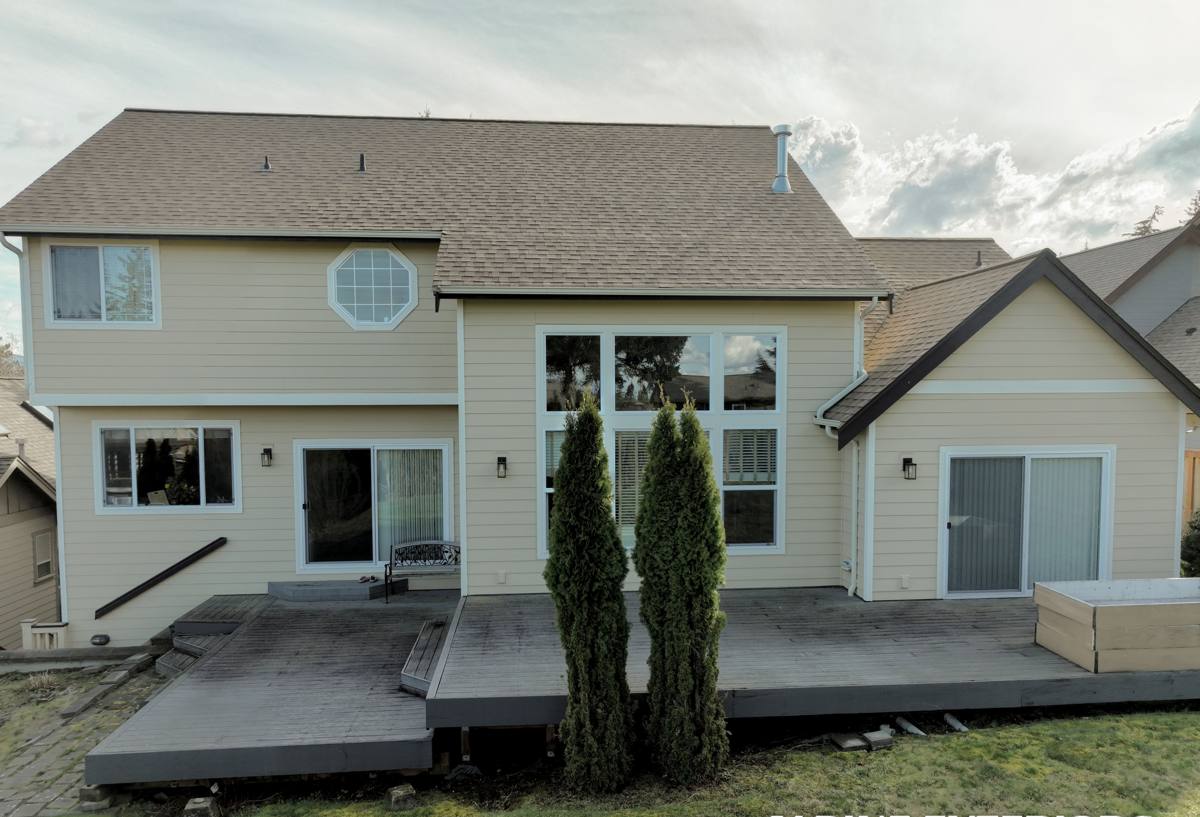
Signs a Happy Valley Deck Needs Replacement, Not Another Repair
Homeowners often call us wanting a quote to "fix a few boards," and sometimes that's genuinely all that's needed. But there's a point where patching a deck costs nearly as much as replacing it and still leaves the underlying problems in place. Here's how we tell the difference on a typical visit:
- Soft or spongy spots anywhere on the deck surface, especially near the house or in shaded corners where moss builds up
- Rust streaks below joist hangers or around fastener heads — a sign the hardware itself is failing, not just the wood around it
- Gaps or movement where the deck ledger board meets the house, which can point to a flashing failure sending water into the rim joist
- Boards that have cupped, crowned, or split along more than a third of the deck
- Visible daylight or rot when you look underneath at the joists and beams, not just the top surface
- A railing that flexes or feels loose when pushed — often a structural issue, not a cosmetic one
If the problems are limited to the top boards and the frame underneath is sound, resurfacing can make sense. Once the framing, ledger connection, or footings are compromised, replacement is the honest answer — patching over a failing structure just delays a bigger repair and adds risk in the meantime.
What a Correct Deck Replacement Actually Involves
A deck replacement done right in this climate is not just swapping old boards for new ones on the existing frame. It's an opportunity to fix the parts of the deck you can't see once it's finished — the parts that determine whether the new deck lasts 10 years or 30.
Framing and Structure
We inspect and, where needed, rebuild the ledger connection, joists, beams, and footings. In a region with this much seasonal rain, joist spacing and beam sizing matter more than they do in drier climates, because wetter wood carries load differently over time. We also check footing depth and condition — undersized or frost-heaved footings are a common issue on older Whatcom County decks that were built to a different code era.
Flashing and Waterproofing
The single most common failure point we find on decks in this area is the ledger flashing — the metal and membrane detail where the deck attaches to the house. Done wrong, or left out entirely on older builds, it lets rain track behind the flashing and into the rim joist and wall framing, which you often don't see until the damage is significant. Correct flashing, properly lapped with the house's water-resistive barrier, is non-negotiable on every replacement we do.
Fasteners and Hardware
Given the salt air this area sees, we use stainless steel or hot-dip galvanized fasteners and connectors rated for coastal exposure, not the cheaper coated hardware that's fine inland but corrodes faster here. This is a small cost difference upfront and a large difference in how the deck ages.
Decking Surface
Whether you choose wood or composite, the surface needs proper board spacing for drainage and airflow, correct fastening for the specific material (face-screwed, hidden clip, or a manufacturer-specified system), and attention to end-grain sealing on any cut boards, which is where most wood decking rot actually starts.
Choosing a Decking Material for Salt Air, Rain, and Moss
There's no single "best" decking material — there's a best material for your budget, your maintenance appetite, and how much moss and shade your particular lot deals with. Here's how the common options actually compare under Whatcom County conditions:
| Material | How It Handles This Climate | Maintenance | Typical Lifespan Here |
|---|---|---|---|
| Pressure-treated wood | Affordable and strong, but needs consistent sealing to resist moss and moisture; end grain is vulnerable | Annual cleaning, re-sealing every 1-2 years | 10-15 years with upkeep |
| Cedar | Naturally moisture- and insect-resistant, ages to a silver-gray if left unfinished; still needs moss management | Periodic cleaning; staining optional but extends life | 15-20 years with care |
| Capped composite | Sheds water well, resists staining, but lower-end or older composite can be prone to moisture wicking at cut ends if not capped properly | Occasional washing; no sealing or staining | 20-25+ years, warranty-backed |
| PVC decking | Fully synthetic, doesn't absorb moisture, handles moss and salt air well; can look less natural to some homeowners | Lowest maintenance of the group | 25+ years, warranty-backed |
Our general standard: on a shaded, low-airflow lot near the water, we steer homeowners away from uncapped or budget composite products, because the maintenance burden and moisture-related warranty gaps aren't worth the upfront savings once you factor in this area's rain and moss exposure. That's a professional judgment call based on how these products perform in wet, shaded conditions — not a knock on any manufacturer.
How Our Deck Replacement Process Works
- On-site assessment. We inspect the existing deck, ledger, framing, and footings, and identify what's driving the failure — not just what's visible from the top.
- Written scope and estimate. You get a clear breakdown of what's being replaced, what materials are being used, and why, before any work starts.
- Demolition and disposal. Old decking, framing, and hardware are removed and hauled off; we check the house's rim joist and sheathing behind the ledger while it's exposed.
- Structural repair or rebuild. Ledger, joists, beams, and footings are repaired or replaced to current code, sized appropriately for this region's rain and snow load expectations.
- Flashing and waterproofing. Ledger flashing and any house-side water management is installed or corrected before a single deck board goes down.
- Decking and railing installation. Boards, fasteners, and railings are installed per the manufacturer's specification for the chosen material, with attention to drainage gaps and airflow underneath.
- Final walkthrough. We go over the finished deck with you, including any maintenance recommendations specific to the material you chose.
Permits, Setbacks, and Local Code Considerations
Most deck replacements in Whatcom County that involve structural changes — new footings, a raised or enlarged deck, or a new attachment point to the house — require a permit. Even a like-for-like replacement can trigger a permit requirement depending on the scope of framing work involved. Setback requirements also vary depending on your specific lot and whether the property is near a critical area such as a slope or waterway, which is a real consideration for parts of Happy Valley. We handle the permitting conversation as part of the estimate so there are no surprises mid-project — it's far easier to sort out before demolition than after.
What Affects the Cost of a Deck Replacement
| Factor | Why It Matters |
|---|---|
| Deck size and shape | More square footage and more cuts (angles, curves, multiple levels) increase both material and labor |
| Framing condition | Rotted joists, beams, or footings add rebuild cost beyond just the surface |
| Decking material | Pressure-treated, cedar, composite, and PVC all sit at different price points and warranty terms |
| Height and railing requirements | Taller decks and code-required guardrails add material and labor |
| Site access | Tight lots, slopes, or limited equipment access can add time to demo and material handling |
| Permit and inspection requirements | Structural changes that require permits add time and coordination to the schedule |
We don't quote a per-square-foot number over the phone, because the framing condition alone can swing a project's cost significantly, and we won't know that until we're underneath the deck. What we will do is give you a written, itemized estimate after the on-site assessment, so you know exactly what you're paying for and why.
Keeping a New Deck Ahead of Moss and Moisture
The best deck replacement still needs a little seasonal attention in this climate. A short list of what actually makes a difference:
- Sweep leaves and debris off the deck regularly in fall, especially in shaded corners where moss gets a foothold first
- Rinse or lightly scrub visible moss or algae before it spreads, rather than waiting for a deep clean once a year
- Keep gutters and downspouts near the deck clear so runoff isn't dumping extra water onto the surface
- Reseal wood decking on the schedule the product calls for — skipping a year is when moisture problems start
- Check the ledger flashing area annually for any sign of water staining on the siding above it
- Trim back vegetation that's shading the deck and keeping it damp longer than it needs to be
Why a Crew That Already Works Happy Valley Makes a Difference
Deck replacement isn't a one-size-fits-all job, and a crew that's worked other decks in this specific neighborhood already knows things that save time and prevent mistakes: which lots tend to have shallow or frost-affected footings, where moss buildup is worst due to tree cover and shade patterns, and how the local permitting office handles deck-specific applications. That familiarity means fewer surprises during demolition, a more accurate estimate from the start, and a finished deck that's actually built for the conditions it has to survive — not just a generic install pulled from a manufacturer's spec sheet written for a different climate entirely.
If your deck in Happy Valley is showing its age — soft spots, moss that won't quit, or hardware that's starting to rust — we're happy to come take a look. Reach out for a free, no-pressure estimate using the form below, and we'll walk the deck with you and give you a straight answer on what it actually needs.