 Whatcom County
 Board & Batten in Columbia: A Style That Has to Earn Its Keep
Board and batten has a long history in this part of Washington, and it's easy to see why homeowners in Columbia keep asking for it. The vertical lines suit the mix of farmhouse, craftsman, and modern builds you'll find through the neighborhood, and it reads as sturdy and intentional rather than decorative. But board and batten isn't just a look — it's a siding system with its own set of rules, and in Whatcom County those rules matter more than they would somewhere dry. Get the layout, fastening, and water management wrong, and you end up with a wall that fails faster than a plain lap siding job would have. Get it right, and it's one of the most durable exterior styles available.
This page is about doing board and batten correctly for homes in Columbia specifically — not board and batten in general. The climate here dictates a lot of the decisions, and the decisions are different than they'd be for the same style installed in Arizona or even in a drier part of Washington east of the Cascades.
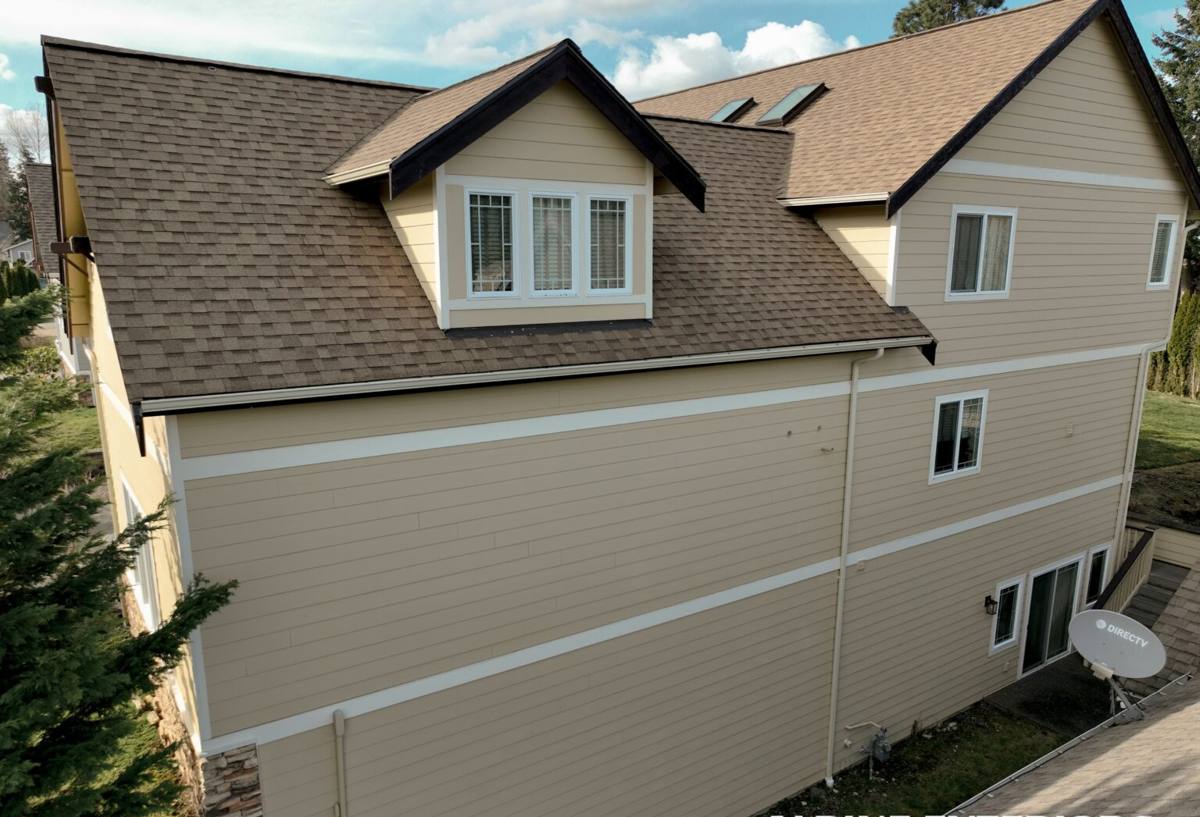
What Whatcom County Weather Does to Vertical Siding
Columbia sits inside the same marine climate band that covers most of Whatcom County — moisture-heavy air moving in off Bellingham Bay and the Salish Sea, frequent driving rain that hits walls at an angle instead of falling straight down, and long stretches of the year where surfaces simply don't dry out between storms. A few specific things happen to siding under those conditions:
- Salt-laden air accelerates corrosion on fasteners, flashing, and any metal trim that isn't rated for coastal exposure.
- Driving rain pushes water sideways into seams, laps, and butt joints that would stay dry in a climate with mostly vertical rainfall.
- Extended moss and algae season means anything that stays damp for days at a time — north-facing walls, shaded battens, areas under overhangs that don't get sun — becomes a growth surface if the material and paint film can't resist it.
- Slow drying cycles mean any water that does get behind the siding has more time to do damage before it evaporates.
Board and batten has more vertical seams per square foot than most siding styles — that's the nature of the pattern, with battens covering the joints between boards. Every one of those seams is a place water can find its way in if the installation isn't handled with this climate in mind.
What a Correct Board & Batten Job Actually Involves
Layout and Spacing
Batten spacing has to account for the width of the panels or boards underneath and for expansion and contraction across seasonal temperature and moisture swings. Spacing that looks fine on a dry-climate installation photo can open gaps or trap water here if it isn't adjusted for local humidity patterns.
Fastening
Every fastener penetration is a potential water entry point. Corrosion-resistant fasteners, correct fastener placement (not too close to panel edges, driven to the right depth — not overdriven), and consistent fastener patterns all matter more in a marine climate where standard fasteners corrode faster.
Water Management Behind the Siding
This is the part homeowners rarely see and contractors sometimes skip. A correct board and batten installation includes a drainage plane — house wrap or building paper installed shingle-style, integrated flashing at every horizontal transition, and often a rain screen gap that lets any moisture that gets behind the siding drain and dry out instead of sitting against the sheathing. In a climate with Whatcom County's rainfall totals, skipping the rain screen is one of the most common corners cut, and one of the most expensive to fix later.
Flashing at Penetrations and Transitions
Windows, doors, hose bibs, light fixtures, roof-to-wall transitions — every one needs flashing detailed to shed water down and out, not just caulked and hoped for. Caulk fails; flashing, done correctly, doesn't depend on a sealant staying flexible for the life of the house.
Why We Install Board & Batten Only in James Hardie Fiber Cement
We install James Hardie exclusively — no vinyl, no engineered wood, no primed cedar or spruce board and batten. That's a deliberate standard, not a default, and it matters more for board and batten than for almost any other siding style because of how many seams and cut edges are exposed to weather.
| Material | How It Handles This Climate |
|---|---|
| Vinyl board and batten | Can warp or distort with temperature swings; seams and battens are often simulated rather than true overlapping boards, and long-term color retention in coastal UV and salt air is limited |
| Engineered wood (LP-type) board and batten | Wood-based core is more sensitive to sustained moisture exposure at cut edges and seams; requires diligent field sealing and ongoing maintenance to keep water out over decades of Whatcom County rain |
| Primed cedar or spruce board and batten | Natural wood movement plus high moisture exposure means more frequent repainting, higher risk of cupping and splitting, and more vulnerability to moss and rot in shaded, damp areas |
| James Hardie fiber cement | Non-combustible, dimensionally stable in wet-dry cycles, factory ColorPlus finish resists fading and doesn't rely on field painting for its primary protection |
Fiber cement doesn't swell, warp, or rot the way wood-based products can, and it doesn't move with temperature the way vinyl does. For a style built entirely around tight vertical seams, that stability is the difference between a wall that stays sealed and one that slowly opens up.
Hardie Products Used for Board & Batten
James Hardie's board and batten profiles are engineered as a panel system rather than individual boards nailed up piece by piece, which gives more consistent, predictable seams than a site-built approach using dimensional lumber battens over plain panels. The HZ5 product line, engineered for wetter, cooler climates like the Pacific Northwest, is the appropriate choice for Whatcom County — it's formulated to resist moisture intrusion and freeze-thaw stress better than Hardie's products built for hot, dry regions. Panels arrive with the ColorPlus factory finish already baked on, which means the color coat isn't something applied on-site and hoping it cures evenly in our weather window.
Our Process for a Columbia Board & Batten Project
- On-site assessment. We look at existing siding condition, sheathing condition where accessible, sun/shade exposure on each elevation, and drainage patterns around the foundation — all of which affect how the new siding needs to be detailed.
- Tear-off and sheathing inspection. Old siding comes off and we check for hidden moisture damage before anything new goes up. This is the point where problems from a prior installation usually show themselves.
- Water-resistive barrier and rain screen. House wrap installed correctly, with a drainage gap where the wall assembly calls for one, before a single piece of siding goes on.
- Flashing integration. Windows, doors, and all penetrations flashed before the siding closes them in.
- Panel and batten installation. Laid out and fastened to spec, with corrosion-resistant fasteners and manufacturer-specified spacing and clearances.
- Final detailing and cleanup. Trim, caulking at the points that call for it, and a walkthrough so you know what was done and why.
Maintenance in a Marine Climate
Board and batten in Hardie fiber cement is low-maintenance, not no-maintenance. A short annual routine keeps it performing the way it's designed to:
- Rinse off accumulated grime, pollen, and the start of any moss or algae growth once or twice a year, especially on shaded or north-facing walls
- Walk the exterior after major windstorms to check for any loose trim, fasteners backing out, or damaged caulk joints
- Keep gutters clear so overflow isn't running down the wall face and concentrating water at specific batten joints
- Trim back landscaping that keeps siding shaded and damp longer than the rest of the house
- Address any caulk failure at flashing points promptly rather than waiting for a full repaint cycle
Cost Factors for a Columbia Project
| Factor | Why It Moves the Price |
|---|---|
| Tear-off scope | Full removal of old siding down to sheathing costs more than installing over a properly inspected existing assembly, but it's often necessary to check for hidden moisture damage |
| Wall complexity | More corners, dormers, and window/door openings mean more flashing detail work and more cut battens |
| Sheathing repair | Rot or moisture damage found during tear-off adds cost but is far cheaper to fix now than to seal over |
| Rain screen inclusion | A true drainage gap adds material and labor but meaningfully extends how the wall performs in sustained wet weather |
| Home size and stories | More square footage and taller walls affect both material quantity and access/scaffolding needs |
We don't quote a job without seeing the house — condition of the existing walls varies enough between properties in Columbia that a number given over the phone isn't a real estimate.
Why a Crew That Already Works Columbia Matters
Board and batten installed to spec on paper can still fail if the crew doesn't understand how this specific climate behaves against a wall. Knowing which elevations in this neighborhood tend to stay shaded and damp longest, how driving rain typically hits a given lot's exposure, and what the moss season actually does to a wall over a full year isn't something you get from a manufacturer's install manual alone — it comes from having installed and then gone back to look at siding in this area across multiple seasons. A crew that only occasionally works Whatcom County is applying general best practices. A crew that works here regularly is applying what actually holds up here.
If you're considering board and batten for a home in Columbia, we're happy to walk the property, talk through what your specific walls need, and give you a straight answer on scope and cost. Reach out for a free, no-pressure estimate using the form below.