 Whatcom County
 Why Blaine Roofs Age Differently
Blaine sits at the northern edge of Whatcom County, right where Semiahmoo Bay and the Strait of Georgia meet a lot of wind and a lot of rain. That combination is harder on a roof than most homeowners realize. Salt-laden air moves inland off the water and slowly corrodes exposed metal — nail heads, flashing, vent stacks, gutter hardware — years before it would fail in a drier, inland climate. Add driving rain that comes in sideways during winter storms, and you get wind-driven moisture testing every seam, lap, and fastener on the roof, not just the open field of shingles.
Then there's moss. Whatcom County's mild, wet winters and shaded, tree-lined lots are close to ideal growing conditions for moss and algae. A roof that isn't detailed correctly for drainage and airflow will grow a moss mat within a few seasons, and that mat holds water against the roofing material year-round. None of this means Blaine homes need exotic roofing — it means the installation details have to be right, and the materials have to be matched to the conditions instead of picked off a generic price sheet.
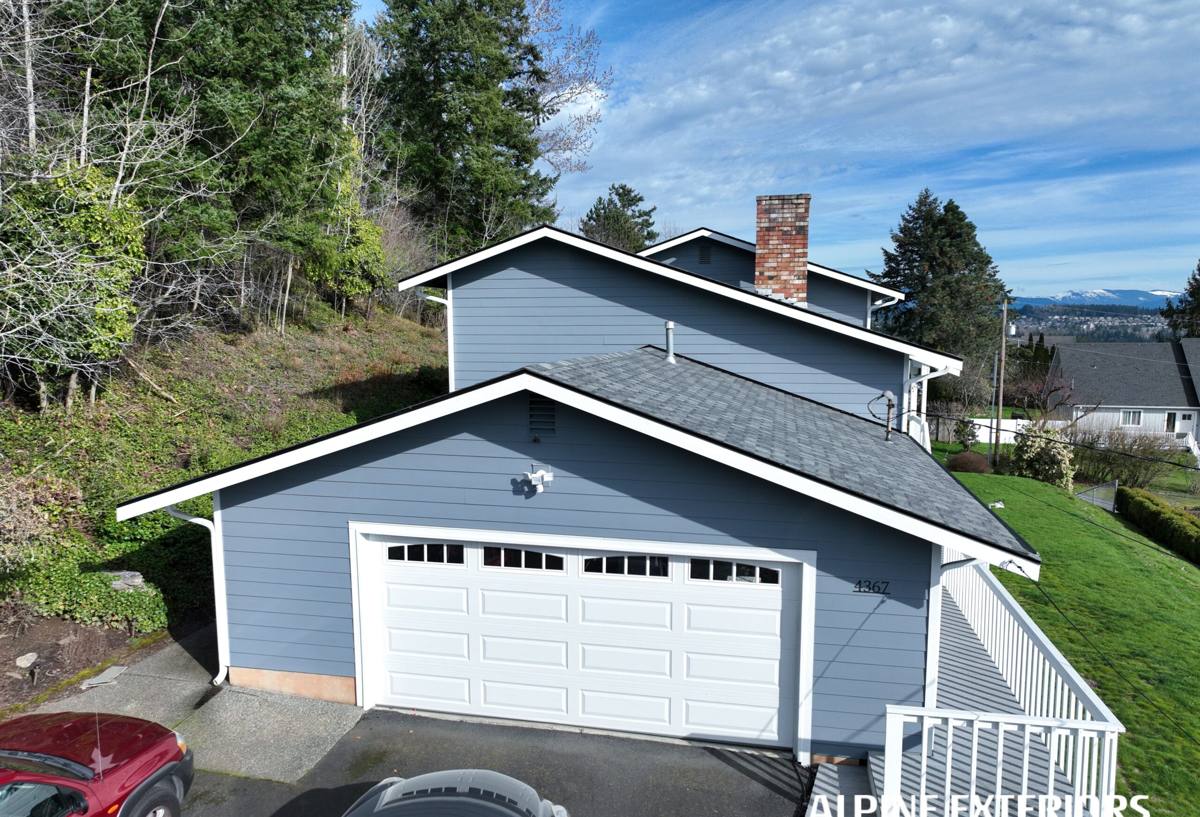
Signs a Blaine Roof Needs Replacement — Not Another Repair
Roof repairs make sense when a problem is isolated: one damaged section, a single flashing failure, storm damage to a limited area. Replacement becomes the honest recommendation when the roof's underlying system — decking, underlayment, and flashing — is failing broadly, even if the shingles still look okay from the ground. In this climate, that broad failure often shows up as:
- Moss or algae mats covering large sections rather than a few scattered patches
- Granule loss heavy enough to see bare asphalt showing through in the gutters or downspouts
- Soft or spongy decking felt underfoot during an inspection, a sign moisture has been getting past the surface for a while
- Rusted or heavily corroded flashing, vent boots, and fasteners, especially on roofs facing the water
- Repeated leaks in different spots after each rain event rather than the same recurring spot
- A roof at or past the manufacturer's expected service life for this climate, which typically runs shorter here than in drier regions
If only one or two of these apply, a repair is usually the right call and we'll say so. Replacement only makes sense when the numbers actually favor it.
What a Correct Roof Replacement Actually Involves
Full Tear-Off, Not a Layover
We remove the existing roofing down to the deck rather than installing over old material. Layering a new roof over an old one traps moisture that's already gotten into the system, and in a climate with this much annual rainfall, that trapped moisture becomes a rot problem within a few years. Tear-off also lets us actually see the deck, which matters more here than in drier parts of the state.
Deck Inspection and Repair
Once the old roofing is off, we check the sheathing for soft spots, delamination, and rot — common wherever a roof has been holding moss or has had a slow leak. Any compromised decking gets replaced before anything new goes down. Skipping this step is the single most common shortcut that leads to a roof failing early, and it's invisible once the new roofing is on.
Underlayment Built for Wind-Driven Rain
Standard felt underlayment is a minimum, not a standard, for a coastal-exposed roof. We use synthetic or self-adhered underlayment at eaves, valleys, and other vulnerable areas so that if wind ever drives water past the surface layer, it doesn't reach the deck.
Flashing and Fasteners That Can Handle Salt Air
Every penetration — chimneys, vents, skylights, sidewalls — gets new flashing, not reused flashing tucked under new shingles. Given the salt exposure in Blaine, we favor corrosion-resistant metals and fasteners over the cheaper standard-grade hardware that's fine for inland installs but corrodes visibly within a few years this close to the water.
Ventilation That Actually Balances
Intake at the eaves and exhaust at the ridge need to be sized to work together. Correct ventilation keeps the underside of the deck dry, reduces the moisture that feeds moss and algae growth, and helps the shingles reach their expected lifespan instead of failing early from trapped heat and humidity.
Choosing a Roofing Material for This Climate
There isn't one "best" roofing material for Blaine — there's a best material for a given roof, budget, and exposure. Here's how the common options actually perform in salt air, driving rain, and moss conditions:
| Material | Moisture & Moss Behavior | Salt Air Considerations | Typical Lifespan Here |
|---|---|---|---|
| Architectural asphalt shingle | Good drainage when installed with proper slope detailing; benefits from algae-resistant granules | Fasteners and flashing matter more than the shingle itself | 20-25 years with correct ventilation |
| Standing seam metal | Sheds moisture and moss well due to smooth, steep surface | Requires marine-grade or coated fasteners and panels near the water; standard-grade metal corrodes faster here | 40-50 years with correct hardware |
| Composite/synthetic shingle | Resists moisture absorption better than wood; low moss retention | Generally stable in salt air; check manufacturer warranty terms for coastal exclusions | 30-40 years |
| Cedar shake | High moss and moisture retention without diligent maintenance; requires regular cleaning | Natural material weathers quickly in salt-laden, damp air without upkeep | Highly maintenance-dependent |
We're upfront that cedar shake, while attractive, carries the highest ongoing maintenance burden in this specific climate — not because it's a poor product, but because the moisture and moss conditions here demand more attention than most homeowners want to give a roof. For most Blaine homes, a quality architectural shingle with algae-resistant granules or a properly detailed metal roof gives the best balance of appearance, cost, and low-maintenance performance.
Our Process, Start to Finish
- On-site inspection: We walk the roof (not just look from the ground), check the attic or crawlspace for existing moisture or ventilation issues, and photograph problem areas.
- Written estimate: A clear scope of work and material options, with pricing broken out so you can see what you're paying for.
- Scheduling around weather: Given how much rain this area gets, we plan tear-off and dry-in around forecast windows to minimize the time your deck is exposed.
- Tear-off and deck repair: Full removal, deck inspection, and any necessary sheathing replacement, documented before we cover it up.
- Installation: Underlayment, flashing, ventilation components, and the roofing material itself, installed to manufacturer specification, not just "close enough."
- Cleanup and final walkthrough: Magnetic sweep for nails, debris removal, and a walkthrough so you can see the finished work and ask questions before we consider the job done.
Cost Factors for a Blaine Roof Replacement
We don't publish flat prices because roof cost depends on real variables specific to your house — but these are the factors that actually move the number:
| Factor | Why It Matters |
|---|---|
| Roof size and complexity (valleys, dormers, pitch) | More cuts, flashing, and labor time |
| Deck condition found after tear-off | Rot or soft sheathing adds material and labor not visible in the initial estimate |
| Material choice | Asphalt, metal, and composite carry different material and installation costs |
| Ventilation upgrades needed | Adding or correcting intake/exhaust venting is easier to price during a full tear-off |
| Access and site conditions | Steep pitch, limited driveway access, or tall trees affect equipment and labor time |
| Corrosion-resistant hardware upgrade | Worth the modest added cost this close to the water; pays off in fastener and flashing life |
Most full roof replacements in this region run into the five figures depending on size and material, but the only accurate number comes from seeing your actual roof.
Why a Crew That Already Works in Blaine Makes a Difference
Roofing crews that work across a wide, drier region and occasionally take a Blaine job don't always account for how differently this specific stretch of coastline behaves. A crew that regularly works Whatcom County's coastal edge already knows to spec corrosion-resistant fasteners as a default near the water, to plan tear-off timing around the area's rain patterns rather than a generic forecast, and to recognize moss and moisture damage patterns specific to shaded, tree-covered lots common around here. That local pattern recognition shows up in fewer callbacks and a roof that's actually built for the conditions it has to survive, not just the conditions on a spec sheet.
We also understand the practical side of working in a border town — permitting timelines, typical lot layouts, and the mix of older homes and newer construction found throughout Blaine and the surrounding unincorporated county.
After the Install: Keeping a New Roof Performing
A correctly installed roof still benefits from basic upkeep in this climate. A short annual routine goes a long way:
- Clean gutters and downspouts at least twice a year so water isn't backing up under the roof edge
- Remove overhanging branches that keep sections of the roof shaded and damp longer than the rest
- Have moss treated or removed at the first sign of growth rather than waiting for a visible mat
- Check attic ventilation isn't blocked by insulation or debris
- Schedule a quick visual inspection after any severe wind event
None of this requires a contractor visit every time — it's mostly homeowner-level maintenance that protects the investment you just made.
Get a Straight Answer About Your Roof
If you're not sure whether your roof needs repair or full replacement, the honest first step is having someone actually get on it and look — not guess from a photo or a drive-by. We offer free, no-pressure estimates for Blaine homeowners, and we'll tell you plainly if a repair is still the right call. Use the form below to schedule a time that works for you.